

Retro Razor Ads and the Making of Modern Masculinity
Retro razor ads did more than move blades and lather. They framed shaving as a daily performance of precision, confidence, and self-command. In the world of retro razor ads, a close shave was never just about removing stubble. It was about looking efficient, looking desirable, and looking like a man who had his morning under control.
That promise runs through decades of shaving cream, razor, and aftershave advertising. The product changed, the packaging changed, and the models changed, but the message stayed remarkably consistent: if you shave correctly, the rest of your life looks sharper too.
Retro razor ads and the promise of control
The most durable selling point in shaving advertising was not comfort, though comfort mattered. It was control. A razor ad could show a clean jawline, a steady hand, and a man who seemed to have mastered a small but revealing daily task. That mattered because shaving happened in a private space, but the results were public.
The ads treated grooming as a kind of efficiency ritual. A good shave was quick, clean, and repeatable. No mess, no fuss, no wasted motion. That message fit neatly into midcentury ideas of productivity, when even personal habits were expected to feel modern and streamlined.
Shaving products were sold as tools for the man who respected his schedule. The ideal user was not vain. He was disciplined. He was not indulging himself. He was preparing himself.
Precision as a masculine virtue
Precision was one of the great emotional currencies of retro razor ads. The ads often presented blades as engineered answers to a grooming problem. The clean line of the jaw, the close trim at the neck, and the even sweep of lather all implied technical mastery.
This is where the ads became especially clever. They borrowed the language of industry and applied it to the bathroom mirror. A razor was not merely a personal-care item. It was a precision instrument. The implication was clear: a man who used a well-made razor was participating in modern progress.
That engineering aesthetic did a lot of work:
- It made shaving feel scientific instead of cosmetic.
- It made product choice feel rational and intelligent.
- It turned a daily habit into a sign of competence.
- It suggested that the right razor reduced friction in both skin and life.
Even the visual style often reinforced the point. Clean diagonals, polished chrome, strong contrast, and tightly framed close-ups all echoed exactness. The compositions rarely wandered. They aimed. Like the products, they were built to get the point across fast.
Confidence was the real aftershave
If precision was the mechanical promise, confidence was the emotional payoff. A smooth face was rarely sold as an end in itself. It was a gateway to better first impressions, better dates, better interviews, better meetings, and better standing in general.
Retro shaving ads understood something basic about social anxiety: people want reassurance that they are presenting themselves well. So the ads made grooming feel like a pre-social ritual. Before the office. Before the dinner. Before the weekend outing. Before stepping into the world, finish the shave.
This is why so many ads leaned on before-and-after logic. The before image often carried shadow, stubble, fatigue, or a vague sense of disarray. The after image was brighter, straighter, and more composed. The transformation did not need to be dramatic. It only needed to be legible.
The narrative was simple:
- Start with roughness or morning neglect.
- Apply the right shaving cream or razor.
- End with smoothness, polish, and social readiness.
That structure made confidence look procedural. It suggested that self-assurance could be manufactured in the bathroom and worn in public.
How shaving ads sold social success
One of the most revealing features of retro razor ads is how often they link grooming to social approval. The clean shave was rarely framed as private satisfaction alone. It was a signal visible to others.
That meant the ads were selling more than a product. They were selling social clearance. A man with a polished face seemed more employable, more dateable, more respectable, and more in step with the moment. The ads often implied that messy grooming could be read as carelessness, while a neat shave marked maturity.
This social pitch was powerful because it was soft. The ads did not usually threaten failure outright. Instead, they offered the quiet possibility of advantage. Be the man who looks prepared. Be the man who does not make people wait, squint, or second-guess.
In the postwar context, that mattered even more. The period favored polish, order, and visible competence. A smooth face became part of the larger visual code of responsibility.
The bathroom as a modern stage
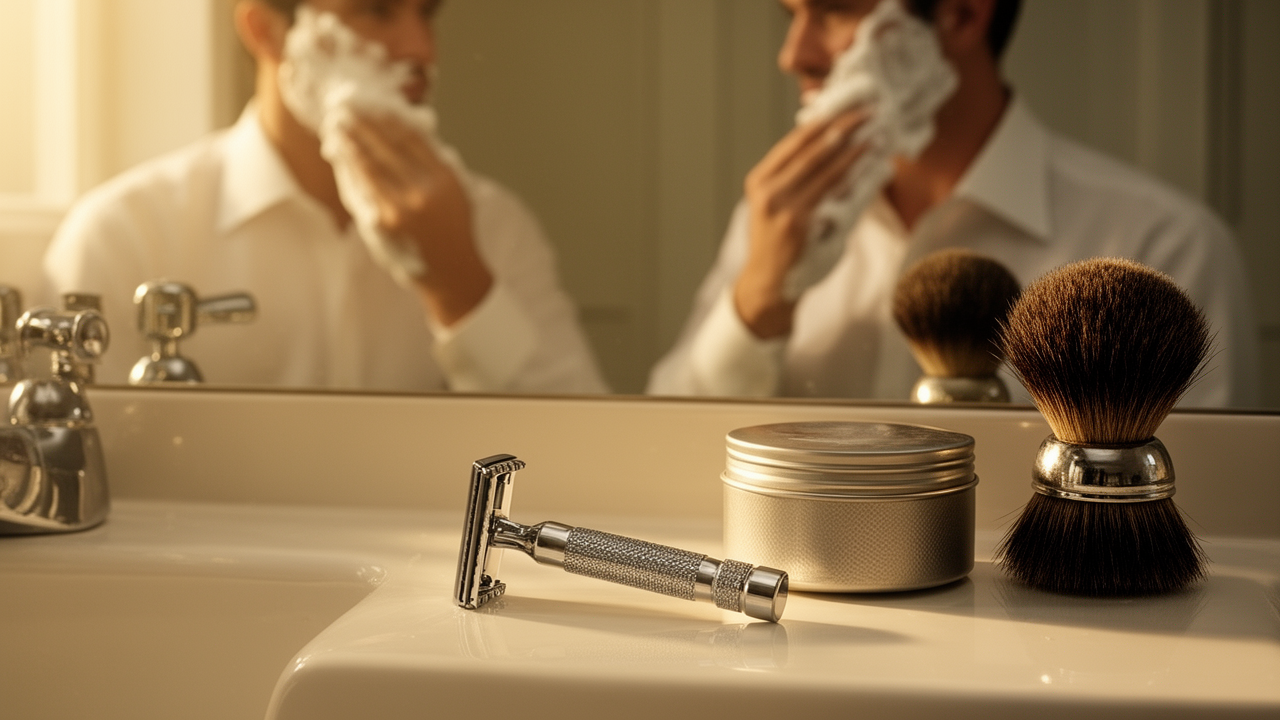
Shaving ads loved bathrooms because the bathroom could be turned into a stage for modernity. Mirror, tile, faucet, razor, foam: the setup was compact, controlled, and perfect for advertising composition.
The best layouts made the act of shaving look calm and deliberate. A man might be shown looking into a mirror with a focused expression, or paused mid-shave in a way that suggested mastery rather than struggle. The framing usually avoided chaos. Water splashes were minimized. Clutter was rare. The whole point was to make the routine look easy.
Typography helped carry that feeling. Headlines tended to be bold and confident, often arranged in clean blocks or angled for emphasis. The copy was usually short on poetry and long on authority. It wanted to sound like a useful instruction and a guarantee.
The visual grammar was consistent:
- Close framing kept attention on the face, blade, and lather.
- Strong contrast made smooth skin stand out against shadow.
- Diagonal placement suggested motion without disorder.
- Clean typography echoed the promise of a clean result.
Even when the ads were stylish, they were rarely abstract. They were concrete about the body and the ritual. That concreteness made the promise believable.
Before-and-after cues did the heavy lifting
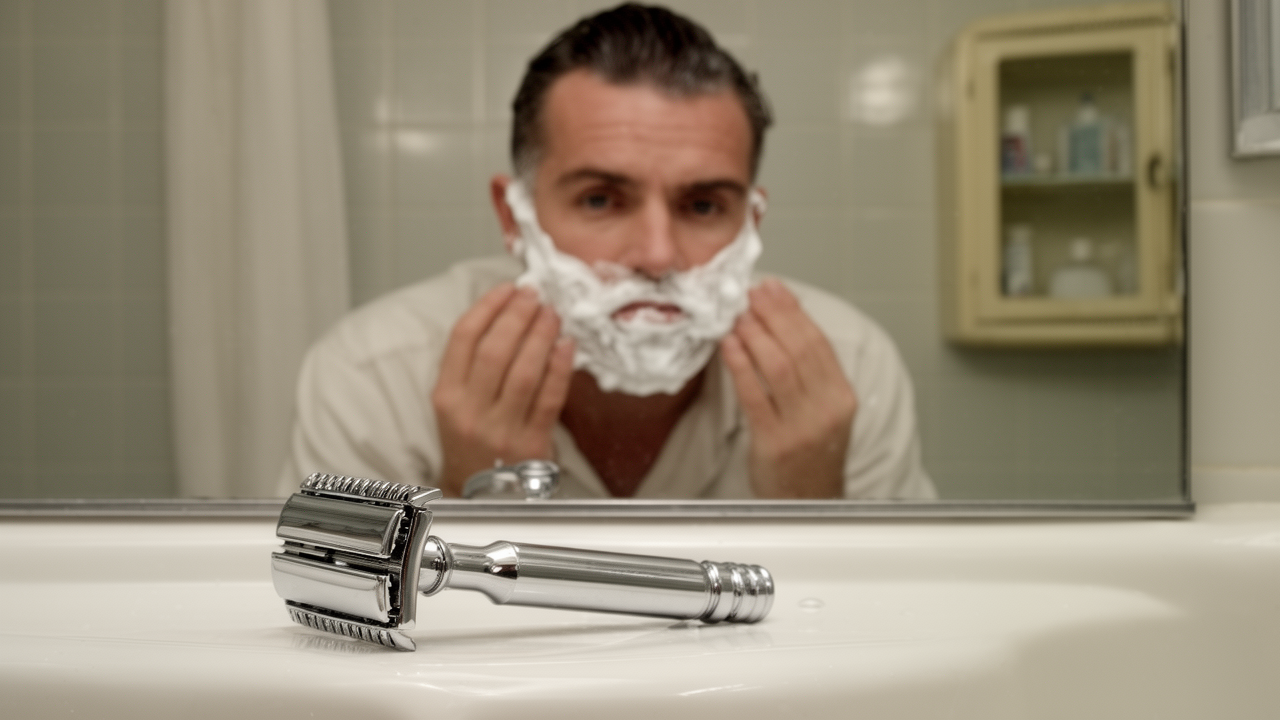
Few advertising devices work as efficiently as a before-and-after comparison, and shaving ads used it with discipline. The “before” was not always ugly. More often it was merely unprepared. Stubble. Dullness. Unevenness. A face that had not yet been brought into alignment with the day.
The “after” scene carried the stronger emotional weight. A smoother face was a face that had achieved order. It could be framed in profile, in a mirror, or in a social setting where the groomed man appeared more poised than he had before.
The transformation did not need to be exaggerated because the viewer already understood the stakes. In a culture that prized neatness, a clean shave read as a small but meaningful upgrade. The ads sold the idea that improvement could be instant, visible, and repeatable.
That was the genius of the format. It made a minor bodily change feel like proof of broader personal discipline.
Shaving cream ads and the ritual of ease
Razor ads often worked in tandem with shaving cream ads, and the cream side of the category added another layer to the message. If the razor delivered precision, the cream delivered comfort and ease. Together they formed a complete routine.
Shaving cream ads often emphasized lather, softness, and glide. The message was not only that the shave would be closer. It was that the process would feel smoother, safer, and more civilized. This helped transform shaving from a chore into a moment of controlled self-care.
That shift mattered. A routine becomes aspirational when it is depicted as polished and efficient rather than merely necessary. The ads turned the bathroom into a site of small luxury, where even an ordinary morning could be improved through the correct product choice.
Why the masculine ideal in these ads still feels recognizable
What makes retro razor ads so readable today is that they crystallized a durable masculine script. The script says a man should be neat, capable, composed, and socially ready. He should not seem fussy, but he should seem deliberate. He should not linger, but he should be polished.
That tension is the heart of the category. The ads wanted grooming to feel practical, but not plain. They wanted men to care about appearance without appearing shallow. They wanted the bathroom ritual to look like evidence of character rather than vanity.
That’s why these ads still resonate. They understood that style messaging lands best when it feels like a function. Precision becomes confidence. Confidence becomes social ease. Social ease becomes masculine success.
What retro razor ads reveal about advertising itself
Shaving campaigns also show how retro advertising turns ordinary behavior into identity work. The product is small, but the story is large. A razor is just a razor until the ad gives it symbolic weight.
In these campaigns, the symbolism was unusually efficient:
- Cleanliness stood in for discipline.
- Smoothness stood in for readiness.
- Speed stood in for modern life.
- Care stood in for self-respect.
- A polished face stood in for public competence.
That is a very modern kind of persuasion. It does not sell the object in isolation. It sells the version of the self that the object supposedly helps produce.
The lasting visual language of grooming ads
The typography, composition, and before-after cues in shaving advertising were not decorative extras. They were the mechanism of persuasion. The ads needed viewers to feel the difference between a rough morning and a controlled one, between ordinary grooming and a sharpened identity.
That is why the category remained so visually disciplined. It had to make control visible. It had to make confidence look like a result. And it had to make the daily shave feel like a small ceremony of modern masculinity.
Seen that way, retro razor advertising is not just about grooming history. It is about how consumer culture taught men to read self-respect in the mirror.
If you’ve got a favorite shaving ad, brand, or visual gimmick from the era, share it in the comments—I’d love to hear which examples stuck with you.