

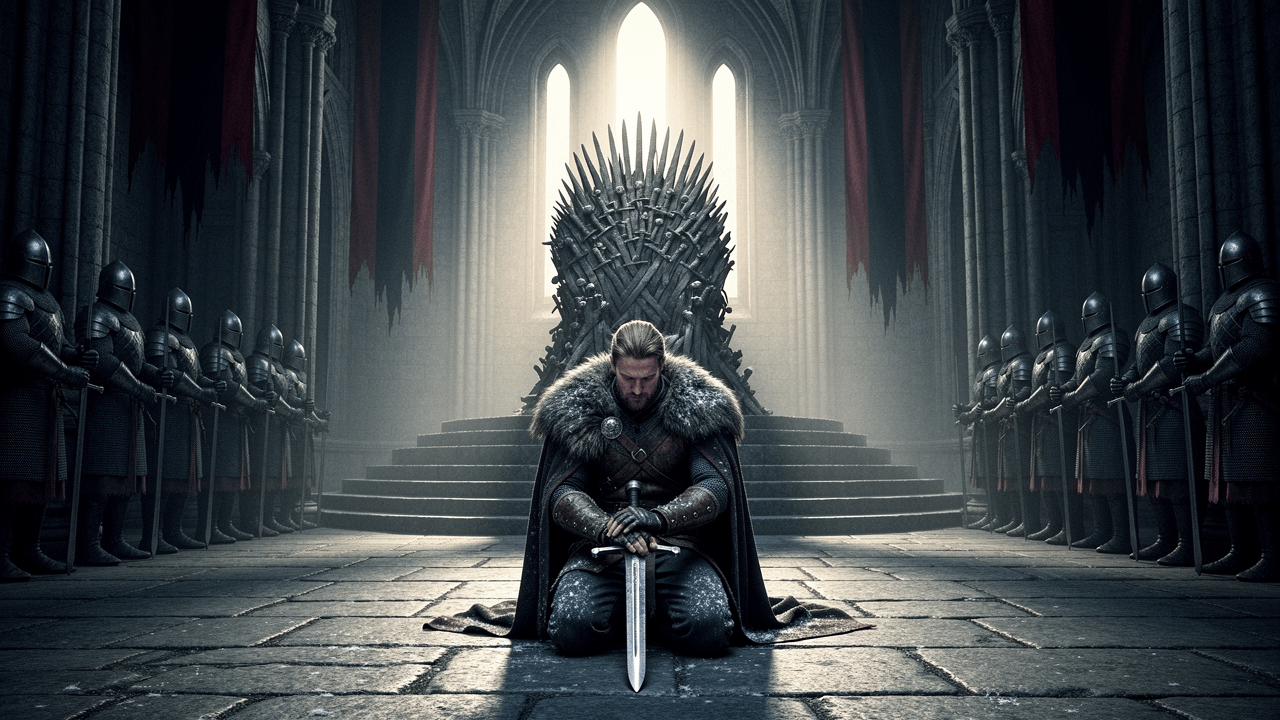
The Knife Edge of Loyalty: Game of Thrones S1E9 “Baelor” Episode Guide
The Game of Thrones S1E9 “Baelor” episode guide has one job above all else: explain how an episode built around judgment, mercy, and political theater turns into the series’ first true catastrophe. “Baelor” is the hour where every alliance hardens, every private compromise gets exposed, and one final act in King’s Landing changes the entire shape of the story.
This is not just a recap of a famous ending. It is the episode where the season’s moral language breaks apart. Honor does not save anyone. Power does not need to be clean. And once the capital decides what justice looks like, the rest of the realm has to live with it.
What happens in “Baelor”
The episode splits its attention between two fronts: the political endgame in King’s Landing and the widening war elsewhere in Westeros.
In the capital, Ned Stark reaches the point of no return. He has already admitted to treason in order to protect his daughters, but the terms of his confession are meaningless the moment the ruling clique decides it can benefit from spectacle. The scene is not a negotiation so much as a trap with formal language around it.
At the same time, the Northern war effort continues to gather force. Robb Stark is consolidating power, his bannermen are beginning to treat him like a king in all but name, and the battlefield story is moving toward larger consequences than any one court could control. The episode quietly underlines that the war is no longer about one family’s grievance. It is becoming a restructuring of the realm.
Meanwhile, Daenerys Targaryen’s story continues to move toward transformation rather than reaction. Her path in this episode is less about immediate plot mechanics than about the growing sense that she is becoming something that Westeros has not accounted for yet. Her line is still distant from the capital, but the series is making the distance feel temporary.
The capital’s logic: how power overrides justice
The most important thing to understand about this episode is that the court in King’s Landing does not operate by a shared standard of law. It operates by leverage.
Ned’s downfall is not caused by weakness alone. It is caused by the fact that once he refuses to play the game fully, others can force the result they want. By the time he is standing before the crowd, the outcome has stopped depending on his actual confession. The machinery of rule has already decided that public obedience matters more than private truth.
That is why the execution lands so hard. It is not just a death scene. It is the moment the show proves that nobility, reputation, and good faith are not protective shields in this world. In the Seven Kingdoms, a man can be right and still lose completely.
Key character moves and what they mean
Ned Stark chooses his daughters over his life
Ned’s final choices are the emotional center of the episode. He has spent the season trying to preserve a code of conduct in a system that rewards calculation, and in the end he gives up that code just enough to keep Sansa and Arya alive.
That choice matters because it reveals the core of his character: he is not simply stubborn. He is willing to sacrifice his own standing if he believes it will spare his children. The tragedy is that the capital turns that mercy into a weapon.
Cersei and Joffrey turn spectacle into policy
The ruling power in the capital uses Ned’s public humiliation as a lesson. The point is not only to eliminate a rival; it is to demonstrate who has the authority to redefine the rules mid-game.
Joffrey’s behavior in this episode is especially important because it clarifies that he is not just impulsive. He is cruel in a way that seeks attention and control at once. His decisions are meant to dominate the room, then dominate the memory of the room.
Sansa learns what court life really costs
Sansa’s arc in “Baelor” is one of the most painful in the first season. She has been trained to believe in courtesy, inheritance, and noble procedure, but this episode strips all of that away. Her pleas do not alter the outcome, and the scene teaches her, brutally, that beauty and rank offer no guarantee of safety.
This is a major turning point for her character. From here on, survival becomes something she must learn rather than assume.
Arya is pushed into action
Arya’s role in the episode is quieter in dialogue but louder in consequence. She is still too young to fully understand the scale of what is happening, but the shock of the capital’s betrayal sets her on a new trajectory. For readers tracking the series as a compendium, this is one of the episode’s most important long-range moves: Arya’s identity is becoming inseparable from flight, grit, and refusal.
Robb’s war begins to look like a kingdom
The Northern campaign continues to gain legitimacy in practical terms. Men follow Robb because he looks and acts like a ruler, not just a rebellious son. That distinction becomes crucial later. The episode makes clear that the war is no longer only about avenging Ned. It is becoming an alternative political order.
The ending of “Baelor” and why it hits so hard
The final sequence is one of the most famous in the series because it refuses the audience the release it expects.
Everything around Ned’s execution is staged to suggest a possible reprieve. The crowd is gathered. The terms have shifted. The mood has the shape of mercy. Then the truth arrives all at once: public order in King’s Landing does not mean fairness, and the people holding power are willing to burn the meaning of honor if it keeps control intact.
What makes the ending devastating is that it is not random. It is the product of every compromise and every misread assumption leading up to it. Ned believed truth had enough force to matter. In this city, it doesn’t.
For the audience, the scene also redefines the series. Game of Thrones is no longer a story where the honorable lead can simply outlast the schemers. From this point forward, every character, and every viewer, has to treat power as something far less stable and far more dangerous.
Lore implications: what “Baelor” adds to the world
This episode deepens the setting in a few subtle but essential ways:
- Rule in Westeros is performative. The public square matters because legitimacy has to be seen.
- Noble law is fragile. The great houses may speak in the language of honor, but enforcement depends on whoever holds the blade.
- The Iron Throne is not a neutral institution. It is a seat that magnifies the worst instincts of the people fighting to sit on it.
- Family is political currency. Ned’s daughters, Robb’s claim, and the capital’s hostage logic all show how bloodline shapes every move.
The title itself also matters. Baelor the Blessed is associated in the series’ history with piety and the Faith, which makes the episode’s name feel bitterly ironic. The world is full of noble-sounding ideals, but the story keeps showing what happens when those ideals meet naked ambition.
Standout scenes that define the episode
Ned’s confession
This scene works because it is emotionally complicated. Ned is not confessing out of cowardice. He is trying to save his children. The show keeps that distinction alive, which is why the sequence hurts rather than simply shocking.
The crowd’s anticipation
The public atmosphere in King’s Landing matters more than it first appears. The city is not merely watching an execution. It is watching the state decide what the truth will cost.
The final betrayal
The closing move is the episode’s thesis in action. Merciful-seeming language, political theater, and sudden violence all collapse into the same instant. That is the moment the series becomes something larger and colder.
Why “Baelor” matters to the larger series
If you are building a full compendium, this is one of the indispensable episodes to understand.
“Baelor” matters because it changes the series in four lasting ways:
- It removes the story’s original moral center. Ned’s death tells viewers that no character is safe just because the narrative has invested in them.
- It accelerates the war. His execution turns a simmering conflict into an all-consuming political disaster.
- It transforms the Stark children’s paths. Sansa, Arya, and Robb all move into new versions of themselves after this hour.
- It clarifies the show’s rules. Sincerity is not protection. Memory is unstable. Power belongs to whoever can enforce the version of events they want.
That is why the episode remains one of the most important chapters in the entire series. It does not just deliver a shocking moment. It resets the emotional contract between the show and its audience.
What new viewers should remember next
If you are watching the series for the first time, keep these takeaways in mind as you move forward:
- Ned’s death is the point where the story’s stakes become irreversible.
- The Stark family is fractured, not finished.
- King’s Landing is now openly a place where cruelty can be rewarded.
- Robb’s war is no longer just personal revenge; it is becoming a claim to rule.
- Daenerys’s path is diverging into something larger than the political fights in Westeros.
In other words, “Baelor” is not the end of a season thread. It is the start of a new series-wide reality.
The bottom line
As a Game of Thrones S1E9 “Baelor” episode guide, this episode deserves its reputation because it is ruthlessly efficient storytelling. It tightens the political noose, empties out the illusion that justice governs the realm, and turns one man’s failed honor into the engine of the whole series.
It is grim, decisive, and unforgettable for a reason: after “Baelor,” no one in Westeros can pretend the game has rules that will save them.
If you have a favorite scene, reaction, or read on the episode’s ending, drop it in the comments and let’s talk about it.