

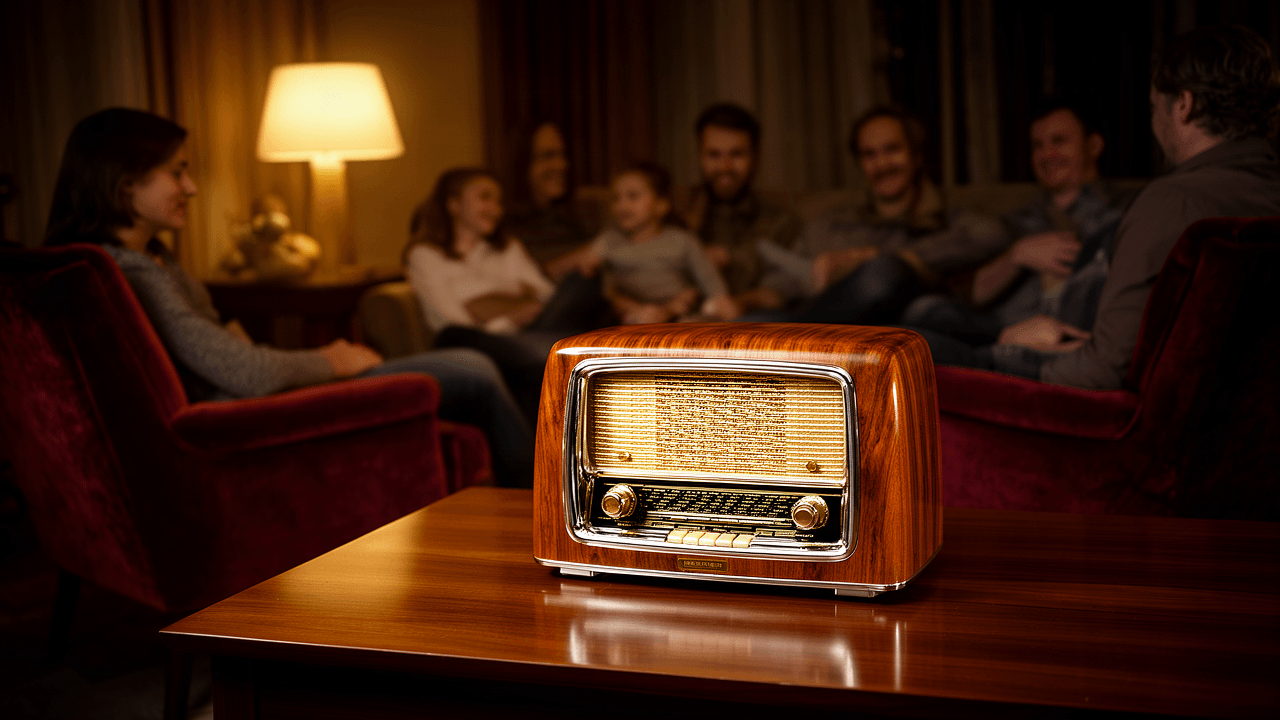
When the Living Room Became a Broadcast Stage: Retro Radio Ads and Status at Home
Before the television flattened the room into a flickering screen, the radio sat in the middle of domestic life like a small piece of modern furniture with a big social job. Retro radio ads understood that the set was never just a machine for sound. It was a decorative object, a signal of taste, and an invitation to gather.
Advertisers sold radios as if they were buying passage into a better version of home life. A good set brought news, music, comedy, sports, and the feeling of being up to date. But it also brought something less obvious and more persuasive: prestige. The radio promised that your living room could look modern, feel cultured, and become the place where the family naturally assembled.
Why retro radio ads treated the set like furniture
A radio in the early and middle decades of the 20th century often occupied a prominent piece of real estate: the mantel, the side table, the cabinet nook, or a dedicated stand in the living room. That placement mattered. Once a machine is visible, it stops being merely functional. It becomes part of the room’s identity.
Retro radio ads leaned hard into that idea. They did not show the set as a lonely utility box tucked away in a corner. They presented it as an object with style, finish, and presence. The casing might be gleaming wood, polished lacquer, or a sleek rounded form that looked designed to belong beside the sofa rather than in a workshop.
That visual treatment did two things at once:
- It made the radio feel like furniture, not clutter.
- It reassured buyers that modern technology could be elegant, not intrusive.
The pitch was subtle but powerful: if you bought this radio, you were not just keeping up with the times. You were improving the room itself.
The radio as a social centerpiece
If the set looked like furniture, it also behaved like a host.
Families gathered around radios for news bulletins, evening dramas, comedy hours, orchestras, and big events. In ads, that shared attention mattered as much as the programming. The radio was not sold as a solitary gadget for private listening. It was sold as the thing that organized the room.
That social function gave advertisers a rich emotional lane. They could show:
- parents listening after dinner,
- children leaning in for a story,
- couples dressed for an evening at home,
- neighbors dropping by for a special broadcast.
The message was plain: a radio made home life fuller because it created a reason to be together. In a period when modern living was often framed as efficient and streamlined, the radio offered a warm counterpoint. It made the house feel active without feeling chaotic.
That is one reason retro radio ads worked so well. They sold community in miniature.
Selling modern life, one broadcast at a time
The deepest trick in these ads was that they didn’t merely sell entertainment. They sold participation.
Owning a radio meant you were in step with the world. You could hear breaking news as it happened, follow popular music while it was current, and keep up with national conversation. The set turned the home into a live connection point rather than an isolated bubble.
That mattered because radio listening carried a kind of social authority. Being informed was fashionable. Being able to talk about the latest program or headline made the household feel engaged, not behind.
So the ads often implied a broader cultural promise:
- You are not missing out.
- You are connected.
- Your home is tuned to the present.
The radio became a domestic badge of modernity. It stood for speed, access, and cultural relevance, all while sitting quietly in the corner of the room.
The prestige of owning a stylish set
Status was everywhere in radio marketing, even when it was never named directly.
A more ornate cabinet suggested refinement. A streamlined design suggested taste. A compact set suggested efficiency and modern urban living. The exact styling changed, but the underlying argument stayed consistent: the right radio said something about you.
This was especially effective because the object was visible to guests. Unlike many household purchases, a radio lived on display. It could be admired, discussed, and positioned as evidence of good judgment. That made it unusually well suited to aspirational advertising.
The ads understood a basic truth about home goods: people do not only buy function. They buy the social meaning wrapped around function. A radio was a machine, yes, but it was also proof that the household kept pace with taste and technology.
What the ads emphasized beyond sound
The most interesting retro radio ads rarely focused only on audio quality, though that certainly mattered. They wrapped technical claims inside a story about lifestyle.
A typical pitch might stress:
- rich tone and clear reception,
- a handsome cabinet finish,
- reliable performance,
- easy operation,
- a place of honor in the home.
That blend is revealing. Sound alone could have been marketed as a technical feature. Instead, advertisers made the radio part of an atmosphere. Clear reception was important because it supported family listening. A handsome cabinet mattered because the set was meant to be seen. Reliability mattered because the radio was expected to anchor routines night after night.
In other words, the ads framed engineering as domestic dignity.
How radio ads changed the meaning of the living room
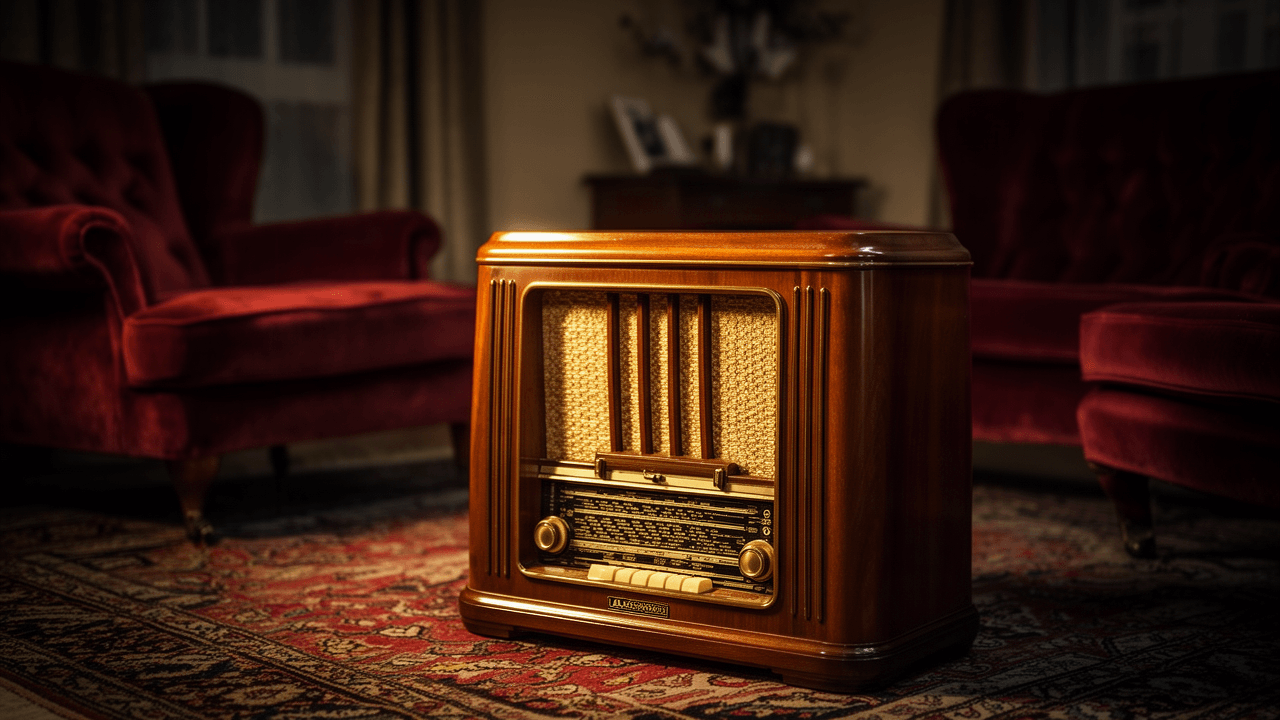
The living room was not just a room with chairs. In radio-era advertising, it became a stage for modern family life.
The radio gave the room a schedule. News at one hour, music at another, a favorite serial after supper. That structure turned the home into a place where cultural life arrived on demand. You did not need to go out to experience the latest news or enjoy performance. The broadcast came to you.
This changed the symbolic power of the room itself. A stylish radio sitting in the living room suggested that the household was not passive or provincial. It was engaged in the larger world while remaining comfortably at home.
That tension is the real heart of the category. Retro radio ads sold a paradox:
- domesticity without isolation,
- comfort without boredom,
- tradition without stagnation,
- modernity without leaving the house.
The family scene as an advertising shorthand
One reason these ads remain visually memorable is that they rely on a very efficient scene. A radio, a room, and a small group of listeners can tell an entire story in a glance.
That scene communicates several ideas at once:
- The radio is important enough to center the room.
- The household values shared experiences.
- The product has emotional as well as practical benefits.
- The buyer is making a tasteful, modern choice.
This is not accidental composition. It is persuasive design. The family gathered around the set becomes evidence that the product improves relationships, not just routines.
The imagery also makes the radio feel trustworthy. A home with people in it suggests order, warmth, and stability. That emotional frame helps transform a consumer product into a household institution.
Why the radio’s image was so durable
The radio’s advertising image lasted because it sat at the intersection of several desires at once.
People wanted entertainment. They wanted news. They wanted elegance. They wanted a home that looked up to date. They wanted the security of family routine and the excitement of the outside world. The radio could speak to all of those wants without ever looking conflicted.
That is why the best campaigns did not over-explain the technology. They showed the radio in a room that looked already improved by its presence. The product was the proof.
Even now, the design logic feels familiar. We still buy objects that promise to organize our lives, elevate our spaces, and make us feel connected. The old radio ad formula is simply more charming in its original form because the object was so visibly central to home life.
What modern marketers can still learn from radio advertising
There is a reason designers and brand teams still study these campaigns. They are a lesson in how to turn a practical item into a social one.
The strongest takeaways are simple:
- Show the object in context, not isolation.
- Link utility to identity.
- Make the home scene do emotional work.
- Sell participation in a wider culture, not just ownership.
That approach is why retro radio ads continue to feel vivid. They knew that the most persuasive household product is often the one that seems to improve both the room and the life happening inside it.
The radio as a quiet status symbol
What makes these ads especially interesting today is their restraint. The radio was not marketed with the loud self-consciousness of some later luxury goods. Instead, it signaled status through placement, finish, and social function.
A good set implied that the family cared about taste. A prominent set implied that the household had made room for culture. A stylish set implied that modernity had arrived gracefully rather than aggressively.
That quiet confidence is part of the appeal. The radio did not need to shout to be noticed. Its presence alone told you the home belonged to the current moment.
And that, more than anything, is what retro radio ads were really selling: the feeling that a household could be fashionable, informed, and socially alive all at once.
If you have a favorite old radio ad or a memorable example of the radio-as-furniture look, share it in the comments. I’d love to hear what stood out to you.