
Image credit: Draft web reference from themoviedb.org
Game of Thrones S5E1 “The Wars to Come” episode guide
The Game of Thrones S5E1 “The Wars to Come” episode guide starts where the series has a habit of being most ruthless: right after a major power shift, when everyone thinks they understand the board and the board moves anyway. Season 5 opens by checking in on the survivors, the stragglers, and the people who believe they are finally close to winning. The result is a premiere that feels less like a reset and more like the first crack in a new world order.
This episode matters because it does three jobs at once. It reconnects the major factions after the chaos of Season 4, plants fresh political conflicts in King’s Landing and beyond, and quietly introduces the logic of the season ahead: old assumptions are dead, and every surviving player has to decide what kind of war they are willing to fight.
What happens in the premiere
Cersei starts losing control
In King’s Landing, Cersei Lannister is no longer operating from a position of confidence. The death of Tywin has removed the family’s most formidable political mind, and the king’s court now feels more unstable than ever. Cersei tries to project authority, but the episode keeps showing the gap between her ambitions and her actual leverage.
One of the clearest signals is her uneasy conversation with the High Sparrow, a religious reformer who arrives looking harmless and ends up sounding like a threat to the entire nobility. He is not just a pious figure; he represents a populist force that can be weaponized against the powerful. Cersei thinks she can manage him. The episode makes it plain that she is underestimating him.
At the same time, the royal family’s internal weaknesses are exposed through Loras, Margaery, and the broader Tyrell-Lannister arrangement. The marriage alliance still exists on paper, but the trust behind it is fading fast. The court is full of smiles, yet almost everyone in the room is calculating the next move.
Arya reaches the House of Black and White
Across the Narrow Sea, Arya Stark arrives in Braavos and finds the city’s weirdness immediately. She is no longer just a fugitive with a name on a list; she is a young woman standing at the threshold of a new identity.
The House of Black and White is one of the episode’s most important lore locations. It is quiet, severe, and unsettling, which fits the Faceless Men perfectly. Arya’s arrival here is not a simple training montage setup. It is a statement that her story has entered a new phase, one built around discipline, secrecy, and the possibility of becoming someone else entirely.
Stannis makes his pitch
At the Wall, Stannis Baratheon still believes he is the rightful king, but the episode makes clear that legitimacy is no longer enough. He needs support, and he needs it badly.
His offer to Jon Snow is one of the premiere’s key political scenes. Stannis wants Jon to serve as Lord of Winterfell if Jon will bend the knee. It is both a tempting and a loaded proposition. Jon is being asked to step into the political inheritance of the North even though he has spent his life trying to stand apart from such claims.
The scene matters because it frames one of the season’s core tensions: honor versus utility. Jon knows what the offer means politically, but he also knows what it would cost him personally and morally.
Daenerys faces the consequences of ruling
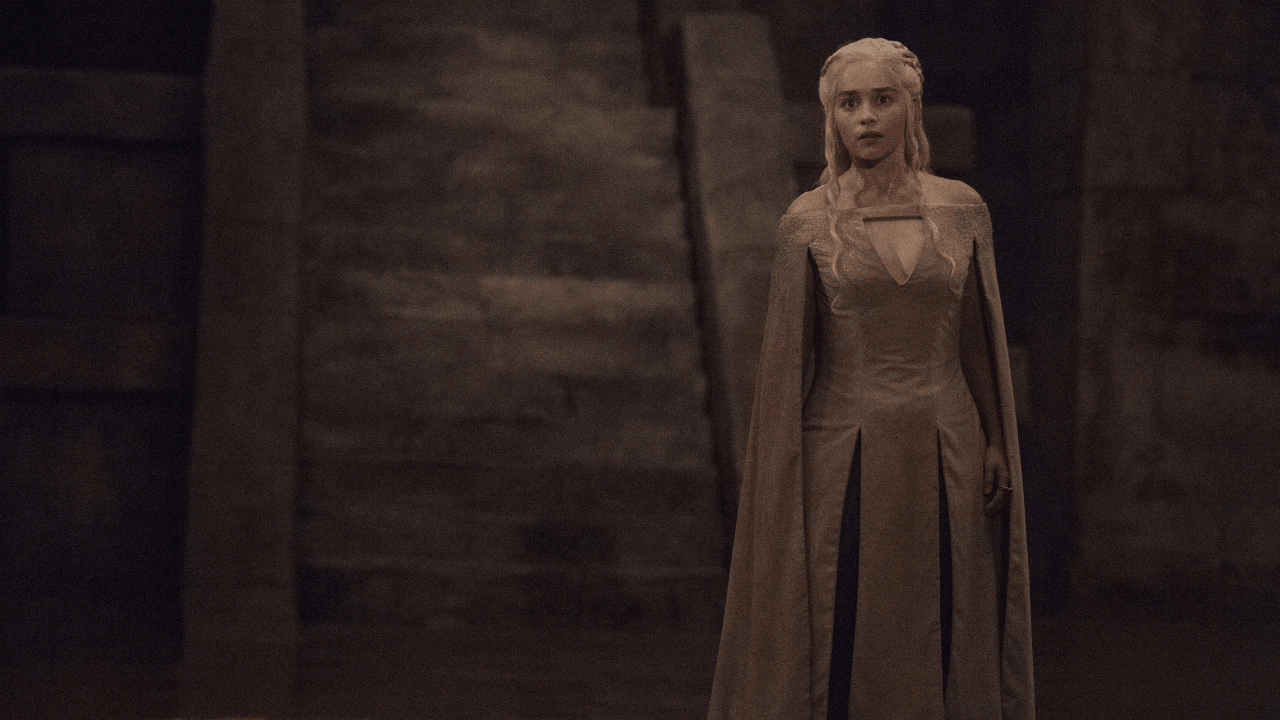
In Meereen, Daenerys Targaryen is no longer just a conqueror. She is a ruler facing the consequences of conquest.
The city is not stabilized by taking it. It has to be governed, and governance is messier than liberation. Sons of the Harpy begin appearing as an organized resistance, reminding Daenerys that the people she defeated did not simply disappear. They adapted.
The episode’s treatment of Daenerys is important because it shifts her arc from triumph to responsibility. She is still gathering power, but she is now learning that power attracts resistance as surely as it attracts loyalty.
Key character moves and why they matter
Cersei: from strategist to cornered regent
Cersei’s major move in this episode is not a bold action but a revealing vulnerability. She believes she can keep the kingdom aligned through old habits of manipulation, yet every conversation shows that her influence is slipping.
That loss matters because Cersei’s style of power depends on controlling the room. If she cannot do that, she becomes reactive. The episode plants the idea that her decisions in Season 5 may be driven as much by fear as by ambition.
Jon Snow: asked to choose a side
Jon’s scene with Stannis is not just about title or rank. It is about identity. Jon has spent the series rejecting claims of birthright, but this offer puts him in the position of deciding whether duty to the North can coexist with his vows to the Night’s Watch.
That tension is exactly why the scene matters. It reframes Jon not as a passive witness to history, but as a man who may be forced to shape it.
Arya Stark: identity becomes a weapon
Arya’s entrance into Braavos marks a critical transition. Until now, her journey has been about survival and revenge. In Season 5, it becomes about erasure and transformation.
The House of Black and White introduces a different kind of power in Westeros: one that does not rely on armies or castles, but on secrecy, ritual, and the ability to become someone else. Arya’s story is about to get stranger, and more dangerous, than ever.
Daenerys: rule is not the same as victory
Daenerys has dragons, followers, and an empire-in-progress, but the episode reminds us that conquest leaves aftershocks. Her enemies in Meereen are not only armed rebels; they are the consequences of a revolution that moved faster than its institutions.
That makes her storyline one of the most politically interesting in the premiere. She is testing whether idealism can survive administration.
Lore connections and world-building that pay off later
The High Sparrow and the return of religious power
The High Sparrow is one of the episode’s most significant introductions because he brings institutional religion back into the center of the story. Westeros has always had faith, but faith rarely gets to sit this close to state power. Here, it does.
His presence foreshadows a season where the old alliance between noble privilege and public order starts to fracture. The Faith is not just background texture anymore. It is a political engine.
Braavos and the Faceless Men
Arya’s arrival in Braavos expands the map in a meaningful way. Braavos is not just another exotic city; it is a place with its own power structures, history, and philosophy.
The House of Black and White also deepens the series’ mythology around death, identity, and paid assassination. It suggests that power in this world is not only about who sits a throne, but about who can erase a name from history.
Meereen as a governing problem
Daenerys’ rule in Meereen helps clarify one of the series’ recurring themes: winning a city is easy compared with making it stable.
The episode sets up the idea that liberation without systems creates a vacuum. That vacuum is where insurgency grows.
The ending: what the premiere leaves hanging
The ending of Game of Thrones S5E1 “The Wars to Come” episode guide territory is all about unresolved pressure. The episode does not close with a spectacular battle or a shocking death. Instead, it ends with a series of strategic uncertainties.
Cersei is more exposed than she realizes. Jon is standing at the edge of a life-changing political decision. Arya has entered a place that could remake her or destroy her. Daenerys is discovering that rule can be more fragile than rebellion.
That is why the premiere works so well as a season opener. It does not just move pieces; it changes the stakes attached to them.
Why this episode matters to the larger series
This premiere is important because it marks the beginning of a more fractured, less forgiving phase of the story. The easy energy of earlier seasons is gone. What remains is the hard work of power: coalition-building, coercion, public image, and the hidden costs of every choice.
A few bigger series takeaways stand out:
- The court in King’s Landing is weakening from within.
- The North is becoming a bargaining ground again, not just a battlefield.
- Arya’s story is shifting from revenge to reinvention.
- Daenerys is being tested as a ruler, not just a conqueror.
- Faith and ideology are becoming active political forces.
Season 5 begins by making one thing clear: the war to come is not only fought with swords. It is fought with law, belief, inheritance, and identity.
What new viewers should remember next
If you are using this episode as a checkpoint in a full series compendium, keep these details in mind for the next stretch of the story:
- King’s Landing is politically unstable without Tywin’s command.
- The High Sparrow is not a background priest; he is a serious power player.
- Arya is now in Braavos, and her storyline has entered Faceless Men territory.
- Jon Snow has been offered a major political role tied to the North.
- Daenerys is dealing with organized resistance in Meereen, not simple unrest.
That combination of plot threads makes the premiere feel like a hinge episode. It does not just launch a season. It locks in the conflicts that will define it.
If you want, share your take on the episode in the comments — especially your favorite scene, the biggest power move, or what you thought mattered most on a first watch.