
Image credit: goodrob13 via Openverse / Flickr · CC BY 2.0 · License
From Coin-Op to Icon: The Classic Arcade Cabinet History of a Cultural Object
The phrase classic arcade cabinet history sounds technical, but the story is really about an object learning how to matter in public. A cabinet started as a delivery vehicle for a game: a box of electronics, art, controls, and coin slots built to survive steady use. Very quickly, though, it became something stranger and more memorable. People did not just play the machine. They gathered around it, watched over shoulders, memorized its sounds, and recognized its silhouette from across a room.
That transformation is why arcade cabinets still linger in memory long after the games themselves have been ported, remade, and preserved in other forms. The cabinet was not a neutral shell. It shaped who could play, how long they stayed, and how visible the act of play became. It was furniture, signage, competition stage, and public sculpture all at once.
Why the cabinet mattered before the game did
In the earliest coin-op era, the cabinet had to do two jobs at once: protect expensive hardware and attract strangers. It lived in bars, bowling alleys, pizza parlors, amusement centers, convenience-store corners, boardwalks, and airport lounges—any place with foot traffic and enough idle time to turn into a quarter.
That setting changed the meaning of the game inside it. At home, play is private and often solitary. In public, the machine had to announce itself. Cabinet shape, screen height, control layout, speaker placement, and artwork all worked together to create a small zone of attention. A player stepped into that zone, while everyone else became audience, challenger, or next-in-line.
This is one reason arcade machines became culturally sticky. They were encountered in the middle of life, not sealed away from it. A cabinet was there while people waited for pizza, skipped time after school, or lingered near a pool table. It did not merely entertain. It occupied space in communal memory.
The physical design of classic arcade cabinet history
The cabinet is where classic arcade cabinet history becomes tactile. If you strip away nostalgia, you find a set of design decisions that made the machine feel immediate and social.
1. The shape told you where to stand
Most cabinets were built to guide the body. The control panel sat at a natural height. The screen was angled for a standing player. The footprint was compact enough to fit in a row, but large enough to claim a corner. Even the heavier wood construction signaled permanence; this was not a tabletop toy. It was a fixture.
The best cabinets made the player feel centered. You were not looking down at a device in your lap. You were stepping up to a machine designed for public use, with your hands out in front of you and your face lit by the display. That posture made play visible. It also made performance visible.
2. The artwork was a sales pitch in motion
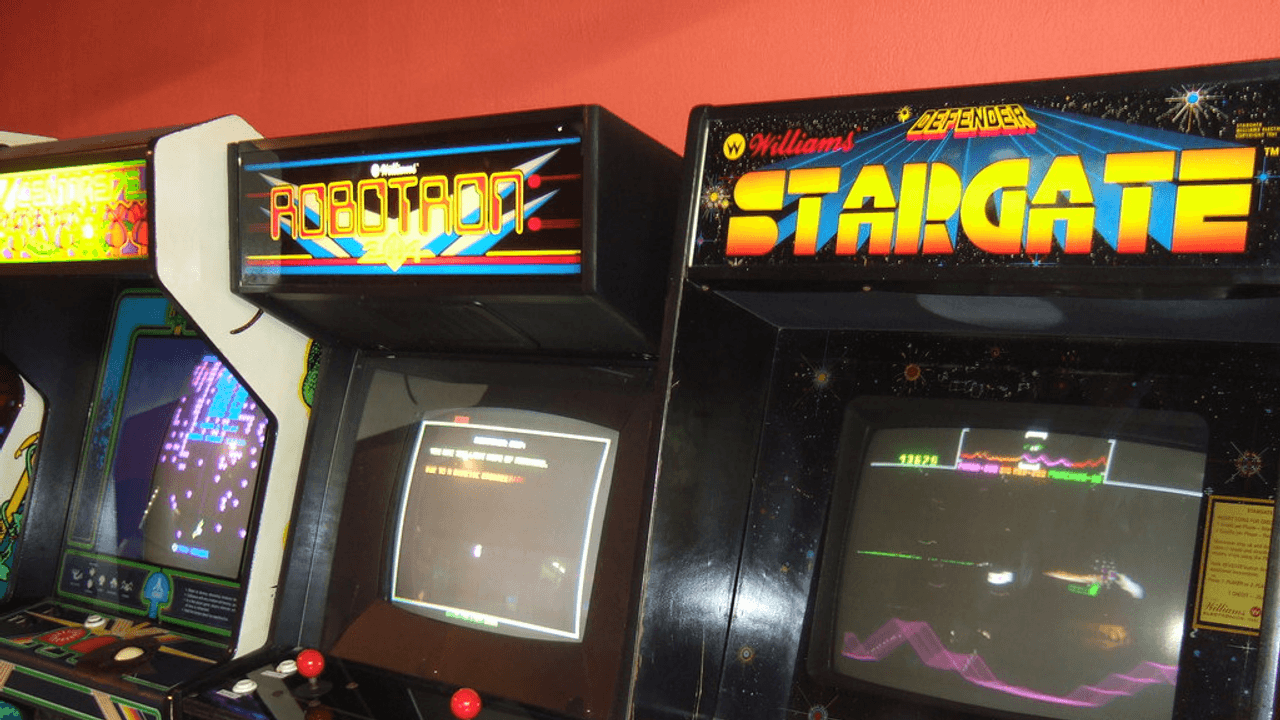
Side art, marquees, bezel graphics, and control-panel labels gave each cabinet an identity before anyone touched the joystick. In a noisy arcade, a machine had only seconds to earn curiosity. Bright illustration and bold color did the work of a poster, except the poster was wrapped around the machine itself.
This visual language mattered because it gave games an iconographic life outside the screen. A machine could be remembered by its cabinet art long after the exact mechanics faded. Some cabinets looked dangerous, some comic, some sleek, some futuristic. That exterior became part of the game’s mythology.
3. The controls turned play into a public gesture
Arcade controls were simple enough to learn in a few seconds, but not so simple that mastery came easily. That balance created a spectator sport out of ordinary button pressing. You could tell, instantly, whether someone was surviving, flailing, or in command.
The cabinet’s control panel did not hide the hands. It displayed them. Buttons were hammered. Joysticks were tilted hard enough to show intention. Watching someone play became its own kind of entertainment, and that made the cabinet a social engine rather than a sealed interface.
Where cabinets lived changed what they meant
A cabinet in a dedicated arcade meant one thing. A cabinet in a diner or laundromat meant another. Placement determined the social contract around the machine.
In a dedicated arcade, the cabinet was part of a competitive ecosystem. Players watched scores, waited for turns, and traded tips. The machine lived in a hierarchy of noise and spectacle. In a smaller venue, it might serve as a destination and a diversion at once—a place to spend one extra coin while the rest of life continued around it.
That difference mattered because it shaped who played. A machine in a restaurant could be discovered by children, siblings, parents, and passersby who had not come looking for games at all. A cabinet near the front of a venue might attract casual attention, while a machine tucked deeper inside could become the territory of regulars.
In other words, the public space did half the design work. The cabinet was never isolated from its surroundings. It borrowed atmosphere from the room and gave some back in return.
Why certain machines became icons
Not every cabinet became legendary, and the reasons usually had less to do with software alone than with the total object.
A cabinet became iconic when several things lined up:
- the game was easy to recognize at a glance
- the artwork was bold enough to live in memory
- the controls invited dramatic body language
- the sound was loud and distinctive in a crowded room
- the machine’s silhouette stood out from nearby cabinets
- the experience felt social, competitive, or watchable
When those elements worked together, the cabinet crossed a threshold. It stopped being just a housing for code and became a marker of an era. People remembered the machine as a whole experience: the glow, the queue, the clatter of coins, the people standing shoulder to shoulder, the screen flickering just above eye level.
That is also why some cabinets survive in nostalgia even when the games have been reissued elsewhere. A modern console port may preserve the rules, but it cannot fully reproduce the public drama of a cabinet under fluorescent lights in a busy room.
The cabinet as a social object
It is easy to talk about arcade history in terms of breakthroughs in graphics or gameplay. Those things matter, but they miss a crucial fact: the cabinet was a social object first.
It created a waiting line.
It invited comparison.
It framed skill as something you could witness.
It encouraged the exchange of advice, dare, and admiration.
A player who walked away after losing did not leave in private. The next person saw the score, saw the defeat, and stepped up. That cycle gave arcade play a public rhythm that home gaming could rarely match. The machine was always performing even when no one touched it.
The cabinet also gave games a physical permanence they do not always retain in digital form. A machine was heavy, repairable, and finite. It could be scratched, re-stickered, yellowed by age, or modified by operators trying to keep it earning. Those traces of use are part of the artifact. They tell you the cabinet was not preserved in a lab. It was lived with.
Design details that shaped the experience
Several small details had outsized effects on how arcade cabinets felt in practice.
Sound spilled into the room
Arcade audio was not personal. It was environmental. The bleeps, theme stings, and failure noises of one cabinet blended with many others, creating a dense soundscape that made the room feel alive. Sound was both advertisement and pressure. It told you where excitement was happening.
Lighting made the cabinet a beacon
Marquees and monitor glow pulled eyes from across a venue. Even when a player was not near the machine, the cabinet broadcast activity. In darker spaces, this effect was even stronger. The machine appeared as a lit object in a room of shadows, almost demanding approach.
Wear made machines memorable
A slightly faded panel or rubbed corner could make a cabinet feel more real, not less. Use marks suggested history. They told onlookers that the machine had passed through many hands before theirs. In a culture built around repeated play, that accumulated wear became part of the charm.
From amusement device to collectible artifact
The later life of arcade cabinets says a lot about their first life. Once the public spaces that sustained them began to shrink, cabinets moved into private collections, museums, bars, and nostalgia-driven venues. Their function changed again.
As collectibles, they became evidence of a particular media ecology: loud, local, mechanical, and communal. They were no longer just tools for playing a game. They were artifacts of design history. People started caring about original side art, correct control panels, restoration authenticity, and cabinet condition in the way car enthusiasts care about trim and upholstery.
That shift is important. It shows that the cabinet had acquired meaning beyond utility. Its material presence became worth preserving even when the commercial logic that created it had weakened.
Why the cabinet still matters now
The modern game world is full of invisible interfaces. Screens are thinner, devices are smaller, and play is increasingly portable. That makes the arcade cabinet feel almost radical in hindsight. It was unapologetically physical. It took up room. It asked you to stand there in public and perform skill while everyone else watched.
That is why classic arcade cabinet history remains more than nostalgia. It is a record of how design can shape culture through placement, scale, and attention. The cabinet taught games how to occupy space and how to become visible to people who were not yet players.
If you remember one thing, let it be this: the cabinet was never just packaging. It was part of the experience, part of the audience, and part of the reason arcade games became unforgettable in the first place.
What arcade cabinet lives strongest in your memory? Share your favorite examples, personal stories, or cabinet details in the comments.