

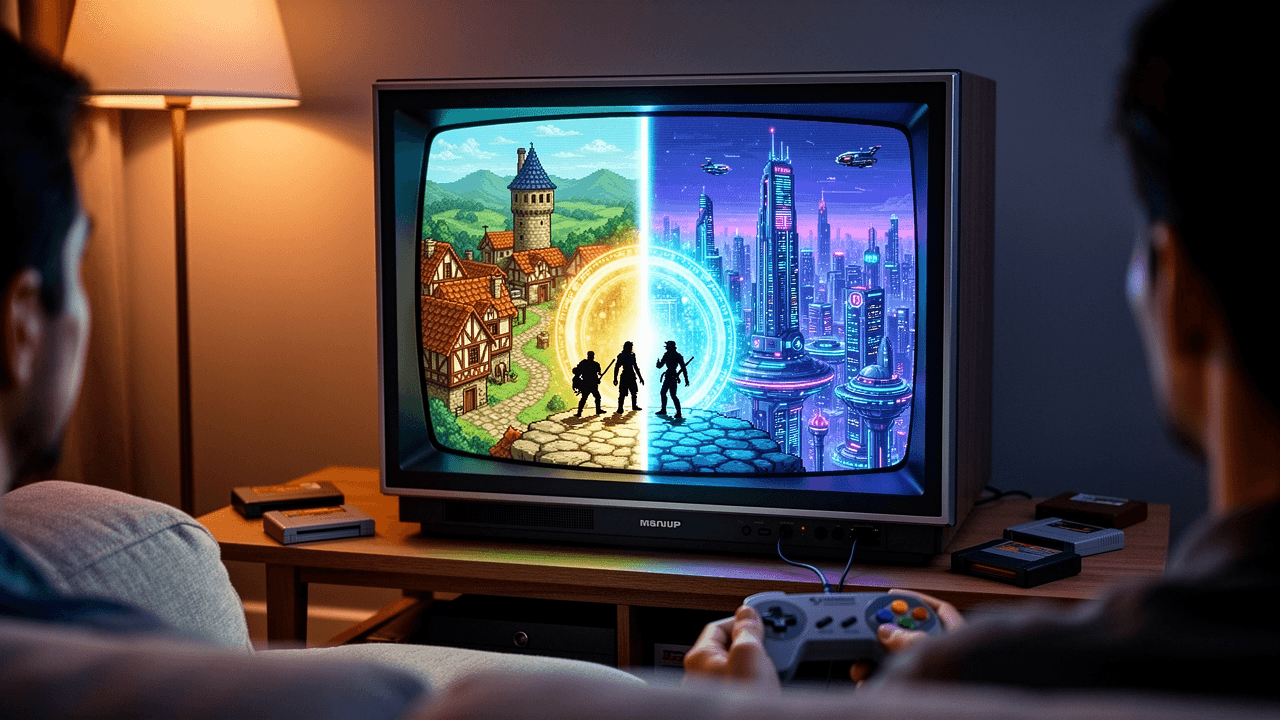
A Super Nintendo Classic That Never Wastes Your Time: Chrono Trigger on Super Nintendo
Some games feel old in the way a museum feels old: important, but sealed behind glass. Chrono Trigger on Super Nintendo is the opposite. It still plays like a machine built to respect your attention. In 1995, that meant something rare for a role-playing game: a brisk opening, readable combat, and a time-travel premise that delivers wonder without padding the clock.
That is why it still works. Not because it is merely nostalgic, and not because it is a sacred cow of the 16-bit era. It works because every major system seems designed around a simple idea: move the player forward, show them something striking, and never make them wait longer than necessary.
The first thing it gets right: momentum
A lot of classic RPGs begin with an obligation. You meet the hero, you cross the first town, you buy a weapon, you accept that the real game will begin later. Chrono Trigger on Super Nintendo wastes almost none of that opening energy.
It starts with a festival. You are already moving through a place full of color, people, and small events. There is a fair amount to look at, but very little standing around for the sake of standing around. Within minutes, the game has introduced its world, its tone, and one of its most important tricks: it treats discovery like a reward, not a chore.
That philosophy carries through the whole adventure. Every chapter feels like a new destination with a distinct visual identity and a clear purpose. The game rarely asks you to slog through long narrative explanations before it gives you something to do.
Why the chapter flow still feels so sharp
Chrono Trigger’s structure is deceptively simple. You are not wandering through an endless chain of errands. You are jumping between eras, each one offering a self-contained burst of mystery, exploration, and payoff.
That matters because it prevents the familiar RPG drag. Instead of stretching one idea until it sags, the game keeps rotating the focus:
- a medieval kingdom with a looming political crisis
- a ruined future that feels eerie rather than merely grim
- a prehistoric age that is playful and dangerous
- a far-future setting that widens the game’s scope
- a late-game sequence that ties everything back together
This is pacing as curation. The game knows when to linger and when to move on.
Combat clarity over complexity for its own sake
The battle system is one of the biggest reasons Chrono Trigger on Super Nintendo remains so approachable. It is not shallow, but it is legible.
You can read what is happening almost instantly. Enemy positions matter. Elemental attacks matter. Team combinations matter. But the game never buries those ideas under menus that feel like administrative work. Even its active-time battle structure, with visible enemy movement and a field that gives fights spatial texture, keeps the action feeling alive without becoming messy.
The real trick is how much it accomplishes with very little friction.
What makes the combat so easy to understand
A modern player coming to the game for the first time may notice how quickly it teaches itself. It does not over-explain, but it does not confuse you either.
- Basic attacks are immediate and readable.
- Techs create satisfying combo possibilities without demanding spreadsheet-level planning.
- Enemy tells are clear enough to reward observation.
- Healing and support actions are useful without forcing constant menu micromanagement.
- Random encounters, while present, rarely feel like a punishment for moving between interesting moments.
That balance is important. The game gives you enough systems to stay engaged, but it never makes those systems the point of the experience. The point is to keep the story and the exploration in motion.
Time travel is the spectacle, but not the excuse
Time travel is one of those ideas that can easily turn into empty branding. Many games use it as a big premise and then spend most of their time doing standard fantasy business in different costumes.
Chrono Trigger on Super Nintendo does better than that. Time travel is not just the selling point; it is the organizing principle.
Each era changes your understanding of the world. A location you visit in one age can become the key to a problem in another. Decisions echo. The setting evolves around you. The game does not treat history as backdrop; it treats history as a mechanism.
That is why the spectacle lasts. You are not simply watching the game be clever about timelines. You are actively feeling the consequences of moving through them.
The game earns its big moments
The famous scenes work because the build-up is so efficient. The game understands contrast. It can go from playful to tragic, from small-town charm to world-ending stakes, without losing its rhythm.
A lesser RPG might pause to explain its dramatic reveal at length. Chrono Trigger tends to trust the player more than that. It sets up a moment, lands it cleanly, and gets out before the emotion goes stale.
That economy is one of its greatest strengths. It knows that spectacle is strongest when it is not overused.
Economical writing, memorable character, no fat
The script in Chrono Trigger on Super Nintendo is remarkably lean. That does not mean it lacks personality. It means every line has to do a job.
Characters are sketched with efficient dialogue and strong visual design. Villains are easy to remember because their entrances matter. Supporting cast members get enough room to register as more than quest dispensers. Even the humor tends to land because it arrives quickly and leaves before it can become strained.
What stands out most is how little the game insists on explaining itself. It gives you context, then moves. It expects you to pay attention. That may sound basic, but it was and remains a surprisingly mature design choice.
There is no sense that the game is trying to justify its own length. It is trying to make each hour count.
Why the Super Nintendo version matters
Any discussion of the game should stay anchored to the 1995 Super Nintendo release, because that version captures the design in its cleanest form. Before later ports, quality-of-life tweaks, and extra content entered the conversation, the original cartridge already contained the core experience that made the game famous.
That matters for two reasons.
First, the pacing feels native to the hardware. The game’s compact presentation, smooth transitions, and efficient battle flow are part of why it feels so light on its feet.
Second, the SNES version shows how carefully the developers used the system’s limits. It is full of expressive sprite work, strong color design, and set pieces that feel bigger than the machine should reasonably allow. The result is a game that looks generous without being bloated.
If you want to understand why the title became a benchmark, start here. This is the version where the design logic is easiest to see.
A benchmark for approachable classic RPG design
So what makes Chrono Trigger on Super Nintendo a benchmark rather than just a beloved relic?
It understands the player’s time.
That sounds simple, but it is the core of everything the game does well. The pacing avoids dead air. The combat is readable on first contact. The writing gets to the point. The time-travel structure creates variety without requiring the player to relearn the whole game every few hours.
In practice, that means it remains unusually friendly to:
- players who love classic RPGs but dislike heavy grind
- newcomers who want a historically important game without a steep barrier
- returning fans who remember the vibe but not the exact details
- anyone who appreciates design that makes progress feel constant
There are older RPGs that feel grander in scale, and there are more mechanically intricate ones. But few are as cleanly composed. Chrono Trigger never feels like it is trying to win by being larger. It wins by being better paced.
The lasting trick: it feels complete
A lot of retro games age by becoming fascinating documents. Chrono Trigger ages differently. It still feels like a complete meal.
You can sense the care in its structure. A scene is introduced, paid off, and released. A battle teaches a lesson, then ends. A time period opens a new possibility, then hands you forward momentum instead of a checklist.
That is why the game keeps finding new players decades later. It does not ask for indulgence. It gives you an adventure shaped to keep moving.
And maybe that is the most modern thing about it.
Final verdict: still the standard for efficient RPG design
If you are looking for the best single argument for the appeal of classic role-playing games, Chrono Trigger on Super Nintendo is a strong place to start. It pairs accessibility with imagination, structure with surprise, and spectacle with restraint.
It does not waste your time. It makes your time feel well spent.
That is a much rarer achievement than it sounds, and it is a big reason the game still looks essential instead of merely historic.
What do you think—does Chrono Trigger still set the bar for approachable RPG design, or is another classic doing something it does better? Share your thoughts in the comments.