

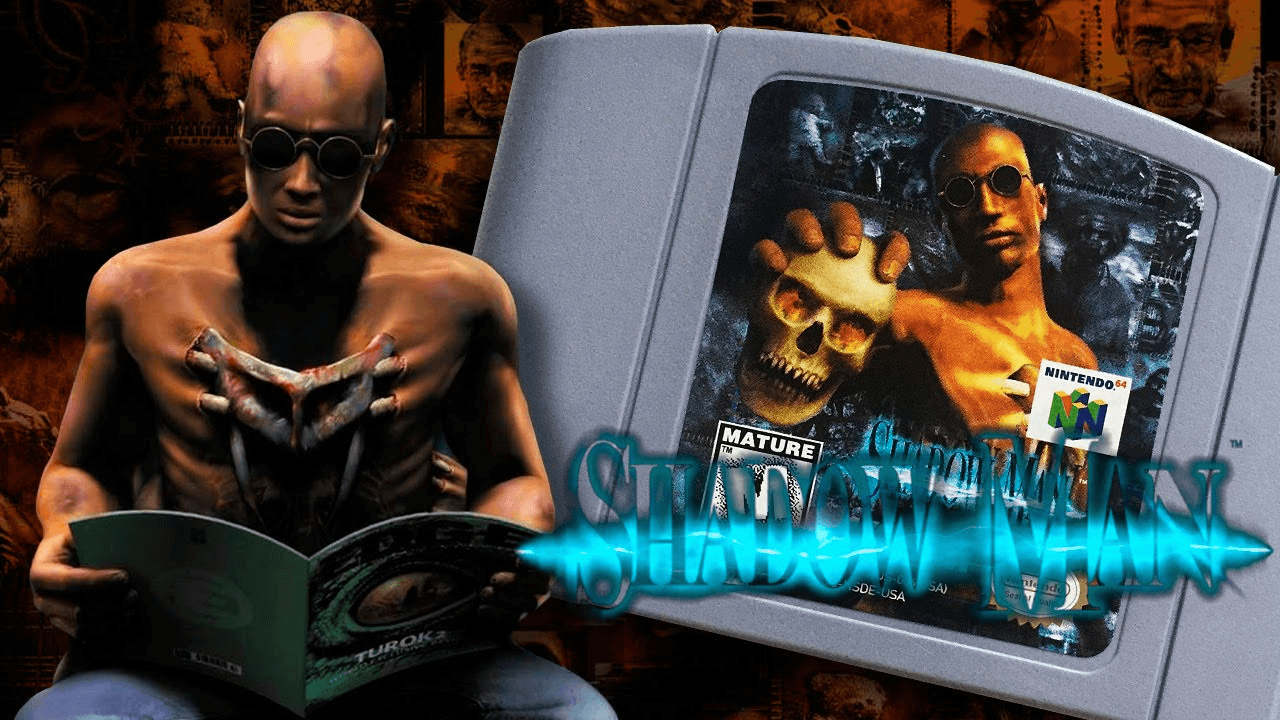
Image credit: Draft web reference from youtube.com
What Shadowman on Nintendo 64 Gets So Uncomfortably Right
Shadowman on Nintendo 64 was never going to be everyone’s favorite action-adventure, and that is exactly why it has lasted. It arrived with the kind of confidence that late-’90s experiments sometimes had: a big, strange world, a grim tone that never asks permission, and movement that makes you feel as if you are crossing forbidden ground rather than simply clearing a level. More than two decades later, its cult identity still makes sense. This is a game that understands how geography, pressure, and traversal can do the storytelling for you.
What stands out now is not just that Shadowman on Nintendo 64 is dark. Plenty of games were dark in the 1990s. The difference is that its world feels oppressive in a structural way. It does not merely decorate the experience with skulls and fog. It builds a place that is awkward, layered, and often hostile to the player’s sense of comfort. You remember the spaces because they feel inhabited by rules rather than theme-park spectacle.
Why Shadowman on Nintendo 64 still feels like a cult object
Some games become cult favorites because they are broken in interesting ways. Others because they are ahead of their time in a few narrow ways. Shadowman on Nintendo 64 sits in a useful middle ground. It is ambitious enough to feel singular, but idiosyncratic enough that the rough edges become part of its personality.
The first thing that defines it is mood. The game leans into an underground, after-the-fall atmosphere that makes almost every area feel contaminated by history. You are not moving through cleanly segmented stages so much as pushing deeper into an ecosystem of ruined architecture, occult symbolism, and threatening silence. Even when the game asks you to do ordinary action-adventure tasks, the setting refuses to feel ordinary.
That matters because cult status often comes from a game’s refusal to flatter the player. Shadowman on Nintendo 64 does not seem interested in being immediately readable or neatly empowering. Instead, it asks you to learn its spaces by surviving them.
The world design is the real hook
The best way to understand Shadowman on Nintendo 64 is to think of it as a game about place first and progression second. Its structure gives the world a heavy, interconnected feel. Areas are not just backdrops for combat encounters; they are obstacles, memory tests, and navigation puzzles all at once.
That design choice gives the game a distinctive rhythm:
- You enter a new region and immediately feel disoriented.
- You learn landmarks slowly, usually through repetition.
- Locked paths, verticality, and hidden routes make the world feel larger than your current understanding of it.
- Progress comes from mental mapping as much as from combat skill.
This is one of the reasons the game lingers. A lot of action-adventures from the era are remembered for set pieces, bosses, or item acquisition. Shadowman on Nintendo 64 is remembered for feeling like a place you had to inhabit. It creates pressure by making the world itself hard to parse. The result is a persistent low-grade tension that never fully goes away, even when you are not in danger.
That oppressive quality is not accidental. It helps transform exploration from a checklist into an emotional condition. When the environment seems to resist you, every new shortcut or traversal breakthrough feels earned.
Shadowman on Nintendo 64 and the power of traversal
Traversal is where the game’s design becomes more than atmosphere. Movement in Shadowman on Nintendo 64 is not just about getting from one objective to another; it is the main way the game communicates discovery.
The game asks you to cross gaps, climb, descend, and revisit areas with new abilities in a way that makes the world feel knit together. That structure creates a useful tension: the spaces are intimidating, but they are not arbitrary. Once you understand how to move through them, you begin to feel the map in your hands.
That is a subtle but important reason the game has endured. A lot of older 3D games used movement as a functional necessity. Here, traversal is part of the experience’s identity. The game is often at its best when you are:
1. Reading space under pressure
The environment is dark, busy, and often difficult to interpret at a glance. You do not glide through it casually. You study it.
2. Learning routes through repetition
Backtracking is not automatically a flaw when the world keeps changing in your head. Revisiting an area after new progress can turn confusion into fluency.
3. Feeling the world open in stages
The game is structured around gradual access, so expansion feels physical. New routes are not just rewards; they are proof that you now understand the place better.
That is a powerful formula, especially for an N64 game. The hardware era often favored bold shapes and clearer goals. Shadowman on Nintendo 64 goes the other way, using density and ambiguity to create a stronger sense of being somewhere dangerous.
Why the oppressive tone works better than simple shock
A lot of horror-adjacent games rely on sudden shocks to keep attention. Shadowman on Nintendo 64 works differently. Its tone is more atmospheric than sensational. It is unsettling because it commits to discomfort as a baseline condition.
That commitment shows up in the way the game spaces itself out. The quieter stretches matter because they make the world feel abandoned rather than merely dangerous. The unpleasantness is not just in enemies or imagery; it is in the feeling of moving through a place that does not want you there.
That approach gives the game a kind of staying power. Moments of action come and go, but the overall mood remains. Years later, what people remember is not a single scare so much as the cumulative pressure of being inside the game’s world.
This is also where the game’s cult identity becomes easier to explain. Fans often gravitate toward titles that make a strong, singular mood part of the mechanics. Shadowman on Nintendo 64 is memorable because it fuses structure and sensation. The level design makes you feel lost; the traversal makes you earn confidence; the tone keeps everything slightly wrong.
It stands out because it respects exploration
The game’s best quality may be how seriously it takes exploration. It does not treat exploration as a decorative feature or a reward after the “real” game begins. Exploration is the real game.
That means the player’s attention is always doing double duty. You are not only asking, “How do I survive this?” You are also asking, “What kind of place is this, and how does it connect to the rest of the world?”
That kind of design is especially rare in retrospect because it asks for patience. Modern players who bounce off the game are often reacting to the same thing that gives it charm: the refusal to hurry. It wants you to absorb the layout, the atmosphere, and the feeling of progression. It is less interested in constant kinetic payoff than in accumulated dread and discovery.
And that is why it still stands apart among late-’90s action-adventures. Plenty of games from the era experimented with 3D movement, item gating, and dark fantasy imagery. Shadowman on Nintendo 64 combined those elements into a world that feels heavy, strange, and insistently its own.
Why it still matters to rediscover it now
Rediscovering Shadowman on Nintendo 64 today is not about pretending it is flawless. It is about recognizing how unusual its priorities were. The game is not beloved because it smooths over its roughness. It is beloved because the roughness is part of the message.
Its oppressive world design gives it weight. Its traversal gives it purpose. Its level structure turns exploration into a mood rather than a chore. Put together, those qualities create a game that feels less like a polished product and more like a place with a history.
That is a big reason it still has a cult following. Some games are remembered because they were universally loved. Others are remembered because they were specific enough to feel irreplaceable. Shadowman on Nintendo 64 belongs to the second group.
Final thoughts
If you come to Shadowman on Nintendo 64 expecting a tidy, comfort-food action-adventure, it will probably push back. But if you are interested in a late-’90s oddity that uses world design and traversal to create an atmosphere you can almost feel on your skin, it remains easy to admire.
The game’s lasting value is not that it was merely strange. It is that its strangeness was organized into a coherent experience. The world feels oppressive because it is built that way. Moving through it feels meaningful because the game makes every route matter. That combination is why it still stands out.
If you have your own memories of Shadowman on Nintendo 64, or if you discovered it much later, share your thoughts in the comments—I’d love to hear where it landed for you.