
Image credit: Draft web reference from screenrant.com
Resident Evil on PlayStation is remembered for zombies, fixed camera angles, and that mansion full of locked doors, but its real trick is simpler and harsher: it makes ordinary movement feel expensive. Every step, every shot, and every item slot carries weight. You do not just explore the Spencer Mansion. You negotiate with it.
That is why the game still works. Its horror does not rely only on monsters jumping out of corners. It comes from pressure built out of scarcity, awkward controls, and a layout that always seems one room ahead of your confidence. The result is survival horror as a design system, not just a theme.
Resident Evil on PlayStation turns friction into fear
A lot of games try to make the player feel powerful first and threatened later. Resident Evil on PlayStation does almost the opposite. It takes away comfort before it takes away safety.
The movement scheme is the first signal. The controls are deliberately stiff, with tank-style turning and a character who does not glide across the floor the way modern action heroes do. That awkwardness can feel dated in a mechanical sense, but in horror terms it is useful. When you cannot pivot instantly or strafe away from danger with ease, even a weak enemy starts to feel like a problem. A hallway is no longer a neutral space. It is a place where commitment matters.
That commitment changes the texture of every encounter:
- you cannot test a room carelessly
- you cannot correct mistakes instantly
- you have to think before entering a fight
- you begin to read the environment like a threat map
The game’s controls make panic legible. If the player feels a little trapped by the interface, then the mansion can feel more oppressive without changing anything else.
Scarcity is the real monster
Resident Evil on PlayStation is constantly asking a brutal question: what are you willing to spend to stay alive?
Ammo is limited enough that every shot feels like an argument. Healing items are valuable enough that using one too early can feel like wasting a future rescue. Inventory space is so tight that even a helpful item can become a burden if you need another essential object more urgently. The game does not just reduce resources; it creates competing claims on them.
That tension is strongest because the player rarely has perfect information. You do not always know whether a key will be needed in the next room or the next wing. You do not know if a handgun round is enough to save you from a cornered mistake later. You do not know if you are over-preparing or under-preparing until the mansion proves you wrong.
In that sense, the inventory is not just a menu. It is part of the horror language. Every item you carry is a promise you made to the future. Every item you leave behind is a risk you accept.
The mansion layout makes anxiety accumulate
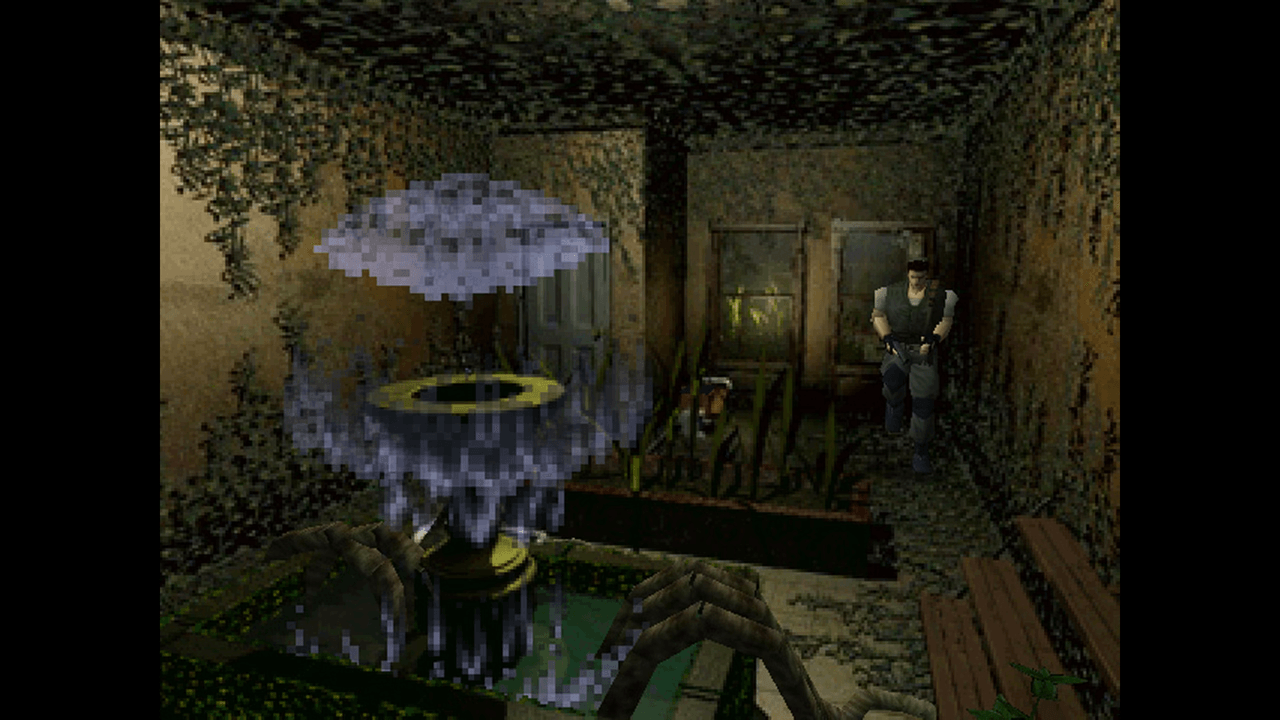
The Spencer Mansion is a masterclass in controlled dread because it feels learnable without ever becoming friendly.
At first, the building seems almost polite. There are grand rooms, decorative halls, and a structure that invites curiosity. Then the game starts folding that space back on itself. Locked doors force detours. Shortcuts open late. Familiar corridors become more dangerous once enemy placement changes or your route is interrupted. The mansion behaves like a puzzle box, but one with teeth.
What matters most is that the layout gives your memory something to do. You start to remember which hallways connect, which rooms are worth revisiting, and which routes are safest when your health is low. That memory is a survival tool, but it also deepens the anxiety. Once you know the mansion a little better, you understand just how many bad choices it can force.
The map structure supports the fear in three important ways:
1. It creates repeated exposure
You keep returning to the same spaces, which means threats never feel fully resolved. A hallway cleared once is not necessarily safe forever.
2. It makes detours expensive
When a locked door or missing item sends you across the mansion, the trip itself becomes a gamble. Distance matters because distance consumes resources.
3. It rewards partial knowledge
The player is never completely lost, but never fully secure either. That middle ground is where the game thrives.
Why the game’s awkwardness belongs here
It is tempting to call Resident Evil on PlayStation clunky and leave it at that. But the better reading is that the game’s awkwardness is selective. It is not random incompetence. It is a pressure valve.
If movement were smooth, enemies would be less frightening. If the camera were always placed for convenience, rooms would feel more transparent. If inventory space were generous, planning would soften into routine. The game gives you just enough control to act, but not enough control to feel safe while acting.
That balance matters because horror is often about uncertainty, not simple danger. The player needs to feel that a wrong move could have consequences beyond the current fight. Resident Evil on PlayStation keeps that possibility alive by making each action carry friction. You are always a little slower than you wish to be, a little more encumbered than you want to be, and a little less certain than you should be.
That is not accidental. It is the point.
Combat is about resource math, not power fantasy
The zombies are scary at first because they are animated threats in a confined place. But they remain scary because the game never lets combat become a comfortable habit.
You do not mow down enemies because the game expects efficiency. You decide whether an encounter is worth the cost. Sometimes shooting is the answer. Sometimes retreating is smarter. Sometimes a room should simply be endured rather than cleared. That calculation keeps the player from settling into action-game confidence.
This is one of the most important reasons Resident Evil on PlayStation still feels tense. The game does not let violence become free. Every shot is a subtraction from future security. Every enemy left alive is a possible problem later. The player is forced into a kind of survival accounting that makes even short sessions feel loaded.
The horror comes from learned helplessness, but not hopelessness
Resident Evil on PlayStation is not a powerless game. If it were, the fear would flatten out into frustration. Instead, it gives the player enough tools to improve, but never enough to relax completely.
That is a delicate design balance. As you learn the mansion, you get better at routing, better at item management, and better at recognizing when to spend ammo and when to save it. The game rewards discipline. But the more competent you become, the more clearly you see how narrow your margins still are.
That means progress does not erase dread. It sharpens it. You stop being scared because you are clueless and start being scared because you understand the stakes.
Why the original still matters
Modern horror games often chase realism, dynamic systems, or constant escalation. Resident Evil on PlayStation proves that fear can also come from restraint. It is elegant in a harsh, old-fashioned way. It trusts scarcity. It trusts layout. It trusts the player to feel the pressure created by a bad turn, a wasted herb, or a hallway that has become just a little too familiar.
That is why the game remains more than a historical artifact. It is a design object that understands how tension compounds. Limited resources make choices heavy. Awkward controls make threat feel close. The mansion turns navigation into dread. Put those pieces together, and the horror is not just what you see on screen. It is what the game makes you carry.
Resident Evil on PlayStation still deserves attention because it understands a hard truth: fear is stronger when the player has to earn every inch of safety.
If you have your own take on the original, or a favorite survival-horror example that handles pressure well, share it in the comments.