

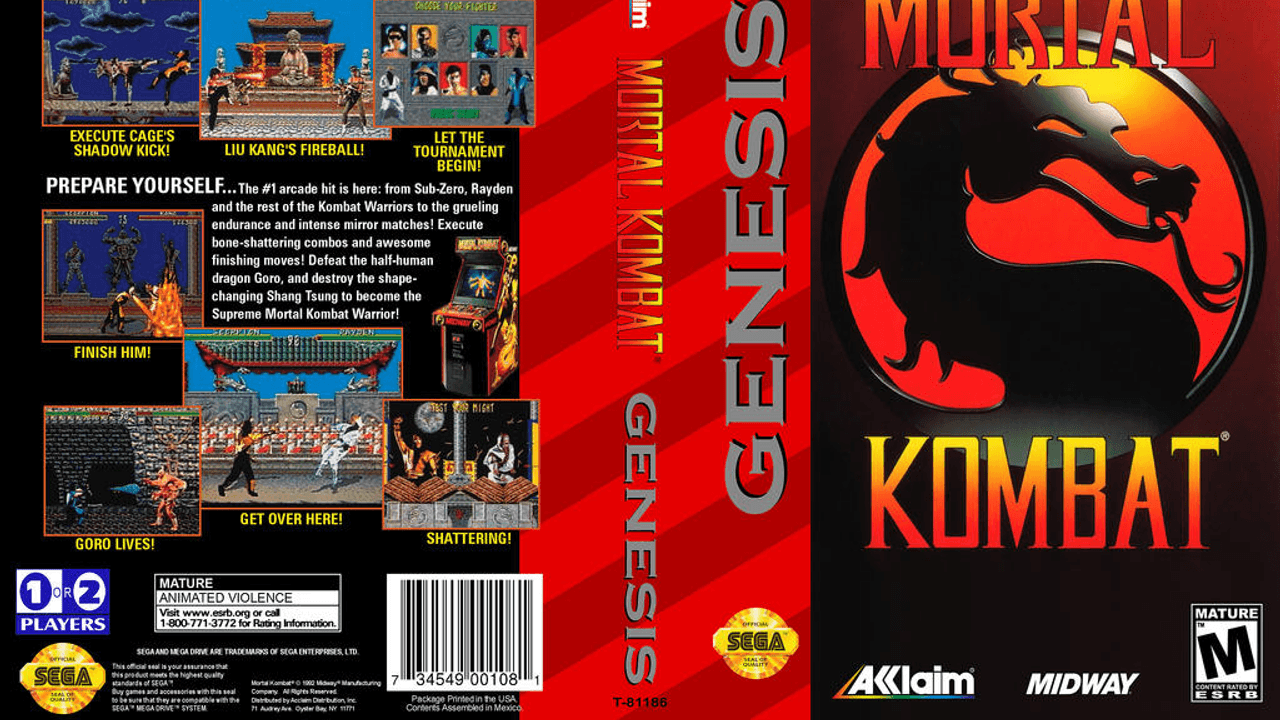
Image credit: Draft web reference from deviantart.com
A Cartridge That Started a Fire: Mortal Kombat on Sega Genesis
Mortal Kombat on Sega Genesis was more than a home conversion of a popular arcade fighter. It became a test case for what console games were allowed to look and feel like in the early ’90s, and it landed in the middle of a loud argument about violence, censorship, and whether the home version could possibly keep up with the arcade original.
That argument is the reason this version still matters. Not because it was the biggest or most complete fighting game on the system, but because it got pulled into a broader cultural fight the moment it reached living rooms. The Genesis cartridge was sold as an answer, a workaround, and for many players, a dare.
Mortal Kombat on Sega Genesis was a port with a reputation problem
The arcade version of Mortal Kombat arrived with a kind of instant myth. It had digitized fighters, sharp animation, and a violence level that made it feel different from the comic-book energy of most fighting games at the time. The Genesis port had to carry that reputation into a home market that was already nervous about what video games were becoming.
That tension shaped everything around the cartridge. Players did not approach it as just another fighter. They approached it as the version that had to prove something: that a home system could deliver the same shock, the same attitude, and enough of the arcade’s identity to justify its existence.
It helped that the Genesis had a reputation of its own. Sega was already cultivating a louder, older-kid image than Nintendo, and Mortal Kombat fit that branding almost suspiciously well. The port’s success was therefore never just about game quality. It was about alignment. The cartridge seemed to confirm a consumer belief that the Genesis was the machine for games parents would side-eye.
What the Genesis version changed
A good port is often remembered for what it keeps. This one is remembered just as much for what it trims, reworks, or disguises.
On Genesis, Mortal Kombat had to translate an arcade spectacle into cartridge constraints. That meant technical compromises, but also a strangely effective shift in tone. The home version did not simply reproduce the arcade cabinet; it reframed the whole experience for a living room, where the drama came less from quarters dropping into a machine and more from the fact that this controversial game was now sitting beside family-friendly software.
Some of the most famous differences were not subtle at all. The Genesis version became known for being adjusted to fit console standards and retailer expectations, and for living in the shadow of the Super Nintendo release, which was widely discussed for its sanitization. In practice, that meant players on Genesis often felt they were getting the bolder, less diluted edition, even when the port still made concessions of its own.
That perception mattered as much as the code.
The port’s practical tradeoffs
- Visual detail had to be simplified to fit cartridge hardware.
- Animation and presentation were necessarily less elaborate than the arcade original.
- Audio had a more compressed, home-system feel.
- The overall experience leaned harder on atmosphere and momentum than on perfect fidelity.
None of that made the game irrelevant. It made the port legible as a product of its moment. This was not the age of seamless console conversions. This was the age when a home version could become famous for how closely it seemed to flirt with the original’s edge.
Why censorship turned the game into a headline
The real reason Mortal Kombat on Sega Genesis became a cultural object is that it collided with a new level of public attention.
By the early ’90s, games were no longer invisible toys. They were becoming a media issue. Parents, journalists, and policymakers were starting to ask what kind of content was being sold in kids’ electronics aisles. Mortal Kombat was the perfect flashpoint because it was easy to describe in a single outraged sentence and impossible to ignore once you saw it.
The Genesis version sat at the center of that conversation because it was marketed, discussed, and passed around as the more uncompromising home release. In other words, the cartridge was not just a game; it was an argument with a start button.
That made the port culturally sticky in a way that more technically polished games rarely become. People who had never touched a fighting game knew the name. People who had no interest in frame data still had opinions about whether a home console should carry a game with fatalities. The outrage was part of the product’s identity.
And unlike a one-week controversy, this one had legs. It helped shape how the public understood the difference between arcade culture and console culture. The arcade had always been a little illicit, a little adolescent, a place for spectacle. The Genesis version brought that feeling into the house and dared the household to decide what to do with it.
The arcade reputation the cartridge had to live up to
If the censorship debate gave the Genesis port its headlines, the arcade original gave it its aura.
The arcade version of Mortal Kombat had an appeal that was both technical and social. It felt immediate, harsh, and performative. People gathered around it. They watched each other lose. They memorized finishers. They talked about the game before they necessarily understood the mechanics.
The Genesis cartridge had to bottle that energy without the cabinet, the crowd, or the coin-drop ritual. That is a harder job than it sounds. Arcade games often survive in memory because of the space around them, not just the code. The Genesis version had to make that room-sized drama happen on a television in a bedroom or den.
It did part of that job by leaning into intensity. The control scheme was direct enough for quick play, and the core loop was simple enough that a kid could hand the controller to a friend and start a feud in minutes. That made the home version socially durable. It was easy to bring out, easy to challenge with, and easy to make into a local legend.
What the cartridge could not reproduce was the arcade’s aura of public risk. What it could reproduce was the feeling that you were playing something adults had already decided to argue about.
Why the Genesis version stayed in the conversation
Some games are remembered because they are best-in-class. Mortal Kombat on Sega Genesis is remembered because it was strategically unavoidable.
It landed at the intersection of several early-’90s shifts:
- the rise of fighting games as a household genre,
- the growing visibility of console hardware rivalries,
- the beginning of mainstream concern over video game violence,
- and the realization that home ports could themselves become cultural statements.
That combination gave the Genesis cartridge a longer afterlife than a normal port. Even people who never played it know what it represented. It became shorthand for the era when game companies learned to sell attitude as much as gameplay.
It also helped define Sega’s public image. The company did not merely publish a version of Mortal Kombat; it benefited from the idea that its system was willing to carry the edge. Whether that edge was technically accurate, exaggerated, or mostly marketing theater almost did not matter. In the marketplace of early ’90s gaming, perception was part of the hardware battle.
How players actually experienced it at home
For a lot of players, the Genesis version of Mortal Kombat was not a cultural statement at first. It was the game you brought home because everyone was talking about it.
And once it was in the house, it had an interesting effect. Its notoriety often exceeded its complexity. Kids didn’t need to master every move to understand why it mattered. They only needed to see that it was harsher, noisier, and more controversial than the average cartridge. That was enough to make it feel like a forbidden upgrade.
At the same time, the port’s home setting changed how it was played. Arcade fighters are communal by design; home fighters become repeatable. You learn patterns, develop grudges, and rematch endlessly. That repetition softened the novelty while deepening the attachment. The game turned into a ritual.
That is one of the strangest things about Mortal Kombat on Sega Genesis. Its most famous quality was shock, but its real long-term value came from habit. It was the game people kept booting up after the initial fuss died down.
The cartridge-era lightning rod
Looking back, the Genesis version matters because it captures a moment when game culture was becoming self-aware.
The industry was learning that ports could be ideological. Console choices could signal values. Censorship could become a selling point. A fighting game could be more than a fighting game if enough people decided to project bigger anxieties onto it.
Mortal Kombat on Sega Genesis sat right at that fault line. It was a cartridge that made players choose sides, even when the gameplay question itself was simple. Did you want the version that felt more daring? The version that seemed closer to the arcade’s threat? The version that came with a reputation already attached?
That is why the port survives in memory so vividly. It was never only about blood, sprites, or finishers. It was about the moment a home console game became part of a national conversation about entertainment, morality, and where the line was supposed to be.
If you remember playing it, renting it, or arguing about it, I’d love to hear your take in the comments.