

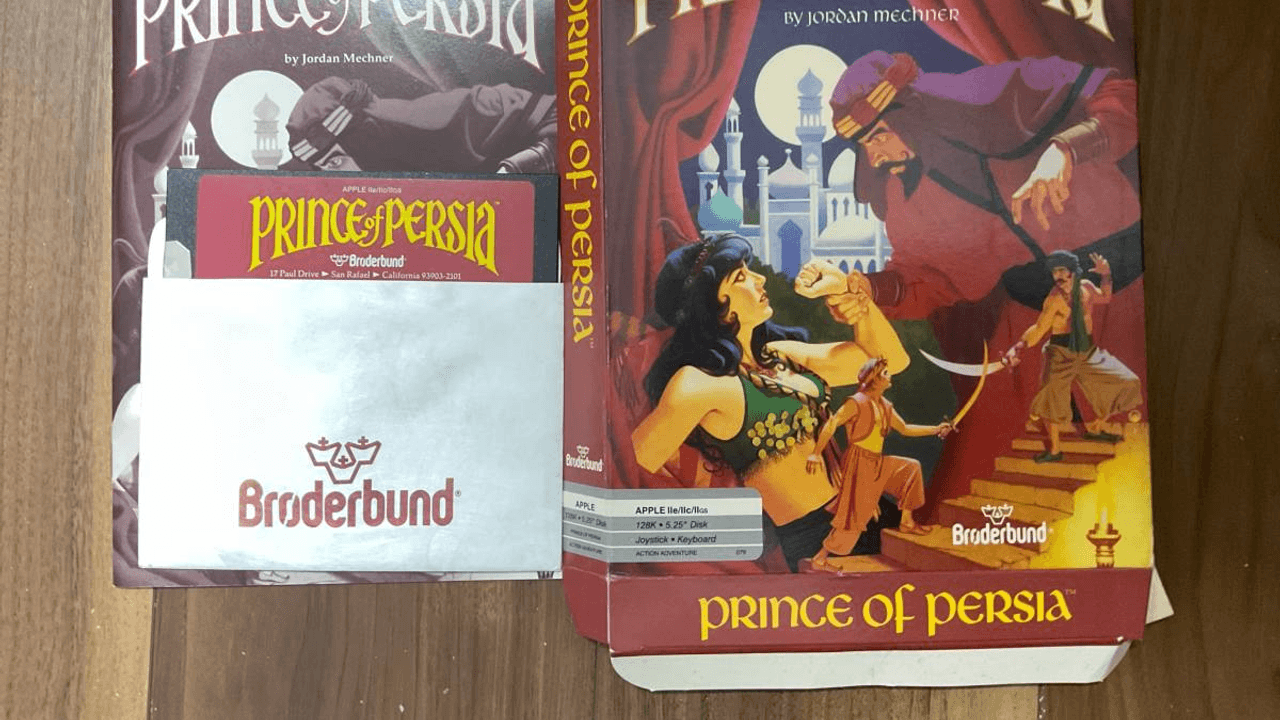
Image credit: Draft web reference from auctions.yahoo.co.jp
Sand, Spikes, and Timing: Prince of Persia on Apple II
Prince of Persia on Apple II is one of those games that feels less like a product of its era than a cleanly preserved idea. Released into the Apple II’s limited color and sound world, it somehow delivered animation that looked alive, movement that felt weighty, and traps that punished hesitation with almost mean precision. It was a tiny side-scroller, but it carried itself like something cinematic.
What makes it linger is not just that it looked different. It moved differently. Every step, jump, ledge grab, and sword advance had to be considered, and the game turned that caution into style. Long before “cinematic platformer” became a familiar phrase, Prince of Persia on Apple II was building the grammar.
Prince of Persia on Apple II and the strange magic of motion
The first thing most people remember is the animation. The lead character does not merely flip or run; he bends, plants, catches, recovers, and stumbles with a physical logic that was rare at the time. That sense of bodily weight comes from rotoscoping, a process that gave the movements a human rhythm instead of the stiff snap typical of early action games.
On the Apple II, that mattered more than spectacle. The machine was not throwing around detailed backgrounds or flashy effects. The game’s power came from convincing the player that the avatar occupied real space. A jump was not a button press that instantly teleported you to safety. It was a commitment. You had to account for run-up distance, ledge height, landing recovery, and the danger of doing everything at exactly the wrong moment.
That alone made the game feel ahead of its time. It understood that action could be expressive without being loose. The animation was not decoration; it was a rules system.
Movement as a set of promises
The game teaches you its logic through repetition, but it never really relaxes its standards. The controls are deliberately narrow, and that narrowness is the point. You are always negotiating with the space around you:
- A short hop can save you or ruin you.
- A badly timed step can drop you into a spike bed.
- A hesitation at a ledge can be fatal.
- Even victory in a duel feels conditional, not guaranteed.
That precision gives the game an almost theatrical tension. You are not simply “playing a level.” You are managing a body in a hazardous environment where every gesture has weight.
The Apple II version’s identity is in its limits
Part of the game’s weird-history appeal is that the Apple II version never feels like a compromise in the cheap sense. It feels like a design distilled by constraint. The visuals are spare, but that sparseness sharpens the reading of each room. You do not need ornate art when the corridor itself is a threat.
The game’s structure also benefits from the machine it landed on. The screen is clean enough that hazards stand out immediately, but not so busy that the player can ignore them. If a floor plate looks suspicious, it probably is. If a gap seems only slightly too wide, that slightness matters. The Apple II’s austerity turns the entire game into a kind of trap language.
That language is crucial. Prince of Persia on Apple II does not overwhelm you with enemies. It lets the architecture do the work. Doors, pressure plates, spike pits, falling floors, and timed gates create a space where the level itself feels like the antagonist.
Trap timing is the real engine of the game
It is easy to talk about the game as a platformer, but that undersells it. The real core is timing. The best rooms are not about speed in the modern twitch sense; they are about reading a sequence and entering it at the correct beat.
There is a particular kind of dread the game produces when you know what to do but not exactly when to do it. A blade cycles. A gate rises and falls. A floor panel seems safe until it isn’t. You watch, wait, commit, and discover whether you understood the rhythm correctly.
That is why the game feels so different from many of its contemporaries. It is not handing out constant empowerment. It is asking for calm. The player who rushes gets punished, but the player who treats every room like a timed mechanism begins to feel the game open up.
Why the rotoscoped movement still matters
The animation has aged in a way that is interesting rather than merely quaint. It doesn’t survive because it is technically perfect by today’s standards. It survives because it gives the game a specific physical vocabulary. You can read intent from the body.
When the prince prepares to leap, you see the preparation. When he reaches for a ledge, the motion sells the risk. When he fights, the back-and-forth of the duel feels like two people occupying the same space, not just two hit boxes trading numbers. That matters because the game asks you to trust animation as information.
Modern action-platformers do this all the time, but the game helped prove the point early: if movement looks convincing, players are more willing to accept demanding controls and harsh outcomes. The animation makes failure legible, which in turn makes mastery satisfying.
The combat is simple, but not casual
The sword fights are easy to underestimate. They are not about deep move lists or long combo strings. Instead, they ask for positioning, patience, and timing. The blade work fits the rest of the game’s design: the smartest thing you can do is often not to rush.
That creates an unusual tone. The game is full of urgency, but it rewards restraint. Even the pace of combat feels like a negotiation instead of a brawl. It is another example of how Prince of Persia on Apple II builds drama from exactness rather than scale.
There is a reason the encounters feel memorable despite their simplicity. They are placed in a world already humming with risk, so each fight becomes one more timed obstacle in a chain of timed obstacles.
A template for action-platformers that came after
It is hard to overstate how much this game helped formalize a certain kind of platforming experience. Not every later action-platformer borrowed its exact mechanics, but many borrowed its assumptions:
- Animation should communicate timing.
- Movement should feel physical.
- Levels should be built as hazards, not just scenery.
- Precision can be more interesting than speed.
- Tension can come from anticipation as much as from action.
That is the quiet legacy of the game. It helped establish that platforming could be about choreography. You were not just surviving screens; you were learning a rhythm.
Even now, that design still feels unusually clear. A modern player may notice the harsh checkpoints, the unforgiving windows, the deliberate pace. But those same qualities are why it remains so readable. It knows what kind of game it is.
Why it still feels ahead of its time
Some retro games feel historic in a museum way: important, but obviously bound to their hardware and era. Prince of Persia on Apple II is different. It still feels like a prototype for a future that took a while to arrive.
That’s partly because its ideas were so clean. The game is not bloated with systems that distract from its central loop. It has a strong identity: move carefully, watch the world, respect the timing, and learn the body on the screen. Once you understand that, the whole thing clicks.
It also has a kind of elegance that’s rare in early action games. The challenge is severe, but it is not random. When you die, you usually know why. That transparency makes the game feel modern in a way few Apple II releases do.
The result is a small masterpiece of precision. Not loud, not sprawling, just sharp. In a medium often remembered for speed and spectacle, this one found power in patience.
The lasting appeal of a tiny cinematic platformer
What keeps people coming back is the feeling that the game is always asking for one more perfectly judged move. It never stops being tense, but it also never becomes chaotic. That balance is the whole trick.
The Apple II version may be technologically modest, yet its design ambition is enormous. It made animation meaningful, turned traps into a language, and treated every step like a decision. That is a lot for a small side-scroller to accomplish, and it is why the game still gets cited whenever people talk about animation-driven action or precision platforming.
If you return to Prince of Persia on Apple II today, you are not just looking at an old game that was good for its time. You are looking at an early statement of what action games could feel like when movement, timing, and danger all speak the same language.
And that’s the kind of weird historical artifact that never quite stops being exciting.
What do you remember most about it—the animation, the traps, or the brutal timing? Share your take in the comments.