

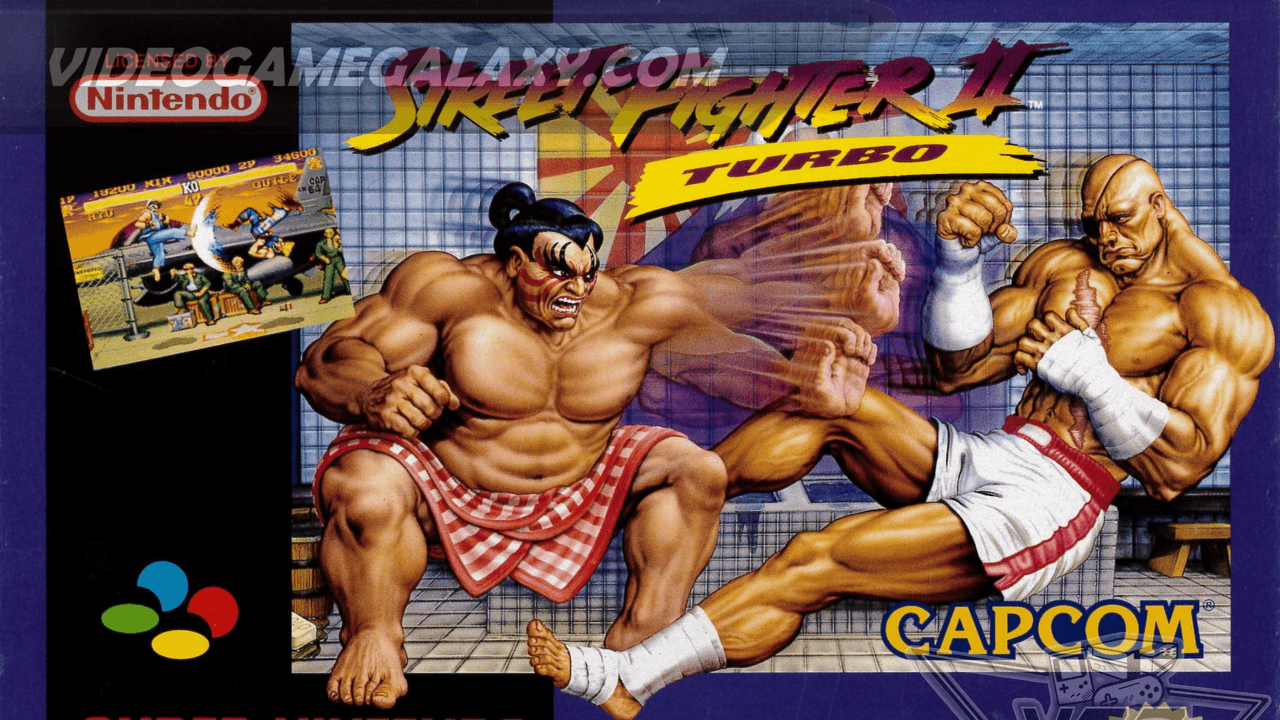
Image credit: Draft web reference from videogamegalaxy.com
Why Street Fighter II Turbo on Super Nintendo Still Feels Sharp
When people talk about Street Fighter II Turbo on Super Nintendo, they usually start with speed. That makes sense, but speed alone does not explain why this version lasted. Plenty of fighting games get faster. Very few stay readable, responsive, and fair enough that players keep coming back to test themselves years later. The SNES port did something more useful than simply shrinking an arcade hit for the living room: it preserved the game’s competitive skeleton and gave it a control feel that made repeat play feel natural.
That is the real reason this cartridge mattered. It was not just a convenient way to play Street Fighter II at home. It was a version that respected timing, rewarded clean inputs, and made the gap between beginner and expert feel legible. Even now, it reads like a sharp fighter rather than a museum piece.
Street Fighter II Turbo on Super Nintendo and the feel of control
The strongest argument for the Super Nintendo version is not a feature list. It is the way your hands respond to what you see on screen.
Fighting games live or die by a simple promise: when you press a button, the game should feel like it understood your intention. The SNES version of Street Fighter II Turbo on Super Nintendo delivers that promise with remarkable clarity for a home port of its era. Moves come out with enough immediacy that you can start thinking in spacing, timing, and punishment instead of fighting the controller itself.
That matters because the game asks for precision in tiny windows. A missed dragon punch motion, a late jump-in anti-air, or a sloppy throw attempt does not just cost a round; it teaches you to tighten your execution. The cartridge’s value lies in that learning loop. You can feel yourself improving in real time, not because the game is easy, but because it is honest.
Why responsiveness changes everything
A lot of older games are remembered as difficult when what they were really doing was obscuring intention. This one is different. Its inputs are demanding, but not slippery. That distinction is why the SNES port still feels usable for competitive-minded players.
- Button presses land with a satisfying sense of cause and effect.
- Motion commands feel consistent enough to build muscle memory.
- Defensive play remains active, not passive.
- Character movement is quick enough to reward position without making the screen unreadable.
That is a deceptively important achievement. Once a fighting game feels trustworthy, every other system becomes more interesting.
Speed as design, not just spectacle
The “Turbo” part of the title is not cosmetic. The increased pace transforms the match flow in a way that is easy to underestimate if you only remember the game as a landmark sequel-era fighter.
At the right speed, the game becomes more than a series of special moves. Neutral play sharpens. Fireball spacing matters more. Anti-airs become more urgent. Jump timing turns into a real threat rather than a loose suggestion. The faster tempo does not erase strategy; it exposes it.
That is why Street Fighter II Turbo on Super Nintendo remains compelling. It is quick, but not chaotic. It creates momentum without drowning the player in noise. You can still read what is happening from the first few seconds of a round, which is crucial for a competitive game. The best speed in a fighter is not “fast” in the abstract. It is fast enough to force decisions.
Fast enough to matter, slow enough to read
The balance here is what makes the game age better than many peers. Some old fighters feel slow by modern standards but are still strategically rich. Others are brisk but visually muddled. This one lands in the sweet spot.
Because the action is quick but legible, every exchange feels intentional:
- A jump has risk, not just momentum.
- A missed special can be punished before it disappears into animation haze.
- Pressure strings are readable instead of mushy.
- The pace gives rounds a real heartbeat.
That clarity is part of why the game never stops feeling like a contest rather than a nostalgia exercise.
Character balance gives the game its lasting shape
Balance in a fighting game is never perfect, and Street Fighter II Turbo on Super Nintendo is no exception. But its overall roster structure is one of the reasons it endured. Characters feel distinct without turning every match into a gimmick.
What stands out, even now, is how many fighters in the game ask for fundamentally different skills while still operating under the same basic rules. Some excel at space control. Some thrive on rushdown. Others reward careful reads and patient punishment. The game’s competitive identity comes from that friction.
It is not just that the roster has variety. It is that the matchups create meaning. You are not only choosing a favorite character; you are choosing how you want to think through a fight.
A roster that teaches matchup thinking
A good competitive game does not hand out equal tools in an identical package. It gives each character a shape. The SNES version’s roster still works because those shapes are clear.
- Long-range specialists force you to respect distance.
- Charging characters make you track movement and commitment.
- Faster close-range characters test your defense and reaction speed.
- Heavy hitters reward patience and punishing mistakes.
That kind of structure is one of the reasons the game became a staple for local play. Players could disagree on who was strongest, but they could always understand why a matchup felt the way it did. That is competitive design at its most durable.
Accessibility without flattening the game
One of the smartest things about the Super Nintendo version is that it did not try to turn a complex fighter into a simplified one. Instead, it lowered the barrier to entry while keeping the ceiling intact.
This is a hard balance to strike. If a fighting game is too technical, casual players bounce off it before they can appreciate the systems. If it is too forgiving, it loses the tension that makes mastery satisfying. Street Fighter II Turbo on Super Nintendo sits in the middle. A new player can pick it up, understand the goal, and enjoy basic matches almost immediately. But the more you play, the more layers appear.
That accessibility helped it thrive in homes, dorms, and rental cycles. It was the kind of game people could learn from each other, not just from manuals or arcades. You watched a friend punish your predictable jump. You copied that. Then you learned to bait the punishment. That social learning loop is one reason the game stuck around.
Easy to start, hard to exhaust
The game’s longevity comes from how little it wastes your time.
- Matches begin quickly.
- The rules are easy to grasp.
- Each character reveals strengths almost immediately.
- Improvement is visible after only a few sessions.
That combination is why it still feels so clean. The game respects the player’s curiosity. It gives enough on the first pass to be fun, then keeps paying off when you look deeper.
Why the SNES port still reads as competitive
Ports of arcade fighters often age in one of two ways: they become beloved artifacts, or they get treated as diluted versions of something better. Street Fighter II Turbo on Super Nintendo avoids that fate because it is still legible as a serious fighting game.
A competitive game has to do three things well:
- Make its rules understandable.
- Make its inputs reliable.
- Make its outcomes feel earned.
This port succeeds on all three counts. It is not simply that the game is fun. It is that it creates a space where outcomes feel tied to decision-making and execution. When you win, you usually know why. When you lose, the lesson is clear enough to take back into the next match.
That is the quality that keeps older fighters alive in the public imagination. Not just nostalgia, but usability.
The home version that became the standard
The reason this specific Super Nintendo release remains influential is that it changed expectations for home fighting games. It showed that a console version could be more than a compromise. It could be dependable, fast, and serious enough to hold up in repeated head-to-head sessions.
That was a meaningful shift. It helped establish the idea that home players deserved a version tuned for actual play, not just passive ownership. The best retro games do not merely survive because people remember them fondly. They survive because their design still performs its job. Street Fighter II Turbo on Super Nintendo still performs.
Even today, it feels like a game built around clean decisions: when to move, when to strike, when to defend, when to wait. That is why it has never fully faded into “important history” mode. It is still an active fighter.
The verdict
Seen from a distance, it is easy to call this release a classic because it mattered. That is true, but incomplete. Its real achievement is that it remained good in the ways that matter most for fighting games: it responds quickly, it reads clearly, and it keeps competition interesting without becoming unapproachable.
That is a rare combination, and it explains why the Super Nintendo version stayed influential long after the hardware generation passed. It was not just a good port. It was a home version that knew exactly what made the original worth competing in.
If you played Street Fighter II Turbo on Super Nintendo, I’d love to hear how it holds up for you today—share your favorite character, matchup, or memory in the comments.