
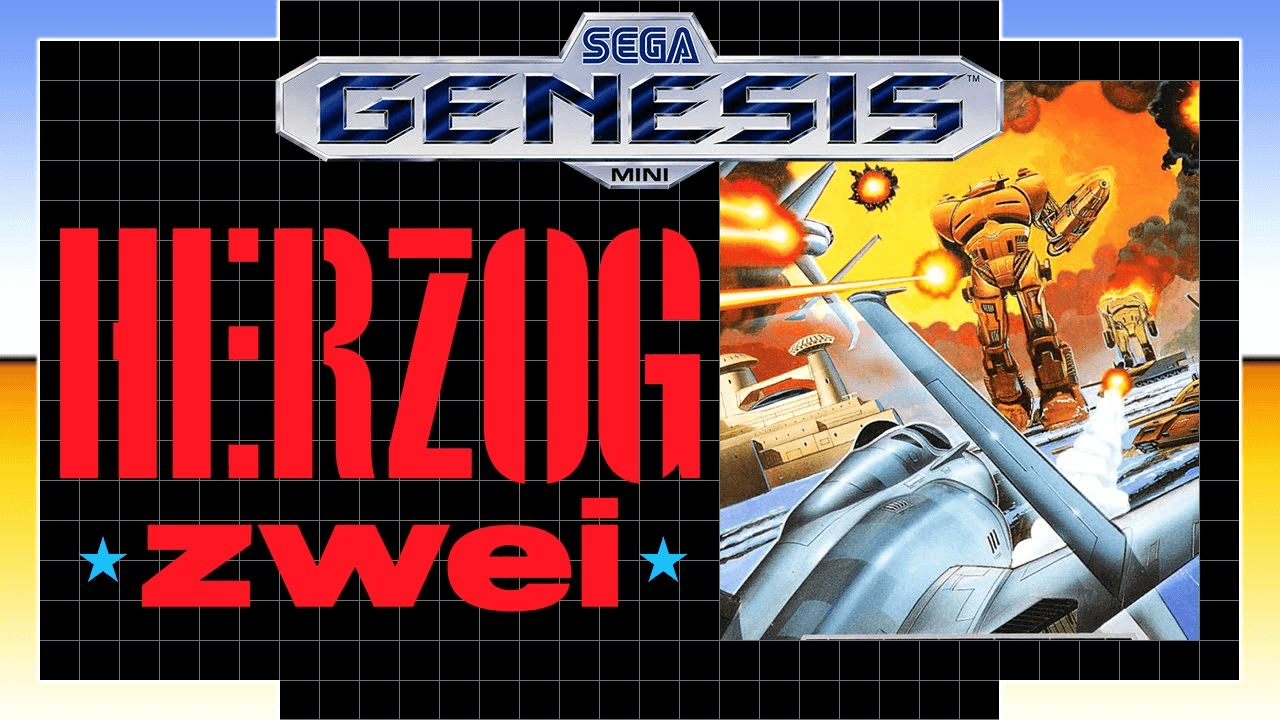
Image credit: Draft web reference from youtube.com
Why Herzog Zwei on Sega Genesis Still Feels Like a Blueprint
Some games are important because they were first. Others matter because they solved a problem so cleanly that later design still echoes it. Herzog Zwei on Sega Genesis belongs to the second group. It is a strange, brilliant hybrid: part action game, part real-time strategy, part battlefield management puzzle. The result is not just a curiosity from the 16-bit era. It is a compact design lesson in how movement, direct control, and pressure can be woven into one loop without collapsing under its own ambition.
What makes Herzog Zwei so fascinating now is that it does not ask you to sit above the action and manage a war from a safe distance. It puts you inside the machine, makes you pilot the mech yourself, and forces every tactical decision to happen at the speed of combat. That one choice changes everything.
The game starts with movement, not menus
A lot of strategy games begin with information: maps, resources, interfaces, unit lists. Herzog Zwei begins with motion. You are always in the machine, and the machine always has to be driven somewhere. That sounds simple, but it shapes the whole experience.
The mech is not just your avatar. It is your transport, your delivery system, your battlefield authority, and your time limit all at once. You cannot think in abstract turns or frozen planning states. You have to consider where the mech is now, where it needs to be next, and whether you can afford to leave your position to do something more important.
That gives the game a very specific rhythm:
- move to a frontline position
- deploy a unit
- return to your mech before the enemy pressure shifts
- react to an opening somewhere else on the map
Because the game is so invested in momentum, every decision has a physical cost. If you spend too long managing one front, the rest of the battlefield starts to slip away from you. If you race around too recklessly, you may be tactically active but strategically empty-handed.
Herzog Zwei on Sega Genesis turns the mech into a strategy interface
The key idea in Herzog Zwei on Sega Genesis is that direct control is not separate from strategy. It is the strategy.
Your mech does not just fight. It also acts like a mobile command post. You travel to bases, spawn units, and push pressure across lanes of the map. That means the game’s tactical layer is never detached from the action layer. There is no moment where you stop being a player of movement and become a player of menus. The two are fused.
That fusion is what makes the game feel so modern, even when its controls and presentation feel unmistakably retro. Many later strategy action games would borrow the same basic tension: you are both commander and operator, and the real challenge is switching mental gears without losing tempo.
Herzog Zwei makes that switch constant. You are not toggling modes. You are living in the overlap.
Unit deployment is fast, but never free
The smartest thing about the game’s unit system is that it keeps deployment quick while preserving consequence. You do not spend ten minutes setting up a perfect build order. You make a decision, launch a unit, and immediately have to live with the outcome.
That creates a battlefield that feels active rather than bureaucratic. Units are not inventory items. They are commitments.
A good deployment does several things at once:
- it occupies space
- it draws enemy attention
- it buys time for your next move
- it opens routes for your mech to exploit
A bad deployment, by contrast, does not just “fail.” It can create a chain reaction of wasted movement, exposed bases, and lost momentum. That is why the game feels so demanding. It understands that strategy becomes meaningful when it has timing attached to it.
This is also why the game remains easy to admire even if you are not immediately good at it. You can read the logic of the design almost instantly. The battlefield is a conversation between pressure and response.
The battlefield flow is the real star
If the mech is the game’s body and the units are its verbs, then the map is its heartbeat. Herzog Zwei on Sega Genesis is built around flow. It does not want static fronts. It wants contested routes, shifting control points, and the feeling that the war is always moving somewhere else.
That matters because the map is not treated like a passive arena. It behaves like a system.
You are encouraged to ask questions such as:
- Which base is vulnerable right now?
- Can I reach it before the enemy reinforces?
- Should I defend what I already own or push for a new opening?
- Is this the moment to commit my mech, or should I keep it mobile?
The best strategy games make location feel dramatic. Herzog Zwei does that by making relocation part of the core loop. Crossing the battlefield is never downtime. It is decision time.
That is one reason the game still feels like a precursor. Later action-strategy hybrids would lean heavily on the idea that the map itself is a dynamic resource. You are not only fighting on it; you are constantly redrawing it.
Why the tempo feels ahead of its time
A lot of older games look primitive until you understand their pace. Herzog Zwei is the opposite. It may look sparer than later entries in the genre space it helped define, but its pace feels remarkably tuned.
The game does not let you settle into a safe pattern. Even when you are winning, you are encouraged to keep moving. That means success never becomes static. You are always trying to convert one advantage into another.
This is the big lesson the game seems to offer: momentum is not just for action games. Strategy can live inside momentum too.
That idea gives Herzog Zwei a distinctive personality. It is not about patiently building a perfect empire. It is about making smart moves quickly enough that the battlefield never gets a chance to freeze around you.
In that sense, the game is less about commanding an army and more about conducting a series of tactical sprints. You are always a few seconds away from either stabilizing the map or losing control of it.
The controls matter because the decisions matter
One reason Herzog Zwei on Sega Genesis has endured in discussion is that its controls are part of the message. The game asks you to handle movement, targeting, deployment, and combat in a compact space. That compactness creates tension. You are never buried under complexity, but you are never relaxed either.
This is a delicate balance. A game like this could easily have become frustrating if its input system were muddy. Instead, the pressure feels intentional. You can usually tell what the game wants from you, even when you are too slow to deliver it.
That clarity is a big part of why the game feels like a prototype for later hybrids. A design can be ambitious on paper, but if the player cannot understand the relationship between action and strategy, the whole thing falls apart. Herzog Zwei keeps those relationships legible.
It does not try to impress you with size. It impresses you with structure.
What later games inherited from it
It is tempting to say a game like this was simply “ahead of its time,” but that phrase can be vague. The better way to describe Herzog Zwei is to say that it established a useful template:
- direct control matters as much as unit management
- movement is part of strategic planning
- the battlefield should keep changing under pressure
- a good hybrid game should make every second count
Those ideas show up everywhere once you start looking. You can see them in action-strategy experiments, in mech games that treat positioning as everything, and in real-time systems that want the player to feel both powerful and stretched thin.
The reason those later games work is not because they copied Herzog Zwei point for point. It is because they absorbed its central insight: strategy gets more exciting when the commander is also physically vulnerable and constantly in motion.
It is still compelling because it refuses to separate roles
The most striking thing about Herzog Zwei on Sega Genesis is how stubbornly unified it is. So many games split their systems into separate experiences: one for action, one for planning, one for logistics. This one refuses that split.
You fight by moving.
You plan by moving.
You defend by moving.
Even your mistakes tend to happen at the speed of movement.
That design makes the game feel lean and surprisingly elegant. It is not polished in the modern sense, but it is coherent in a way many bigger games are not. Every part of the loop reinforces the same idea: control is only meaningful if you can apply it quickly enough to matter.
That is why the game keeps its fascination. Not because it is obscure, and not because it was first to invent every idea it touches. It sticks around because it understands how to make strategy feel immediate.
A blueprint disguised as a curiosity
If you approach Herzog Zwei expecting a rough historical artifact, you may miss how carefully it is built. It is not just an odd blend of genres. It is a compact blueprint for a kind of game design that would become much more common later: action, strategy, and battlefield flow working as one system.
That is what makes it worth revisiting now. Its ideas are clear, its pressure is constant, and its sense of momentum still holds up. You can feel the shape of later strategy action games inside it, even when the details are very much of their era.
And that may be the highest compliment a design-forward retro game can earn: not merely that it was interesting once, but that it still helps explain how other games learned to move.
If you have your own memories of Herzog Zwei on Sega Genesis, or a favorite action-strategy game that carries its influence, share your thoughts in the comments.