
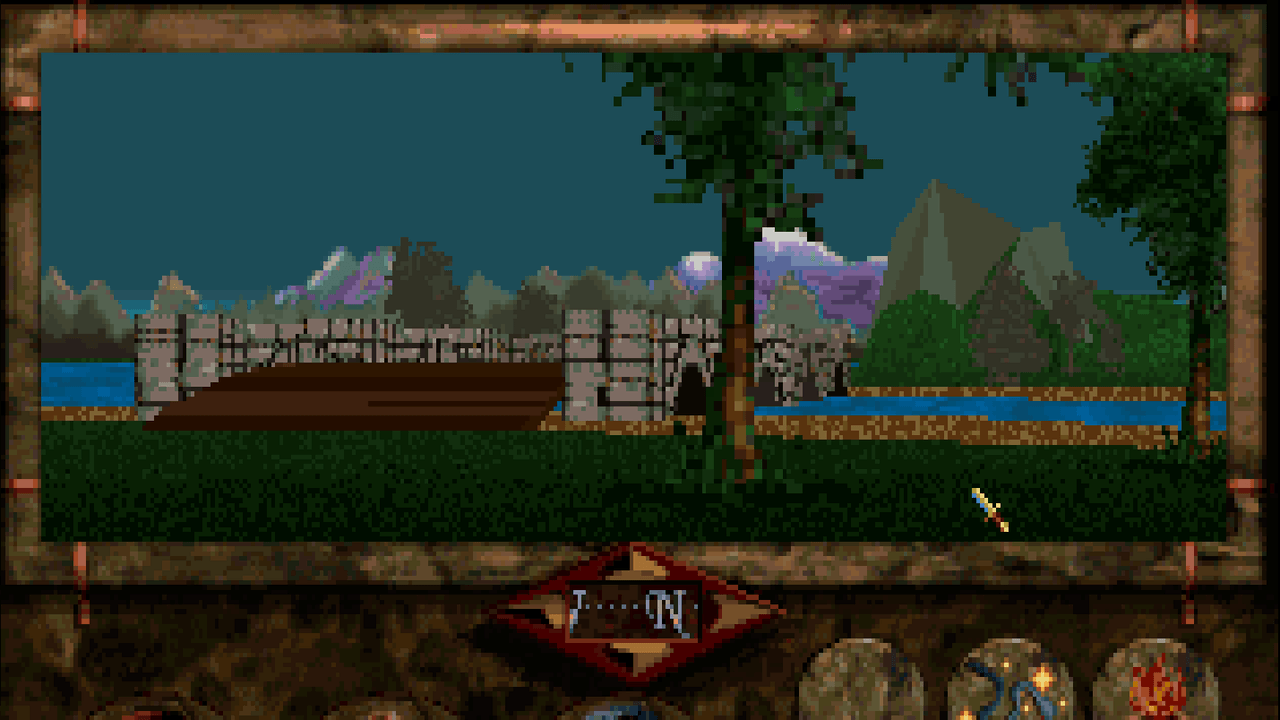
Image credit: Draft web reference from waltoriouswritesaboutgames.com
Chapter Breaks and Quiet Tension: Betrayal at Krondor on PC
Betrayal at Krondor on PC is one of those old PC RPGs that feels like it was assembled by someone who cared just as much about pacing as about spells, swords, and statistics. Plenty of role-playing games from the early 1990s wanted to be epic. Betrayal at Krondor wanted to read like a book that happened to contain combat, exploration, and a few hard decisions along the way.
That is what makes it such a strange artifact now. It does not simply tell a fantasy story and then interrupt it with battle. It uses its chapter structure and encounter rhythm to control how the story lands. Scenes breathe. Conversations linger. A stretch of travel can feel like a setup for the next reveal, and then combat arrives almost like punctuation rather than the main sentence.
That design is not flashy, but it is unusually deliberate. Even by the standards of retro PC RPGs, Betrayal at Krondor on PC stands apart because it treats progression as a literary device, not just a map of dungeons to clear.
Betrayal at Krondor on PC and the feel of a game that reads like fiction
The first thing you notice is how much of the game is built around context. In a lot of RPGs, the fantasy world is there to support the systems. Here, the systems often feel like they were built to support the world.
Characters do not just hand over quests in the blunt, transactional way that many games of the era used. They talk. They explain themselves. They gossip, argue, reveal motives, and occasionally waste your time in a way that actually makes the world feel inhabited. You are not simply collecting objectives; you are moving through a setting that behaves like a place with memory.
That matters because the game’s fiction is always doing work. The major beats do not arrive as isolated checkboxes. They are threaded through dialogue, travel, and small shifts in tone. The result is a RPG that often feels closer to serialized fantasy than to a conventional dungeon crawl.
This is also why the game can feel oddly modern in one respect and stubbornly old-school in another. It is generous with story, but it still expects you to pay attention. It does not constantly highlight the critical path or explain the emotional stakes in neon. Instead, it trusts the chapter pacing to do part of that job.
Why the chapter structure matters so much
The chapter format is the key to the whole experience.
A lot of RPGs unfold as a long, continuous sprawl. Betrayal at Krondor breaks itself into cleaner dramatic units, and that gives each segment a distinct texture. One chapter might be heavy on investigation and dialogue. Another might push travel and tension. Another may finally open up into a more dangerous run of battles.
That rhythm does a few useful things:
- It gives the story a sense of movement without needing nonstop escalation.
- It makes the game easier to remember in scenes rather than in grinding stretches.
- It lets combat feel like a consequence of story progression instead of a default state.
- It creates natural pauses, which help the game avoid fatigue even when the maps are slow.
The chapter breaks also make the game’s ambitions more visible. You can feel the designers trying to preserve a novel’s cadence inside an RPG structure. Instead of asking, “How do we keep the player busy?” the game often seems to ask, “What should this part of the story feel like?” That is a rarer design question than it sounds like.
Encounter pacing as punctuation, not wallpaper
The combat in Betrayal at Krondor on PC is turn-based, but what makes it unusual is not just the rules. It is the spacing.
Battles are not stacked so densely that they drown out the narrative. Nor are they so rare that the game feels like a pure story engine with occasional token fights. Instead, combat arrives at a pace that supports the fiction. It can heighten a scene, break a conversation open, or force the player to reframe the journey they thought they were on.
That matters because turn-based combat can easily become background noise in a long RPG. Here, it still feels like an event. You notice when the game shifts modes. Exploration gives way to a tactical problem. Dialogue gives way to danger. Then, after the encounter, the story resumes with a different temperature.
The pacing gives the battles a kind of narrative weight that many contemporaries did not attempt. Some games used combat as a constant treadmill. Others used story as a wrapper around mechanics. Betrayal at Krondor does both, but it also understands timing. A well-placed fight can make the prior conversation feel sharper, and the calm after it can make the next chapter feel earned.
A conversation-heavy RPG that trusts the player to listen
One reason the game still stands out is that it is comfortable with conversation.
Modern players sometimes describe older RPGs as text-heavy, but that phrase can flatten the real experience. In Betrayal at Krondor, dialogue is not just exposition. It is structure. It establishes tone, signals priorities, and gives the world a texture that combat alone could never provide.
This is a game where the social side of the adventure matters enough to shape the memory of the whole thing. Who said what, where the mood changed, which exchange hinted at trouble later on — those details linger because the game builds around them. It does not rush the player through every scene in the name of efficiency.
That slower conversational rhythm also helps the setting feel lived-in. The writing has room to dwell on local concerns, political friction, and the small irritations that make a fantasy kingdom feel less like a backdrop and more like a system of people with competing interests.
If you are used to RPGs that treat dialogue as a bridge between fights, Betrayal at Krondor can feel almost backward. The dialogue is part of the terrain.
Exploration that serves the story instead of replacing it
The exploration in Betrayal at Krondor on PC is not especially interested in spectacle. It is practical, measured, and often constrained by the needs of the narrative. That restraint is part of the appeal.
You are not roaming a world designed to be admired from every angle. You are moving through locations that feel selected for dramatic function. A road, a town, a wilderness stretch, a guarded route — these spaces are shaped by the chapter they belong to.
That can make the game feel narrow if you come looking for open-ended wandering. But if you care about how a game organizes attention, it is fascinating. The world is not there to overwhelm you with size. It is there to arrange encounters, discoveries, and conversations in a way that keeps the story readable.
In other words, the game does not use exploration to advertise freedom. It uses exploration to control tempo.
Why it still feels unusual compared with other RPGs of its era
A lot of classic PC RPGs from the same broad period are remembered for systems: character builds, party management, combat depth, loot, maps, and numbers. Betrayal at Krondor is not absent those things, but they are not the main memory.
What lingers is the sense of shape.
The game is unusual because it is willing to be episodic without feeling fragmented. It is willing to be talky without becoming inert. It is willing to space out its battles so that they feel meaningful rather than constant. That combination gives it a tone that is easy to recognize even if you have not played it in years.
This is also why it can feel like a strange offshoot of RPG history. It is clearly of its time: text-forward, turn-based, built around a computer interface that expects patience. But it is also unusually disciplined about narrative rhythm. Instead of sprawling in every direction, it keeps returning to the same central idea: story is not just what happens. Story is also when it happens.
That is a big reason Betrayal at Krondor on PC has lasted as a reference point for players who like RPGs that feel authored rather than assembled.
What makes the game memorable now
If you return to Betrayal at Krondor today, the first thing you may notice is not combat complexity or technical ambition. It is the cadence.
The game knows when to pause.
It knows when to advance.
It knows when to let a conversation breathe.
It knows when a battle should hit like a chapter-ending exclamation point.
That control gives it a distinctive identity. Even if some of its mechanics now feel dated, the overall experience still communicates a strong point of view. It is a fantasy RPG that behaves like an episodic novel and a tactical adventure at the same time, and it rarely compromises that identity for the sake of easy momentum.
That’s why it remains interesting: not because it invented every part of the formula, but because it arranged familiar parts in an uncommon order.
The bottom line
Betrayal at Krondor on PC is not memorable simply because it is old, or because it has dialogue, or because it contains turn-based combat. It is memorable because it understands pacing as design. Its chapter structure, conversation-first scenes, and carefully spaced encounters create a rhythm that still feels unusual among retro RPGs.
In a genre often defined by accumulation, it stands out for composition.
If you have played it before, or if you have thoughts on other story-forward RPGs that get pacing right, share your take in the comments.