
A Clean Break at the Wall: Game of Thrones S1E3 “Lord Snow” Episode Guide
Game of Thrones S1E3 “Lord Snow” episode guide readers get the first real sense that this series is not just about who sits on a throne. It is about training, power, survival, and the cost of being dropped into a world that does not care who your father is. “Lord Snow” slows the story down just enough to make the series’ larger machine click into place: Jon is humbled at the Wall, Daenerys starts understanding command, Tyrion sees the shape of the game, and the North begins to feel colder, harsher, and more dangerous by the minute.
This is one of the season’s most important setup episodes. The battles are still ahead, but the rules of the world are already being written.
Quick recap of “Lord Snow”
The episode opens in the aftermath of Ned Stark’s arrival in King’s Landing and Jon Snow’s first days at Castle Black. Across the map, the show keeps splitting the Stark family, the Lannisters, and Daenerys Targaryen into separate pressure points, each one revealing a different kind of power.
At the Wall, Jon’s expectations of heroism run straight into routine, hierarchy, and disdain. He learns that being a Stark-blooded bastard means little when the Watch is full of men who resent him on sight. In King’s Landing, Tyrion continues to play the role of observer, soaking in the politics while testing the loyalties and habits of everyone around him. Daenerys, meanwhile, starts moving from passive bride to active ruler, quietly discovering that dragons are not the only source of strength in her story.
The title, “Lord Snow,” lands as both insult and identity. Jon is reduced to a joke by the Watch, but the episode uses that slight to strip him down and begin rebuilding him into someone sharper, more disciplined, and less entitled.
Jon Snow learns what the Wall really is
Jon’s storyline is the heart of the episode, and it works because it refuses to romanticize the Night’s Watch. He arrives with the naïve certainty of someone who thinks skill and noble birth should earn respect. Instead, he gets mockery, dirty work, and a blunt education from Tyrion Lannister, who understands the Wall better than almost anyone else in the episode.
The first lesson: lineage means less than experience
Jon expects a cold welcome, but not this degree of open contempt. The men of the Watch call him “Lord Snow,” turning his bastard name into a public bruise. It is more than teasing. It is a reminder that the Wall strips away courtly fantasy and exposes the raw social mechanics underneath.
Jon’s frustration is easy to understand. He has spent his life being treated as lesser in Winterfell, and now he is in a place where rank still matters, but not in the ways he understands. At the Wall, the hierarchy is based on toughness, age, cynicism, and survival. Jon can swing a sword, but so can a hundred other men. What he does not yet have is perspective.
Tyrion’s counsel is the episode’s sharpest politics
Tyrion’s conversation with Jon is one of the most useful scenes in the early series. He does not flatter him. He does not tell him he is special. He tells him the ugly truth: the world already hates him, so he should use that as leverage instead of a wound.
Tyrion’s advice is crucial for the larger series because it articulates a central Game of Thrones idea: power often comes from how well you understand the hostility around you. Tyrion survives by reading people, not by outmuscling them. Jon is still trying to prove his worth. Tyrion is already teaching him how to survive the insult.
The scene also reveals how much Tyrion sees through other people’s self-mythologizing. He knows the Watch is not a brotherhood of noble sacrifice in practice; it is a shelter for broken men, criminals, drifters, and idealists who have all been worn down by reality. That understanding makes him a guide, even if he is not a moral one.
The training yard changes Jon’s status instantly
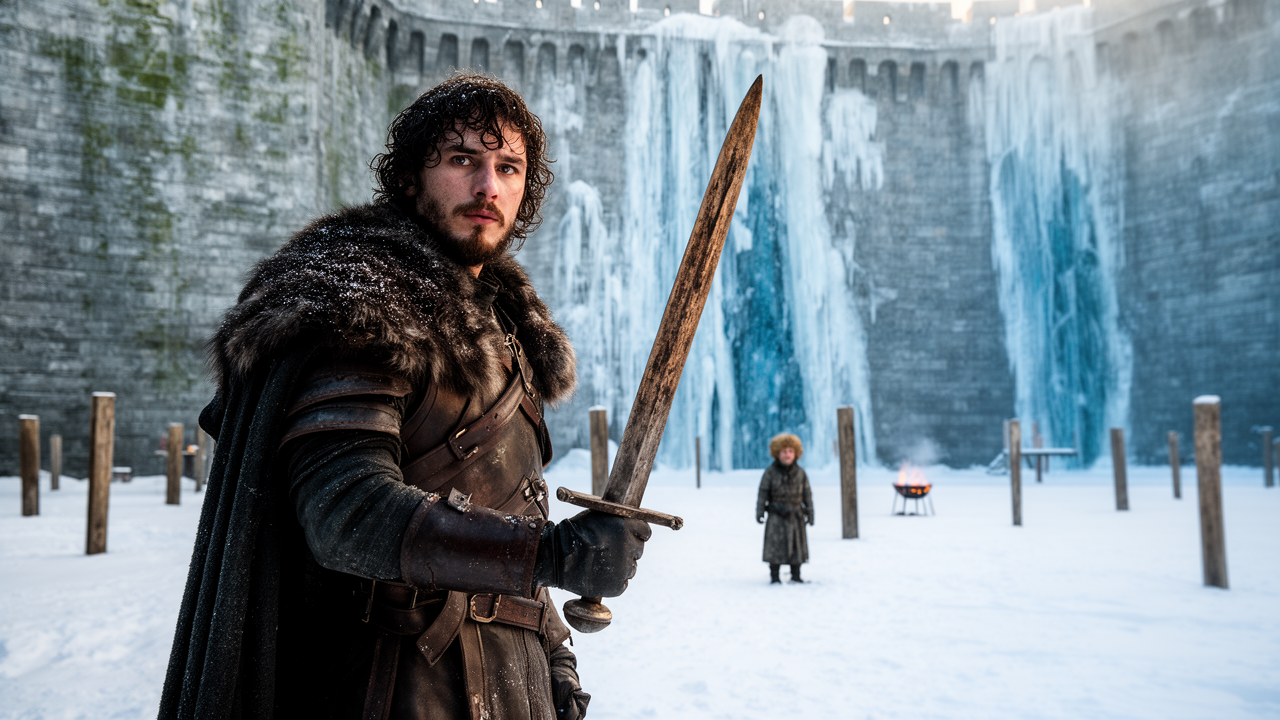
Jon’s first serious day of training at the Wall is where the episode turns the screw. He is not destroyed, but he is challenged enough to understand that the Watch will not hand him a place by default. The world of the North does not care about how he sees himself.
What matters here is not whether Jon is competent. It is that competence alone is not enough. In Westeros, skill must be translated into authority, trust, and endurance. Jon is just beginning that process.
Daenerys starts to become dangerous in a different way
While Jon is being reduced, Daenerys is expanding. “Lord Snow” quietly advances her transformation from threatened child-bride into a ruler who can read power in the room.
Drogo remains forceful, but Dany starts shaping the story around him
Daenerys and Khal Drogo’s relationship is still uneasy, but this episode gives her more agency than she had earlier in the season. She begins to speak with greater confidence, and the show makes it clear that she is learning the language of leadership as quickly as she can.
The shift is subtle, but it matters. Dany is not yet controlling her environment. She is starting to influence it. That difference defines much of her arc in the early season. She does not seize a crown in one move. She gradually stops being moved by everyone else’s decisions.
The Dothraki world is still a political world
One of the episode’s most useful lore reminders is that the Dothraki are not just background barbarians. They have customs, status rules, and internal logic. Dany’s position within the khalasar is tied to pregnancy, ritual, and Drogo’s authority, but she is beginning to understand that influence can come from more than force.
That understanding becomes essential later. The episode is quietly showing how Dany learns to use the structures around her instead of simply enduring them.
Tyrion Lannister’s role expands the political map
Tyrion is not merely comic relief in “Lord Snow.” He is one of the show’s best lenses on the system.
He moves through the episode with the ease of a man who is underestimated often enough to make it useful. In King’s Landing, that means he can hear what others say when they think they are safe. At the Wall, it means he can talk to Jon without the usual noble fiction that warps most conversations in Westeros.
Why Tyrion matters here
Tyrion’s importance in this episode comes down to three things:
- He recognizes the Wall as a social dumping ground as much as a military order.
- He understands that Jon’s identity will either harden him or hollow him out.
- He functions as one of the show’s clearest advocates for realism over myth.
That last point is easy to miss, but it is vital. Game of Thrones is already building a universe where people survive by reading incentives, not by believing in clean heroism.
The episode’s key political fallout
Even though “Lord Snow” is not a council-heavy episode, it still changes the board.
In the North
Jon’s humiliation at the Wall separates him from the fantasy of being Ned Stark’s son in everything but name. He is still a Stark in spirit, but the Wall will force him into a different kind of identity. That matters because the series is repeatedly asking who deserves inheritance, who earns leadership, and whether either one means anything without judgment and sacrifice.
In King’s Landing
The early court remains in motion, and the episode continues the slow tightening around Ned Stark. The important thing is not a single explosive political event, but the sense that the capital is a place where information is currency and every conversation has a second meaning.
In Essos
Daenerys is becoming more than a figure being carried by circumstances. Her storyline is still defined by vulnerability, but it now has momentum. That is a major shift.
Lore connections and worldbuilding that matter
“Lord Snow” is loaded with small details that pay off later because they teach the audience how this world works.
The Night’s Watch is not a noble fantasy
The episode makes the Watch feel real, which means grim. It is a place for oathbreakers, criminals, zealots, and a few men who actually believe in the mission. That contrast becomes important later when the series asks who is there by duty and who is there because life left them nowhere else to go.
Bastardy is a social weapon
Jon’s name is not just a personal burden. It is a legal and cultural mark that follows him everywhere. The show keeps using his bastard status as a way to explore inheritance, legitimacy, and the stories noble families tell about themselves.
The Dothraki are a structured society
The episode keeps reinforcing that the Dothraki have rules, rituals, and status markers. That matters because it prevents Daenerys’s arc from becoming simple captivity-to-freedom storytelling. She is entering a functioning political culture, not a lawless void.
Standout scenes in “Lord Snow”
A few moments carry the episode’s memory:
- Jon’s first severe confrontation at the Wall, which shows how quickly idealism gets punished.
- Tyrion and Jon’s conversation, the episode’s most memorable exchange and one of the clearest statements of the show’s worldview.
- Jon’s training sequence, which turns embarrassment into a longer-term character test.
- Daenerys asserting herself more clearly, signaling that she is becoming a participant in power rather than only a victim of it.
These scenes are not flashy on their own, but they are structurally important. They tell us what kind of series this is going to be: one where character growth comes from pressure, not speeches.
The ending of “Lord Snow”
The episode closes without a giant twist, but that is exactly why it works. The ending leaves several important things in motion: Jon has been knocked down but not broken, Tyrion has sharpened the show’s political logic, and Daenerys has taken a small but real step toward command.
Rather than ending on spectacle, the episode ends on alignment. Each storyline is now pointed in a clearer direction.
That makes the ending deceptively important. It is the kind of chapter break that tells viewers the season is no longer just introducing pieces. It is beginning to move them.
Why “Lord Snow” matters to the larger series
This is the episode where Game of Thrones starts acting like Game of Thrones.
Not because it is the first to have politics, or the first to have danger, but because it shows how the show’s core systems connect:
- Jon’s story is about identity under pressure.
- Tyrion’s story is about intelligence in hostile environments.
- Daenerys’s story is about the slow acquisition of power.
- The Wall becomes a symbol of exile, duty, and institutional decay.
- The title itself captures the series’ habit of turning status into irony.
If the pilot introduced the world and the second episode widened the map, “Lord Snow” gives the series its working philosophy. People are rarely who they think they are. Power rarely looks honorable. And survival usually depends on adapting faster than your pride allows.
For new viewers building a compendium, this is the episode to remember as a turning point for Jon, a formative step for Daenerys, and a defining early statement of Tyrion’s intelligence. It is quiet on the surface, but it is doing the heavy lifting for the rest of the season.
What to remember next
Before moving on, keep these takeaways in mind:
- Jon’s place at the Wall is not secure, and that tension will keep shaping his arc.
- Tyrion’s role as the show’s clearest political realist is now established.
- Daenerys is beginning to act rather than only endure.
- The Watch, the Dothraki, and the court are all shown as systems with rules, not just settings.
- The show is building toward consequences, not just confrontation.
That is the real value of Game of Thrones S1E3 “Lord Snow” episode guide material: it helps you see how much of the series’ future is already embedded in these early scenes.
If you’re reading through the season chronologically, this is a great place to pause and appreciate how much groundwork the episode lays. Share your thoughts in the comments — what stood out most in “Lord Snow,” and which scene do you think matters most for the rest of the series?