
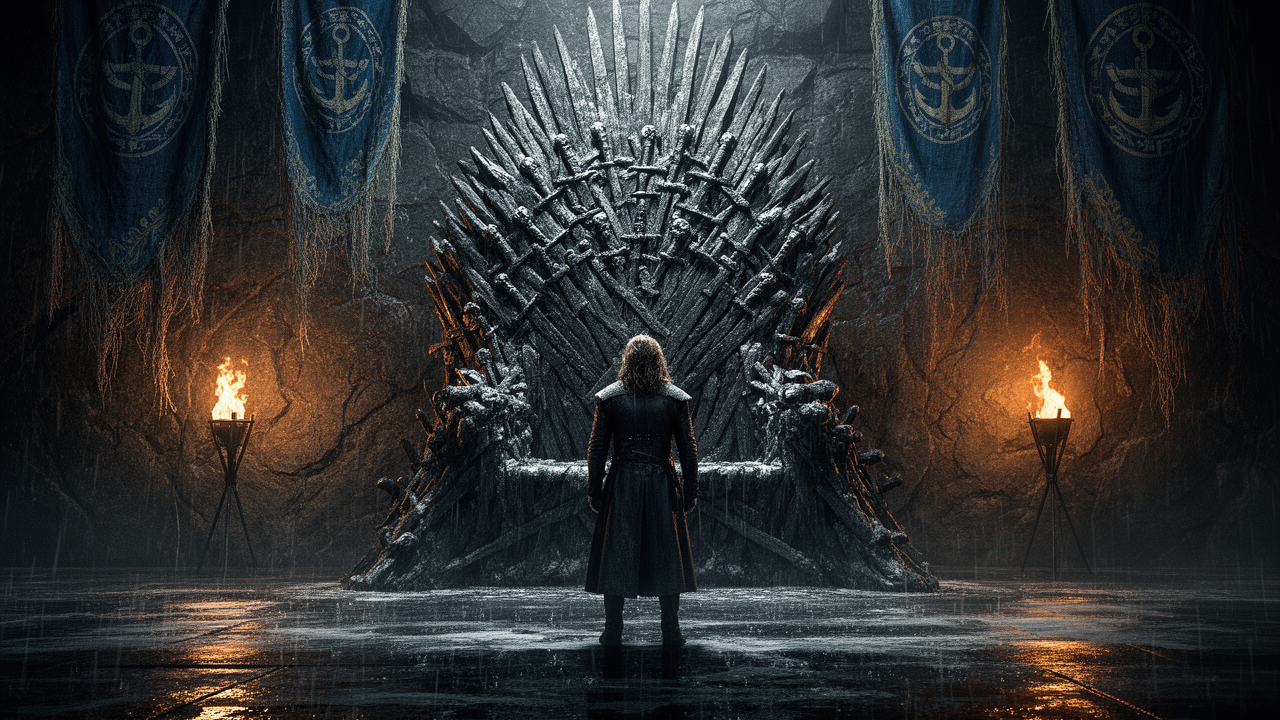
The Iron Islands open the season’s real power struggle
The Game of Thrones S2E3 “What Is Dead May Never Die” episode guide begins where the season’s politics get sharper and stranger at the same time. Westeros is still reeling from the aftermath of Ned Stark’s execution, but this episode shifts the board instead of simply mourning the pieces already lost. Theon Greyjoy returns to Pyke, Tyrion starts to discover how power actually works in King’s Landing, and Daenerys learns that exile in Qarth comes with its own kind of danger.
This is not a battlefield episode. It is a control episode. Everyone is trying to seize leverage, and almost nobody fully understands the cost.
Quick recap of what happens
At a glance, the episode splits its attention between three major fronts:
- Theon returns to the Iron Islands to present himself as a son and a political asset.
- Tyrion begins tightening the noose around the capital’s corruption, even as Cersei resents his authority.
- Daenerys meets the mysterious warlocks of Qarth while searching for allies, ships, and a way out.
Along the way, the show keeps planting smaller but important markers: Brienne’s place in Renly’s world, Arya’s growing fear in Harrenhal, Jon’s uneasy service beyond the Wall, and Stannis’ grim march toward a claim he believes is his by right.
What happens in Pyke: Theon comes home
The episode’s clearest turning point is Theon Greyjoy’s return to Pyke. He has been living as a hostage-ward among the Starks for years, which means he arrives at his family’s island carrying two identities at once: ironborn by blood, Stark-adjacent by upbringing.
That tension is the whole scene.
Balon Greyjoy receives Theon with open contempt. He does not treat him like a long-lost son; he treats him like a man who has been softened by northern manners. The old values of the Iron Islands matter here: strength, reaving, independence, and contempt for anyone who bends the knee. Theon assumes he can talk his way back into favor. Balon makes it clear that blood alone is not enough.
The real revelation is Asha Greyjoy—called Yara in the books—who immediately reads the room better than Theon does. She understands that her brother is trying to win approval by becoming the perfect heir in theory, but the ironborn respect action, not speeches. Her presence also sharpens the family dynamic: Theon is not the smartest Greyjoy in the room, and Pyke is not waiting around to comfort him.
Why this matters
The Pyke scenes establish the Iron Islands as a political faction with their own logic, not just another corner of the North. That matters later because the Greyjoys are not a side plot. They are a fracture line in the realm, and Theon’s return eventually becomes one of the show’s most catastrophic personal and political arcs.
Tyrion starts ruling like a realist
In King’s Landing, Tyrion spends the episode proving that being Hand of the King is less about ceremony and more about making enemies efficiently.
He begins by inspecting the city’s defenses and its financial rot. The point is not just that the crown is weak; it is that the crown has been running on habit, intimidation, and debt. Tyrion’s intelligence is practical. He asks where the weakness is, who controls the food, how the gold is spent, and who can still be trusted when the walls are tested.
Cersei immediately becomes a problem. She hates Tyrion’s authority, and the feeling is mutual. Their conversations are some of the episode’s best because they are not loud power plays; they are surgical. Tyrion knows Cersei’s strengths, and Cersei knows exactly how dangerous he is when he stops performing and starts planning.
The episode also hints at the broader instability of court life:
- the crown’s money is a mess,
- loyalty is transactional,
- and control of King’s Landing depends on information as much as armies.
Tyrion begins assembling that information.
Key character move
Tyrion’s major move in this episode is not a grand decree. It is the decision to treat governance as a problem of systems. That is what makes him effective, and it is why every powerful person around him eventually wants him contained, removed, or dead.
Daenerys in Qarth: hospitality with teeth
Daenerys’ storyline in Qarth keeps reminding viewers that a beautiful city can still be a trap.
She arrives with almost nothing: no army, no fleet, no secure future. In another show, that would mean she has reached safety. In Game of Thrones, it means she has reached a place where politics wears silk.
The Qartheen elite admire her dragons, but admiration is not the same as support. The city is wealthy, exotic, and deeply suspicious. Daenerys needs ships to continue her journey, yet every promise seems conditional. Her position is a familiar one in the series: she has power that everybody wants to look at and nobody wants to trust.
The episode introduces the warlocks of Qarth, whose interest in Daenerys is immediately unsettling. Their magic feels older, colder, and more hidden than the political schemes in King’s Landing. When the show begins mixing sorcery and statecraft this explicitly, it signals that Daenerys’ story is moving beyond simple exile. She is entering a larger mythic framework.
Lore implication
Qarth expands the world beyond Westeros without losing the show’s core theme: power is never free. The dragons are not merely symbols anymore. They are becoming strategic leverage, and that makes Daenerys both more important and more vulnerable.
Harrenhal, the Wall, and the edges of the episode
While the episode’s central arcs carry the most weight, the side material keeps the world in motion.
Arya remains trapped in Harrenhal, where fear is becoming routine. Her scenes reinforce the brutality of occupation and the danger of being small inside a huge political machine. Every day there is a lesson in how power behaves when no one is watching.
At the Wall, Jon Snow continues learning that the Night’s Watch is not a noble brotherhood so much as a harsh institution that survives by grinding people into shape. His early-season storyline is still about testing values against reality: duty, fear, honor, and what any of those words mean once the wilderness starts pushing back.
Across the Narrow Sea and the southern kingdoms, Stannis Baratheon’s claim to the throne grows more important in theory and more isolated in practice. His movement toward war matters because the audience can feel the realm’s split widening even when no single battle has begun.
The episode’s strongest scene: Theon and Balon
If there is one scene that defines the hour, it is Theon’s confrontation with Balon.
Balon is not interested in nostalgia. He is interested in power, and he measures it in terms Theon has not yet learned to speak fluently. Theon wants belonging; Balon wants use. That mismatch is heartbreaking because Theon still believes family can be negotiated through effort, while Balon treats family as a hierarchy sharpened by contempt.
The scene lands because it is doing several jobs at once:
- it reintroduces the Greyjoy family as a major political force,
- it defines Theon’s insecurity,
- it establishes that the Iron Islands have their own expansionist logic,
- and it quietly foreshadows how badly Theon will misread the people he is trying to impress.
Ending explained
The episode closes with the sense that no one has reached safety. That is the point.
Theon’s position in Pyke is unstable from the moment he arrives. Tyrion’s grip on King’s Landing is real, but so is the resentment building around him. Daenerys is still stranded, with her dragons and her reputation but not yet the practical means to move forward. Even the characters who seem to be advancing are actually walking into deeper political complications.
So what does the ending mean?
It means Season 2 is no longer about aftermath. It is about alignment. The important players are sorting themselves into factions, and the costs of those choices will soon become unavoidable.
Why this episode matters to the larger series
This episode matters because it quietly redraws the series’ map.
1. It reestablishes the Greyjoy threat
The Iron Islands are not just family drama. They are an independent political machine with ambitions that can destabilize the North and the coast alike. Theon’s return is the beginning of a major collapse in loyalties.
2. It shows Tyrion becoming a true governing force
Tyrion’s intelligence stops being theoretical here. He is no longer just witty or perceptive; he is building an approach to power that will define much of his arc in King’s Landing.
3. It turns Daenerys’ journey into a global one
Qarth broadens her story from escape to empire-building. The episode makes clear that dragons are not just creatures of legend. They are political gravity.
4. It keeps the show’s theme intact
The episode’s title, “What Is Dead May Never Die,” is a Greyjoy saying, but the sentiment hangs over the whole hour. Old loyalties don’t stay buried. Old claims return. Old power structures keep crawling back into the story.
What new viewers should remember next
If you are building a Game of Thrones compendium or watching the series in order, keep these points in mind after S2E3:
- Theon is no longer safely embedded with the Starks; his homecoming puts him on a collision course with his family’s ambitions.
- Tyrion is consolidating authority in King’s Landing, but he is doing it in a hostile environment.
- Daenerys still lacks ships, allies, and stability, which makes her vulnerable to manipulation.
- The war is becoming less about one throne and more about a contest of regional powers.
- The supernatural elements around Daenerys are no longer background flavor; they are becoming plot-driving forces.
Final take
Game of Thrones S2E3 “What Is Dead May Never Die” episode guide territory is where the series starts feeling less like a sequence of individual crises and more like a system of competing powers locking into place. That is what makes the episode essential. It does not deliver the loudest spectacle of the season, but it changes the shape of the story in ways that matter for everything still to come.
If you’re working through the series in order, this is the kind of episode that pays off later precisely because it seems so measured now.
What stood out most to you in this episode—Theon’s return, Tyrion’s first real moves in the capital, or Daenerys’ uneasy welcome in Qarth? Share your thoughts in the comments.