

Why retro automotive service ads still work
The best retro automotive service ads did more than sell oil changes, tire rotations, or battery checks. They sold a feeling. In a world where car trouble could strand you, delay you, or drain your wallet, these ads tried to make maintenance look orderly, skilled, and safe. They wrapped routine service in a visual promise: this place is clean, this team knows what it is doing, and your car will come back ready for the road.
That is the core trick. Repair is rarely glamorous, but the ads made it look like part of modern life rather than a necessary nuisance. Clean bays, shining chrome, crisp uniforms, and bold roadside signs all worked together to turn uncertainty into confidence.
The message under the hood
At a glance, many of these advertisements seem straightforward. A gas station attendant checks a tire. A mechanic leans over an engine. A service center promises a tune-up before a long trip. But the persuasion runs deeper than the product being sold.
These ads were not just about what service you needed. They were about who you could trust to do it.
That trust was built through repeated visual cues:
- Uniforms suggested training, professionalism, and consistency.
- Clean bays implied discipline and modern equipment.
- Bright signage made the business visible, legible, and dependable from the road.
- Smiling attendants softened the fear of being overcharged or ignored.
- Shiny tools and polished floors made the whole operation feel current, not improvised.
Together, those cues told drivers that maintenance could be routine, even reassuring.
How retro automotive service ads made repair feel modern
The big cultural shift in these ads is that they sell maintenance as a feature of modern living. If the house had appliances and the office had fluorescent order, the car needed its own version of managed efficiency. A well-run station or repair shop became a place where expertise was visible.
That mattered because early and mid-century drivers were often negotiating real anxiety. Cars were more temperamental, roads were less forgiving, and preventative care was not always an everyday habit. Ads answered that uncertainty by framing service as the smart, civilized choice.
They often suggested three ideas at once:
- Your car deserves attention.
- The right shop can provide it without hassle.
- Regular service keeps you part of a modern, mobile world.
In other words, the ad was not only selling a product or a repair. It was selling continuity. The driver stays on schedule. The family keeps traveling. The machine remains trustworthy.
Cleanliness as proof
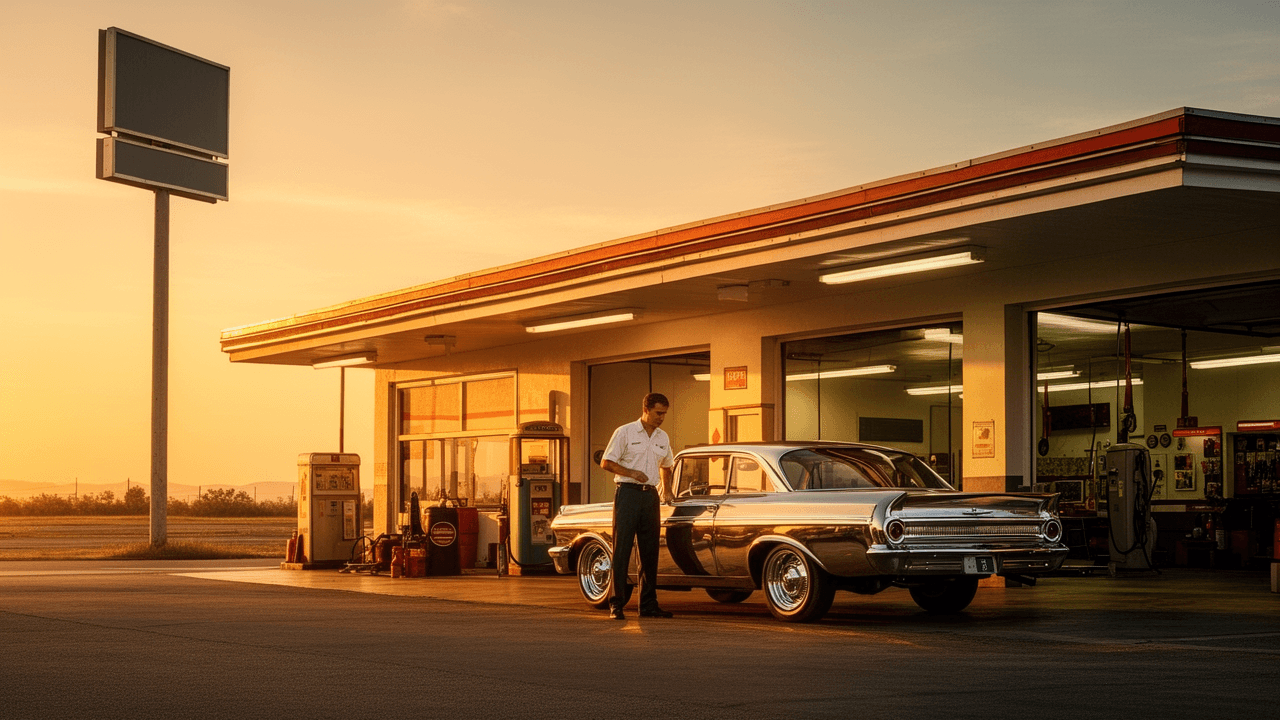
Few visual details mattered more than cleanliness. In many retro automotive service ads, the spotless station is a silent argument. Grease is minimized. The floor is swept. Tools are orderly. The mechanic’s clothes look neat. Even when the scene is busy, it feels controlled.
That cleanliness does two jobs at once. First, it reassures the viewer that the work will be done carefully. Second, it positions the business as modern and competent, not rough or improvised.
This is especially important in ads for services that are easy to defer:
- oil changes
- tire service
- tune-ups
- battery replacement
- radiator checks
- general station maintenance
None of those tasks is inherently thrilling. The ad has to make them feel necessary, worthwhile, and professionally handled. Clean visuals do a lot of that work before the copy even gets a chance.
Uniforms and the authority of the attendant
Uniforms are one of the most powerful shorthand tools in the entire category. In these ads, the attendant is rarely a faceless laborer. He is a representative of order. The cap, the shirt, the matching colors, and the polished appearance all communicate rank and reliability.
That matters because a driver seeking service is often seeking reassurance first. The car may be rattling. The road may be long. The customer may not know enough about engines to judge the repair. A uniform bridges that gap by making expertise visible.
It also humanizes the transaction. Instead of a cold mechanical process, the service becomes a conversation with a helpful professional. The best ads show attendants with attentive posture, open hands, and a calm expression, as if to say: you are in good hands.
Roadside signage and the geography of trust
Another recurring feature in retro automotive service ads is the sign. Tall, readable, often placed against a wide sky or at a highway edge, signage turns the business into a landmark. You are not just buying service; you are finding your way back to safety.
That roadside presence is crucial. Cars live in motion. A service station has to be located in the driver’s imagination as much as on the map. The sign does that work by making the shop easy to spot, easy to remember, and easy to return to.
The best roadside ads imply:
- This place is visible from the highway.
- This place is ready when you need it.
- This place belongs to the rhythm of travel.
It is a small but powerful form of persuasion. Visibility becomes credibility. If the station is prominent, clean, and orderly, then it must be dependable.
Maintenance as part of the journey
These ads often blur the line between repair and travel. A tune-up is not an interruption; it is preparation. An oil change is not a chore; it is what keeps the trip alive. A tire check is not an annoyance; it is what keeps the family moving.
That framing is important because it changes the emotional stakes. The ad is not asking, “Do you want to spend money on maintenance?” It is asking, “Do you want to keep moving with confidence?”
That is why the imagery so often includes:
- open roads
- family cars
- service bays bathed in light
- attendants at work beside a vehicle
- signs that suggest national mobility and local care
The car becomes a symbol of access, and the station becomes the guardian of that access.
Why the copy sounds calm instead of pushy
The tone of these ads is often surprisingly measured. They are persuasive, yes, but not frantic. That restraint is part of the pitch. A business that handles engines, batteries, and tires should sound calm enough to trust.
The copy may promise efficiency, expertise, or convenience, but it usually avoids panic. Instead, it leans on confidence. The station is ready. The crew is trained. The service is prompt. The result is peace of mind.
That calm tone helps the ad fit the broader mid-century ideal of progress. Modern life was supposed to be orderly, efficient, and improved by systems. A competent repair shop fit neatly into that fantasy. It was the mechanical version of the well-run home.
What the category teaches modern marketers
There is a reason these ads still feel useful. They show how to advertise an invisible service without overcomplicating it. The lesson is not nostalgia for chrome and cap visors. The lesson is that trust is visual.
Modern service brands can still borrow from the old playbook:
- show the workspace, not just the promise
- make expertise visible through people and process
- use tidy environments to imply control
- present service as care, not just transaction
- connect routine upkeep to confidence and continuity
That combination is timeless. Customers may not remember technical details, but they remember how safe the brand made them feel.
The lasting appeal of service as reassurance
Part of the charm of retro automotive service ads is that they imagine a world where competence is visible at a glance. The mechanic is prepared. The station is bright. The sign is easy to find. The car is checked, tuned, and sent back into motion with minimal drama.
That is still persuasive because people do not only buy repairs. They buy certainty. They buy the idea that someone has looked after the machine, noticed the problem, and taken care of it before it became a bigger problem.
Seen that way, these ads are about more than transportation. They are about trust in public space, confidence in specialists, and the quiet comfort of knowing that the next mile is covered.
And that is why the category endures: it made maintenance feel like a modern ritual of care, not a breakdown waiting to happen.
If you have a favorite example of retro automotive service ads, or a memory of the kinds of stations and repair shops they portrayed, share it in the comments—I’d love to hear your take.