
The real shape of retro challenge
When players talk about retro game difficulty curves, the conversation usually drifts toward punishment: limited lives, brutal bosses, and checkpoints that seem to have been placed by a grudge-bearing architect. But that framing misses the more interesting truth. A lot of older games were not simply harder—they were structured to become harder through the way they used space, enemy density, and resource pressure.
That distinction matters. A well-authored difficulty curve does not just spike. It teaches. It squeezes. It changes what the player can safely assume. In many retro games, challenge was less a wall and more a series of pressure changes, each one tightening the same basic loop until the player had to move, memorize, or conserve differently.
Once you start looking for it, you see the pattern everywhere.
Retro game difficulty curves were built in the room, not just the rulebook
Modern players sometimes think of difficulty as a menu setting or a boss’s health bar. In older games, difficulty was often embedded directly into the room-to-room experience. The designer could make a space feel generous or hostile without changing the core rules at all.
That happened in a few repeatable ways:
- Room size changed risk. A wide arena gave you room to react. A cramped hallway made every enemy more dangerous.
- Enemy density changed tempo. One foe invited patience. Four foes forced improvisation.
- Spawn rhythm changed confidence. A room that stayed quiet after a fight felt safe. A room that kept introducing pressure told you not to relax.
- Exit visibility changed decisions. When the next safe zone was visible, players pushed forward. When it was hidden, hesitation grew.
These are not accidental effects. They are authored signals. A designer can make a level feel fair, oppressive, generous, or desperate by combining these ingredients in the right order.
Room layout is the first difficulty curve
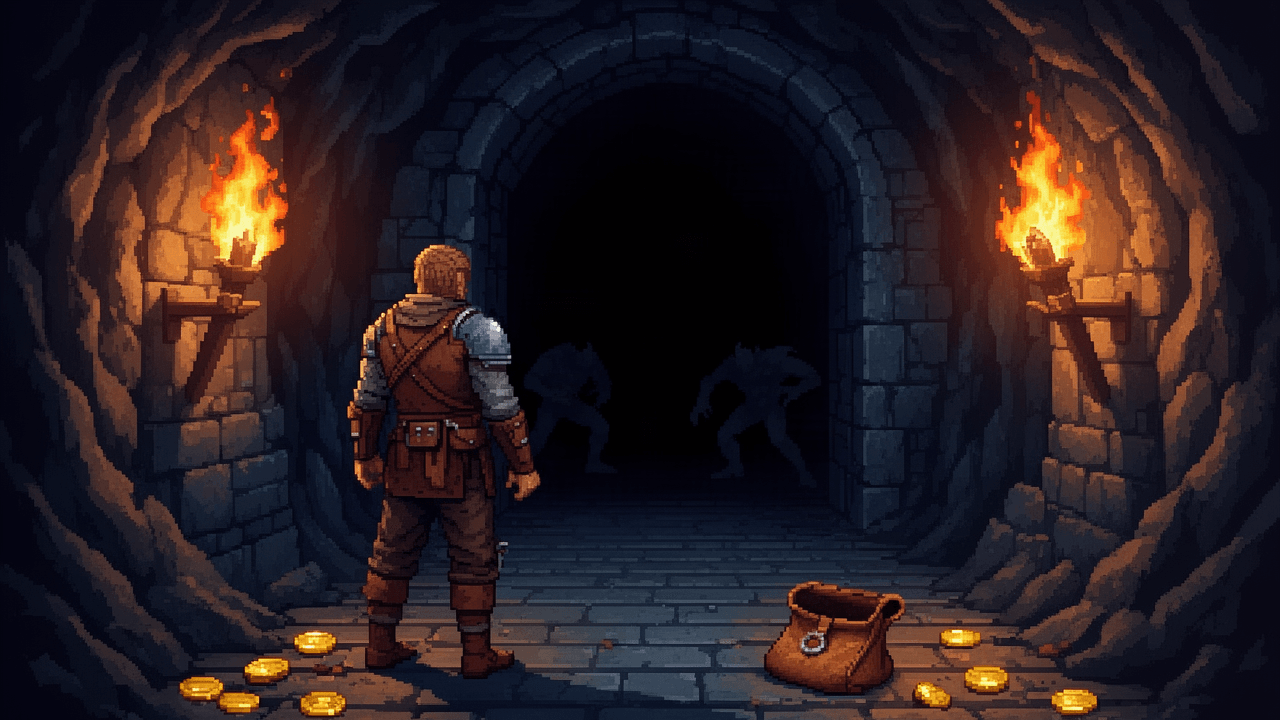
The simplest way to shape challenge is with architecture. A narrow staircase, a looping corridor, a room with blind corners, or a bridge with no lateral escape all make the same enemy encounter feel completely different.
That is because room layout controls the player’s options:
1. It limits movement
When you can strafe freely, enemies are puzzles. When you cannot, they become hazards. Older action games understood this well. Even if enemy behavior stayed constant, the room could turn a manageable encounter into a tense one by reducing the safe paths available to the player.
2. It changes line of sight
A long sightline gives players time to plan. A sudden reveal forces reaction. That reveal can be a small thing—a doorway, a corner, a stair landing—but it alters the difficulty curve by controlling how much information the player receives before contact.
3. It shapes recovery
Big rooms are not always easier. Sometimes they are harder because they expose the player after an error. If healing, turning, or repositioning takes time, then the room itself becomes part of the punishment.
This is why some retro stages feel harder than their enemy lists would suggest. The challenge is not the enemy stats. It is the choreography of the environment.
Enemy density turns tension into pressure
One enemy can be read. Two enemies can be managed. Three or more often become a conversation about attention: which threat gets ignored, which one closes the gap, which one is allowed to stay alive?
Enemy density is one of the clearest tools in retro game difficulty curves because it changes the player’s mental load without requiring new mechanics.
A sparse early stage teaches fundamentals by giving breathing room. A denser midgame stage raises the stakes by making every dodge or attack create a new problem. A late-stage gauntlet may not need stronger enemies at all; it simply needs more of them, or more overlap between enemy movement patterns.
This kind of design creates a recognizable escalation:
- Early spaces ask, “Can you survive?”
- Midgame spaces ask, “Can you prioritize?”
- Late spaces ask, “Can you do both while under pressure?”
That is a curve. Not a spike. Not random cruelty. A curve.
Resource pressure is where the curve becomes memorable
If room layout shapes danger and enemy density shapes tempo, resource pressure shapes anxiety. This is where many older games did their best work.
Health, ammo, mana, consumables, checkpoints, extra lives, and even time limits all act as silent multipliers on difficulty. A fight that would feel routine with a full stockpile can feel severe when the player is already running low.
The key point is that resource pressure often changes the meaning of every room. When you are healthy, you explore. When you are nearly empty, you conserve. When resources are scarce enough, even a harmless enemy becomes a threat because it costs something to deal with.
That is a very retro feeling, and it is one reason older games can still feel so sharp today. Their difficulty curves were frequently built around cumulative strain rather than isolated challenge.
Common forms of resource pressure
- Limited healing between checkpoints
- Ammo scarcity that makes every shot matter
- Consumables that must be saved for unknown danger
- Lives or continues that turn failure into a long-term cost
- Backtracking that consumes time and safety
A modern game can replicate the surface version of this. What it often misses is the way those pressures stacked across a whole sequence of rooms.
Why authored difficulty feels different from raw punishment
There is a big difference between a game that is simply harsh and a game that is carefully escalated.
Raw punishment says: you failed, so try again.
Authored difficulty says: you have enough information now to understand why this space is dangerous, and enough room to adapt.
That authored quality is what makes so many retro game difficulty curves feel memorable instead of merely exhausting. The player notices the logic. Maybe not consciously on the first run, but certainly by the third. The hallway before the boss has fewer safe turns. The enemies arrive in a tighter cluster. The items are placed just far enough apart to force a choice. The game is talking to you through arrangement.
This is also why some classic games feel unfair on a first pass and elegant on a second. Once you recognize the language, the curve becomes readable.
A few classic approaches that still show the pattern
Different retro games used the same basic idea in different accents.
The attrition dungeon
Some games built tension by chaining modest threats across a long route with few safe recovery points. The individual encounters were not monstrous, but the cumulative cost was. By the time the player reached the end, the real boss was often exhaustion.
The funnel stage
Other games used a narrow path with carefully spaced threats. Here, the difficulty came from forced engagement. There was nowhere to orbit, little room to reset, and little mercy in how enemies entered the frame.
The pressure chamber
Some stages started generous and then tightened. Early rooms let the player feel competent, then the game started clustering enemies, reducing pickups, and adding environmental traps. The effect was psychological as much as mechanical: the player sensed safety leaving the building.
The resource trap
Certain segments looked simple but were designed to drain the player before a major test. You were encouraged to spend health, ammo, or magic in the short term, only to discover that the next area assumed you had held back.
These approaches are different on the surface, but all of them show the same principle: difficulty was authored through sequencing.
Why this still matters in modern design discussions
We still recognize these patterns because players still respond to them.
Even in contemporary games, a well-made difficulty curve often comes from the same ingredients:
- tighter spaces that reduce freedom,
- enemy groupings that force triage,
- and resources that make every mistake echo forward.
What has changed is the language around it. Modern design often talks about accessibility, onboarding, and player agency. Those are useful terms. But they all connect back to the same older truth: good challenge is usually about controlled pressure, not just bigger numbers.
That is why retro design remains such a useful reference point. It shows how much can be done with layout, composition, and economy before you ever touch a boss phase or stat table.
The best retro difficulty curves teach you to read the game
The strongest retro game difficulty curves do not merely block progress. They train perception.
They teach players to notice how a room is arranged, how enemies are grouped, how far the next safe point is, and what resources the game expects them to spend. After a while, players stop seeing isolated obstacles and start reading the level as a system of pressures.
That is the lasting lesson. Older games did not become iconic because they were tough for the sake of it. The best ones were legible. Their challenge had shape.
And once you see that shape, a lot of supposedly random retro hardness starts looking a lot more like design.
The takeaway
When people remember old games as punishing, they are not entirely wrong. But punishment was only the surface. Underneath it, the most effective retro game difficulty curves were built from authored space, escalating enemy density, and increasingly tight resource pressure.
That is why these games still feel sharp. They did not just ask players to survive. They asked them to adapt to a language of escalation.
If you have a favorite classic game that uses room layout or resource scarcity especially well, share it in the comments—I’d love to hear what still gets your pulse up.