
Retro Game Enemy Design Was a Form of Communication
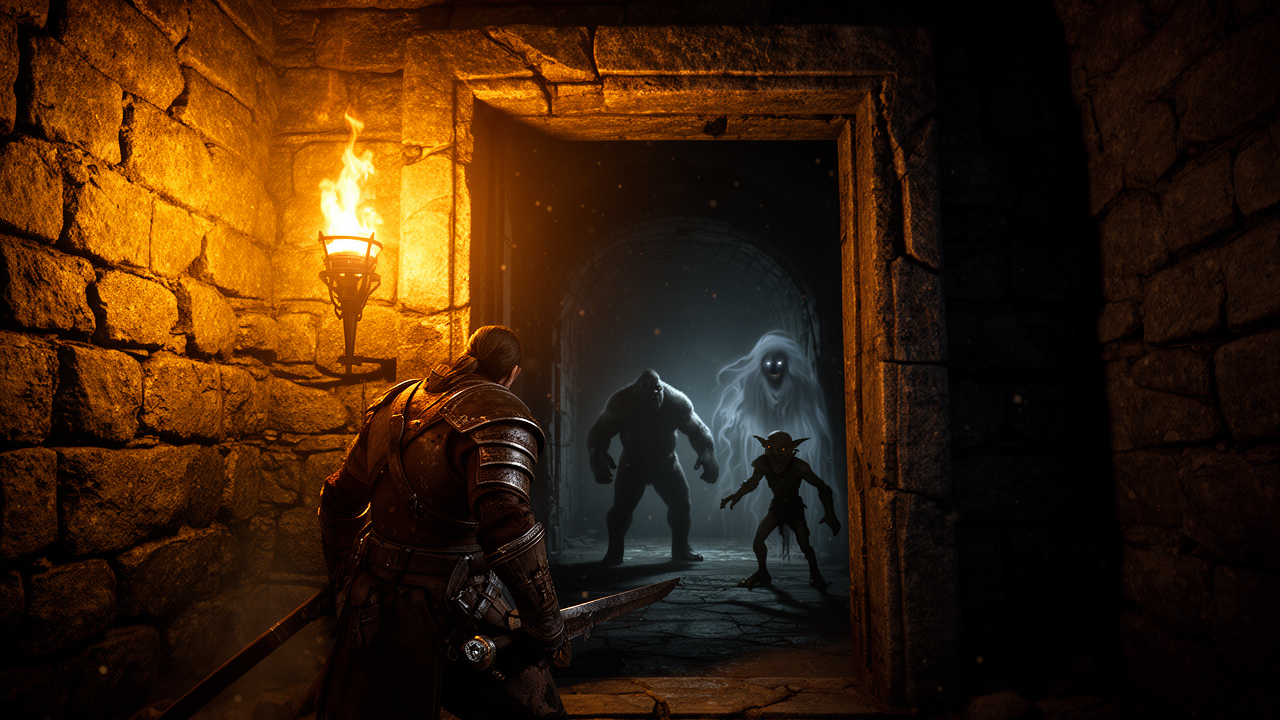
In retro game enemy design, the enemies were never only there to drain health bars. They were part of the level’s grammar. A bat at ceiling height, a slow shambler in a narrow corridor, a sniper on a ledge, a turret guarding an obvious treasure chest: each one told you something before you even attacked. Classic games used enemy placement as a language of danger and guidance, teaching players how to read spaces instead of just asking them to fight harder.
That distinction matters because old games rarely had generous tutorials, waypoint arrows, or on-screen prompts spelling out what a room meant. If a hallway felt safe, it was usually because the enemies had been arranged to let you breathe. If a room felt wrong, the placement itself was the warning. Designers were quietly training players to scan shapes, exits, sightlines, and blind spots. The fight was only one layer of the lesson.
Retro Game Enemy Design and the Meaning of Space
The best retro stages do not simply escalate by adding more enemies. They escalate by changing how those enemies occupy space. A single foe in an open field communicates something very different from the same foe in a cramped tunnel or on an elevated platform. The enemy type matters, but the placement tells the real story.
That is why classic games often felt so readable even when they were hard. The player was learning a visual language:
- Front-loaded enemies say: stop here, inspect, and prepare.
- Ambushers from above or behind say: your current assumption is unsafe.
- Mixed enemy groups say: prioritize targets and manage timing.
- Sparse rooms after dense stretches say: recover, then advance.
- Enemies near rewards or checkpoints say: the path is still under pressure.
This is retro game enemy design at its most elegant. Instead of pausing the action to explain itself, the game arranged pressure into the environment. The room became the instruction.
Read the room first, then the enemies
A modern player may describe a difficult old game as “cheap” when they are actually reacting to a space they have not yet learned to read. The first encounter in a new area often serves as a test of observation. Are enemies guarding a choke point? Are they spaced to force movement? Is there a safe lane that only becomes visible after you notice the pattern? The level is asking these questions one by one.
That is why so many classic stages feel like memorization at first and intuition later. What seems unfair is often the game teaching a spatial habit. Once the player understands the room, the difficulty does not disappear. It becomes legible.
Why Enemy Variety Made Pacing Feel Intentional
Enemy variety was not only about freshness. It was a pacing tool.
When a game introduces a new enemy type, it changes the tempo of the area around it. A slow tank enemy creates caution. A fast swarm enemy creates panic. A ranged enemy stretches the distance between safe positions. A flying enemy makes vertical space matter. The room itself can stay visually simple, but the behavior of its occupants creates emotional movement.
This is one of the cleverest tricks in classic design: the same map can feel like three different experiences depending on the enemy mix. A corridor with a lone weak enemy feels like setup. Add one ranged attacker at the far end and the corridor becomes a timing puzzle. Add a second, faster enemy from behind and suddenly the player is reading escape routes, not just attack windows.
Enemy variety also prevented fatigue. If every room demanded the same answer, the player would stop seeing the level. Variety forces re-evaluation. It asks the player to re-map the space every few screens, which keeps progression active even in a limited visual environment.
Common ways classic games used variety
- Grunt plus support enemy to teach priority targets
- Flying enemy plus ground enemy to split attention vertically
- Projectile enemy plus slow blocker to prevent tunnel-vision
- Elemental or status enemy to make positioning more important than damage output
- Mini-boss style foe in a regular room to signal a new chapter of difficulty
The point was not merely to make combat harder. It was to make rooms speak with a different accent.
How Enemy Placement Taught Progression Without UI
One of the most overlooked strengths of retro game enemy design is how often it served as a substitute for explicit UI. Designers needed players to feel where they were in the game’s structure, and enemy placement became one of the cleanest ways to do that.
Early in a game, enemies are often isolated and easy to read. Their job is to teach basic rules. Midgame, the same areas become busier, with overlapping threats and less forgiving spacing. Late-game spaces tend to compress those lessons, combining earlier enemy types in tighter patterns or in more dangerous terrain. Even without a dialogue box or mission tracker, the player senses escalation because the spaces themselves become more crowded with intent.
This also gave classic games a kind of natural rhythm. The player would move through:
- Introduction — a simple encounter that shows the threat type
- Repetition — a similar setup that confirms the lesson
- Variation — the same enemy appears in a less comfortable position
- Complexity — multiple threats now overlap in one room
- Resolution — the layout opens up or the enemy density drops
That structure made progression feel physical. You didn’t just gain levels; you gained fluency. The game was teaching you how to move through its world more intelligently.
When Enemy Placement Became a Difficulty Curve
A lot of retro difficulty is not about raw stats. It is about where enemies are standing.
Put a harmless-looking enemy at the mouth of a bridge and the bridge becomes a choke point. Put archers on opposite sides of a room and the room becomes crossfire. Put a trap-triggering enemy near a pit and the room gains a positional hazard even if the enemy itself is weak. The enemy placement does the heavy lifting because it changes how the player navigates the map.
This is why the hardest classic games often feel memorable even when the enemies themselves are simple. The challenge comes from the arrangement, not the complexity of the AI. A basic foe becomes interesting when it is placed:
- near a hazard
- on a narrow path
- behind a blind corner
- in sight of a reward
- between the player and a safe retreat route
That placement creates tension before the first hit lands. The player starts considering line of sight, spacing, and commitment. In other words, the game has transformed combat into spatial planning.
The Best Retro Enemies Changed How You Moved
The strongest enemy designs in old games did more than threaten your health. They changed your movement vocabulary.
A game with only lumbering melee foes encourages direct advance and retreat. Add projectiles and players start using cover or timing bursts. Add enemies that attack from different elevations and suddenly jumping, climbing, or dropping into a room matters more. Add enemies that punish standing still and the entire map starts to feel like a flow state.
This is why certain retro encounters are still so easy to remember decades later. They were not just fights. They were lessons in motion. You remember the room where you had to bait one enemy while slipping past another, or the hallway that became safer only after you realized the ranged enemy could be defeated from an awkward angle. Those moments stick because they connect cognition to movement.
Enemy placement can teach all of this at once
- where to pause
- where to retreat
- where to commit
- where to circle around
- where the safe lane probably is
- when to trust the obvious route and when to distrust it
That is the secret power of retro game enemy design: it turns layout into memory.
Classic Games Trusted the Player to Notice Patterns
A lot of modern design tries to prevent confusion at all costs. Retro games often did the opposite. They trusted players to notice the pattern after a few attempts. That trust is why their enemy placement feels so rich in hindsight. The game was not merely punishing failure; it was giving the player enough information to self-correct.
This is also why enemy placement can feel more meaningful than sheer enemy count. Ten enemies in a chaotic space may feel busy. Three enemies arranged with intention may feel like a lesson. One teaches panic. The other teaches reading.
The smarter classic games understood that uncertainty is not the same thing as obscurity. They let the player feel the shape of the danger, then discover the details through play. Once you notice that design principle, you start seeing it everywhere:
- in the lone enemy placed before a gauntlet
- in the safe-looking room that hides a threat at the edge of the camera
- in the corridor that narrows just as the enemy type changes
- in the boss arena that quietly trains one mechanic before the boss appears
Every one of those choices is a sentence in the game’s spatial language.
Why This Still Matters in Retro Game Enemy Design Today
Modern games have more tools, but the lesson remains useful: enemies should communicate. Not every threat needs a pop-up tutorial or a glowing indicator. Sometimes the strongest guidance is architectural. Enemy placement can say, “Take your time,” “This area is a trap,” “You need a different approach,” or “You are ready for the next step.”
That is why retro game enemy design continues to influence good level design now. It rewards clarity without over-explaining. It makes spaces meaningful. It turns pacing into something the player can feel in their hands, not just read on a menu.
The classic lesson is simple: when enemies are placed well, they do not just test combat skill. They teach attention. They teach reading. They teach the player how to understand a room before they try to conquer it.
The Takeaway: Enemy Placement Is Design, Not Decoration
If modern players remember old games as brutal, they are missing half the picture. The best retro stages were often generous in a very specific way: they gave you information through arrangement. Enemy variety and placement were how the game whispered its rules.
That is why the most satisfying retro encounters still hold up. They are not only battles. They are spatial puzzles with teeth.
If you want difficulty that feels fair, readable, and memorable, start with the room. Then place the enemies like you mean it.
If this kind of design analysis is your thing, share your favorite examples or strongest opinions in the comments.