

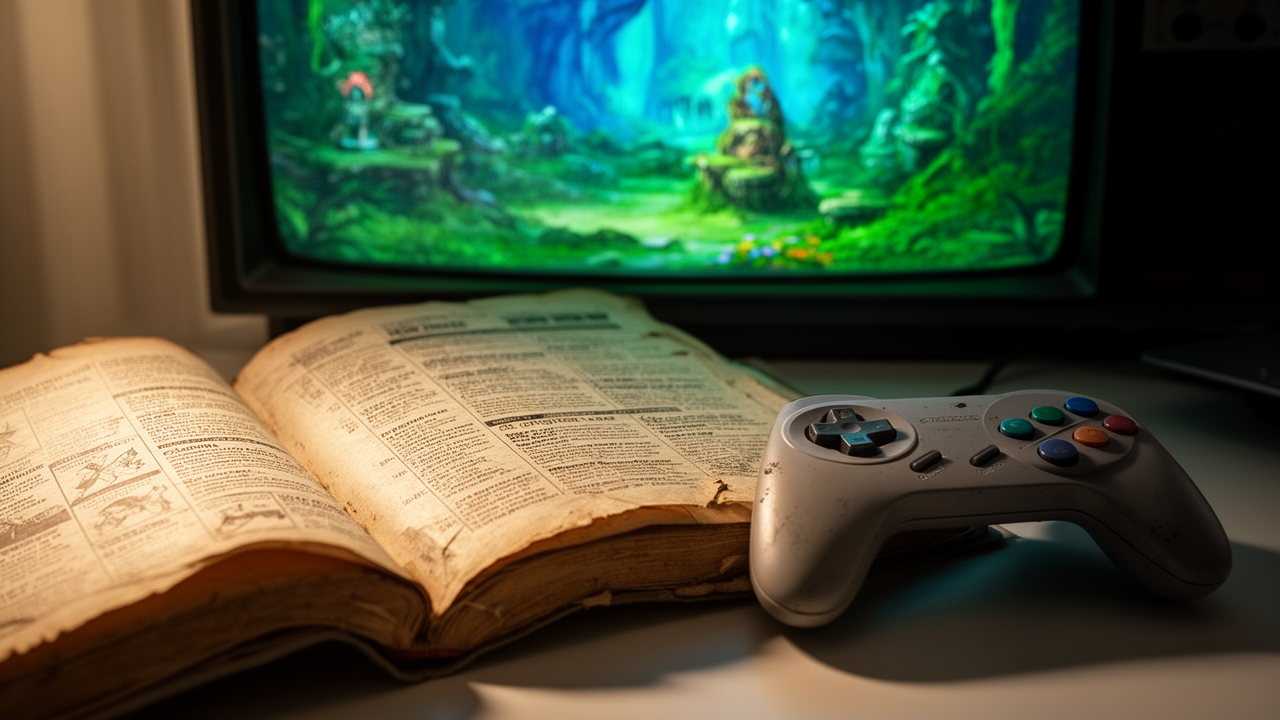
Retro game manuals were never just packaging
Before every game started with a floating tooltip or a voice calmly saying, press jump to jump, retro game manuals did more than explain the basics. They were part of the first contact between player and game. You opened the box, pulled out the cartridge or disc, and the manual was already doing work: it set the mood, taught the rules, hinted at the world, and quietly told you what kind of attention the game expected.
That matters because classic games were often designed around uncertainty. You were not meant to arrive with a complete onboarding sequence already built in. The manual was the bridge between the physical object in your hands and the digital world waiting on the screen. It was instruction, but it was also framing.
Today, a lot of players treat manuals like optional extras. Sometimes they are. But in the era that produced them, skipping the manual often meant missing half the design language.
Retro game manuals taught tone before the title screen did
A good manual introduced the game’s personality before you ever hit Start. Some were dry and technical, but the best ones had voice. They could make a strategy game feel militaristic, a fantasy RPG feel ancient, or a horror game feel unsafe before the first monster appeared.
That tone was not decoration. It was a signal. If a manual sounded grave and matter-of-fact, the game probably expected patience. If it sounded playful or theatrical, the game might reward experimentation. A manual could prepare you for comedy, melancholy, menace, or epic scale long before the opening cutscene tried to do the same.
This is one of the biggest things modern players miss when they ignore manuals: they assume the game begins at boot, when in many cases the game began on page one.
They explained controls, but they also taught interpretation
Yes, manuals told you which button attacked and which button opened the menu. But good retro game manuals went beyond control mapping. They taught you how to read the game’s systems.
That distinction matters. A controls screen tells you inputs. A manual tells you what those inputs mean in context.
For example:
- In an RPG, the manual might explain status effects, party roles, or how equipment changes battle strategy.
- In an action game, it might clarify when to defend, when to commit, and how stamina or movement timing shapes survival.
- In a simulation or adventure game, it might teach the logic of exploration, inventory management, or environmental interaction.
That kind of guidance shaped player expectations. It reduced the sense that the game was being unfair and replaced it with a clearer understanding that the player was being invited to learn a system, not just react to prompts.
Modern tutorials often do this in-game, but manuals had a special advantage: they let the player absorb information at their own pace before the pressure of play started.
Retro game manuals were worldbuilding devices
The best manuals acted like short companion books. They gave names to kingdoms, gods, factions, monsters, and technologies. They filled in the edges of worlds that cartridges and limited storage could not fully support.
That extra context mattered because classic games were often lean in presentation. A manual could turn a few sprites and a tune into a convincing setting.
A good example is how RPG manuals often framed the stakes of a quest with historical summaries, maps, bestiary notes, or character bios. Suddenly, the world felt older and broader than the opening dungeon. You were not just a pawn moving from one objective marker to another. You were stepping into a setting with its own history and internal logic.
That is why so many retro fans remember manuals fondly even when the games themselves were cryptic. The manual was part encyclopedia, part storybook, part sales pitch—and it made the game feel larger than the hardware could show.
They reduced friction without removing mystery
There is a difference between clarity and over-explanation. The best manuals were clear enough to prevent confusion, but not so exhaustive that they flattened discovery.
They might tell you:
- how saving works,
- what an item category is for,
- how combat pacing should feel,
- which hazards to respect,
- and what kind of goal structure the game uses.
But they usually stopped short of solving the game for you. That restraint is important. Manuals were there to orient, not to spoil. They gave you the language to begin, then let the game take over.
That balance helped classic titles feel tougher and more memorable. You entered with a map, not a script.
Why some games felt better because the manual existed
Some genres benefited more than others, but almost every category gained something from a well-made manual.
RPGs needed manuals to make complex systems legible
A role-playing game often had layered mechanics: leveling, equipment types, magic schools, menus, encounters, and party structure. The manual helped players understand the shape of the journey before the first random battle.
Without that support, an RPG could feel less like an adventure and more like a wall of unfamiliar menus.
Adventure games used manuals to establish logic
Point-and-click and text-heavy games often relied on manuals to explain the world’s rules, especially when puzzles depended on tone and observation rather than explicit markers. If the game wanted you to think like a detective, explorer, or intruder, the manual had to prepare you for that mindset.
Action games used manuals to teach discipline
Many classic action games were not just about reflexes. They were about commitment, pattern reading, and movement awareness. A manual that explained enemy behavior, weapon tradeoffs, or level hazards helped players understand that success came from learning rhythms, not button mashing.
Simulation and strategy games used manuals as serious tools
This is where manuals often became essential reading. If the game simulated a craft, a city, a battlefield, or a management system, the manual was almost part of the software. Players did not just “look things up.” They studied the manual to understand the intended way to think.
The physical object changed how we learned
One reason manuals felt so integral is that they were tied to the physical ritual of playing.
You were not clicking through a help menu buried under settings. You were flipping pages, scanning diagrams, reading lore snippets, and maybe leaving the manual open beside the console for reference. That tactile experience changed the rhythm of learning.
It also changed your relationship to anticipation. Reading a manual before playing created a kind of pressure and imagination that modern onboarding rarely replicates. You were forming theories before the first save file existed.
In that sense, manuals were part of the game’s pacing. They slowed the player down just enough to create curiosity.
What modern players miss when they skip the manual
A lot of retro games become more frustrating than they need to be when the manual is ignored. But the loss is not just mechanical. It is interpretive.
When players skip manuals, they often miss:
- the intended tone of the game,
- the framing of the story world,
- the importance of specific systems,
- the difference between a fair challenge and a misunderstood one,
- and the developer’s intended learning curve.
That last point is crucial. Many old games were not designed to explain themselves on demand. They assumed a manual would carry part of that weight. Without it, players may think a game is obscure, punishing, or badly designed when the real problem is that they started reading too late.
Manuals also reveal how developers thought about players
The design of a manual tells you a lot about the era that produced it. It shows whether a studio trusted players, feared them, teased them, or expected them to study.
Some manuals are charmingly dense because developers assumed people wanted the full picture. Others are concise because the game was built to be intuitive and the manual only had to cover edge cases. Either way, the manual is a clue to the designer’s assumptions.
That makes retro game manuals fascinating historical artifacts. They are not just support material. They are evidence of a different contract between game and player—one built on preparation, patience, and a little bit of mystery.
The manual as design language
When people talk about “design language,” they usually mean visual cues, UI conventions, enemy silhouettes, or level composition. But manuals belong in that conversation too.
They used layout, typography, illustrations, and copy style to communicate how a game wanted to be understood. A dense chart signaled systems. A painted map signaled adventure. A terse warning on hazards signaled danger. A character bio signaled narrative importance.
In other words, the manual was not separate from the game’s design language. It was the first chapter of it.
That is why some classics still feel richer when experienced with the manual intact. The game is not only being played; it is being introduced.
Why the manual still matters now
Even in an era of searchable wikis, patch notes, and instant tutorials, manuals remain useful as design documents and cultural objects. They show how games once invited players in. They remind us that onboarding can be atmospheric, not just functional.
For retro players, returning to a manual can make a familiar game feel newly coherent. For modern players, it can explain why old games expected more patience and more reading. And for preservation-minded fans, manuals are crucial because they preserve the tone and intent that digital storefront listings often erase.
If you want to understand a classic game the way its original players encountered it, the manual is not optional background. It is part of the experience.
The old lesson was simple: read first, play better
The best retro manuals did not just teach you how to win. They taught you how to enter the game properly.
They set tone. They explained systems. They built worlds. They told you, quietly and confidently, what kind of player you needed to be.
That is why retro game manuals deserve to be remembered as more than packaging. They were design, instruction, and invitation all at once.
If you still have a favorite manual tucked in a box somewhere, or remember a game that only truly clicked after you read the booklet, share it in the comments—I’d love to hear which ones stuck with you.