

Image credit: Draft web reference from pinterest.com
Celestial Cities and Chrome Dreams: How Older Futures Imagined Tomorrow
The appeal of retro science fiction is not just nostalgia. It is the feeling that a past generation tried to map tomorrow with the tools it had on hand: brushed metal, rocket fins, atom symbols, bubble domes, and an almost stubborn belief that the future would be both dazzling and legible. Read enough old covers, magazine stories, and mid-century concept art, and a pattern emerges. These futures were never merely decorative. They were arguments about what technology could fix, what it might break, and what kind of people we would need to become to survive it.
That is why retro sci-fi still holds up. It does not simply show us obsolete ideas. It shows us how older cultures imagined progress as a visual language. Sometimes that language was hopeful. Sometimes it was anxious. Often it was both at once.
The Future as a Design Problem
One of the most striking things about vintage science fiction is how often the future looks designed rather than grown. Cities are organized into sweeping arcs. Vehicles hover with impossible cleanliness. Interiors are filled with dials, domes, translucent panels, and control rooms that seem built more for symbolic clarity than human comfort.
That aesthetic reveals something important: earlier generations often imagined the future as an engineering challenge that could be solved through better systems. If the right materials existed, and if the right experts were in charge, then transportation would be streamlined, labor would be reduced, and daily life would become rational.
In that sense, retro science fiction is deeply optimistic. It treats design as a promise. A better chair, a better city, a better ship, a better kitchen—each one suggests a future where confusion has been replaced by order. The clean lines and gleaming surfaces are not only style. They are social ideals in disguise.
Why chrome meant confidence
Chrome, glass, and polished white panels appear again and again in older sci-fi art because they symbolize cleanliness, efficiency, and control. These materials suggested a world that had solved grime, clutter, and scarcity. They also made the future look manufacturable. If a surface could be shiny enough, perhaps civilization itself could be made shiny too.
That confidence is part of why mid-century futures feel so distinct. They are not ruined landscapes or improvisational survival zones. They are built environments, carefully framed and curated. Even when the stories involve danger, the world itself often seems to have been planned.
Pulp-Era Machines and the Power of Imagination
Before the sleek space-age aesthetic took over, pulp-era science fiction was louder, stranger, and often more hand-assembled in spirit. Its inventions were full of coils, levers, ray guns, pressure tanks, and impossible engines. The technology looked exaggerated because it had to look believable enough to carry the reader into a new possibility.
This era of retro science fiction was fascinated by invention as spectacle. Machines were not hidden behind minimalist interfaces. They were displayed. A device could be oversized, dangerous-looking, and impractical, yet still communicate a simple message: the future will be made by people who can build things no one has seen before.
The pulp imagination also made room for wonder in a way later realism sometimes muted. There was often little distinction between scientific plausibility and narrative thrill. That flexibility gave early sci-fi enormous creative freedom. It could imagine artificial gravity, interplanetary travel, or advanced weapons without needing every detail to hold up under scrutiny. The point was not technical perfection. The point was possibility.
When Space Travel Looked Like a Public Dream
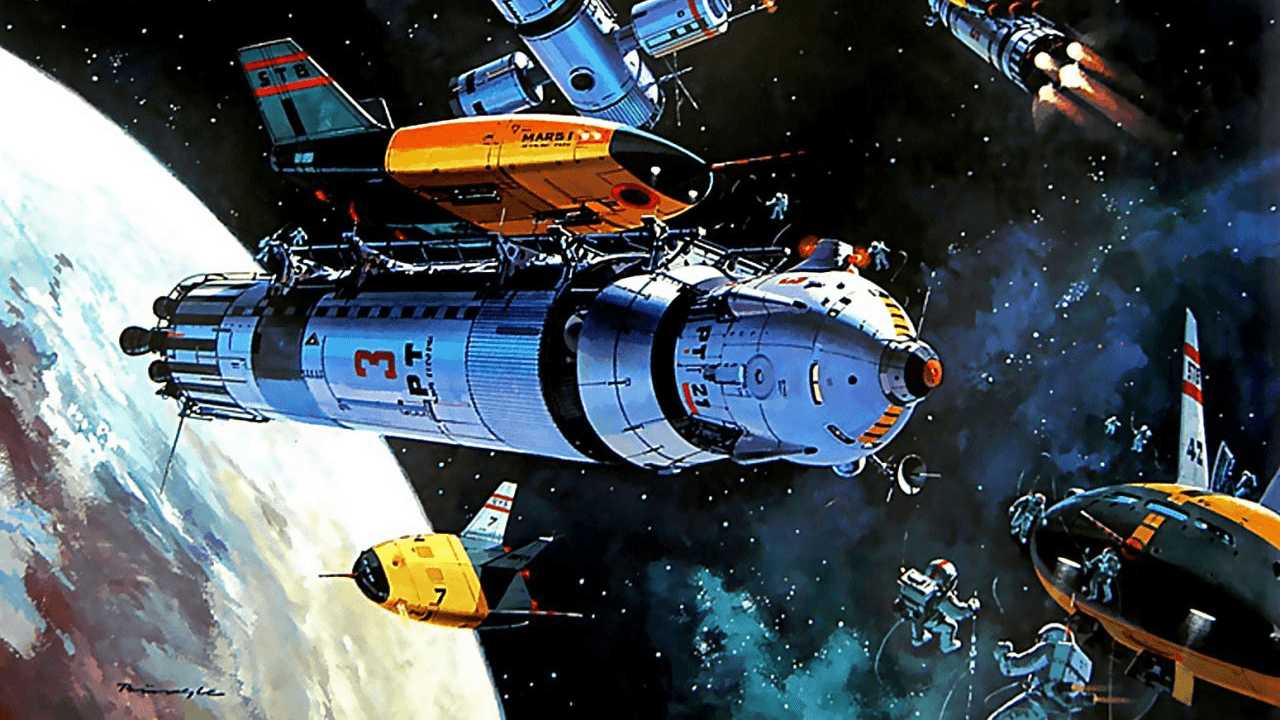
For much of the 20th century, space travel was not yet a settled fact of life. It was a dream in motion, half science, half national fantasy. Older science fiction captured that moment beautifully. Rockets are built like monuments. Launches feel ceremonial. Astronauts look less like technicians and more like ambassadors.
That matters because retro sci-fi often framed space as a moral frontier as much as a physical one. To go beyond Earth was to test discipline, courage, and civilization itself. Space stations, moon bases, and planetary colonies were imagined as extensions of social order. They were not just locations. They were thought experiments about what humanity would carry with it.
And yet the optimism was never pure. Even the brightest space-age fantasies often hinted at vulnerability: sealed habitats, fragile systems, lonely voyages, and the possibility that the very tools meant to extend civilization could isolate us from it.
The Anxiety Beneath the Shine
If retro science fiction only celebrated progress, it would feel flat. The reason it endures is that it also records fear. The same decades that gave us pristine futures also produced stories about automation gone wrong, machines that outpace ethics, and governments that weaponize technology.
This tension is one of the genre’s defining features. A sleek city can be a dream of abundance or a warning about surveillance. A robot helper can signal liberation from drudgery or the replacement of human judgment. A space program can symbolize exploration or militarized competition. The visual vocabulary stays similar, but the emotional meaning shifts.
Older science fiction understood, even before the language was common, that every technological promise creates a shadow. Faster communication can mean stronger connection or deeper monitoring. Smarter systems can mean convenience or dependence. The future is never only what we gain. It is also what we surrender.
The machine as a stand-in for social power
Many vintage sci-fi stories project political concerns onto hardware. A computer is never just a computer. It can represent bureaucracy, central planning, authoritarian logic, or the fantasy of perfect objectivity. A robot is never just a robot. It can be worker, servant, threat, or mirror.
That is why retro science fiction often feels so contemporary. The machinery may be dated, but the questions are familiar. Who controls the system? Who benefits from it? What happens when efficiency becomes a moral value in itself?
Why Vintage Cover Art Still Works
Cover art is one of the clearest windows into retro sci-fi imagination. A single image had to do a lot of work: sell the adventure, signal the mood, and suggest the scale of the unknown. So artists reached for bold silhouettes, impossible landscapes, radiant planets, and figures caught between awe and danger.
Those covers mattered because they turned speculative ideas into immediate emotion. A reader did not need a long explanation to understand that a gleaming tower, a tiny figure, and a looming alien sky meant wonder—and risk. The composition itself taught expectation.
That is also why old covers remain so influential in modern design. They distill future-thinking into icons: domes, jets, masks, antennae, star fields, ray beams. Even when the details feel dated, the visual grammar still reads instantly.
What Retro Science Fiction Reveals About Its Time
The best way to read retro science fiction is as a cultural record. Its futures reveal the values of the era that produced them.
- Optimism about systems: Many stories assume that planning, engineering, and expertise can solve large-scale problems.
- Faith in mobility: Rockets, flying cars, and moon colonies suggest a world where movement equals progress.
- Fear of dehumanization: Automation and bureaucracy often appear as threats to individuality.
- Anxiety about war: Space-age imagery frequently overlaps with military power and Cold War thinking.
- Hope for reinvention: New worlds are often presented as places where society can start over.
What makes these ideas compelling is the contradiction between them. A mid-century future could be utopian and fragile, orderly and unstable, confident and deeply uneasy. That mix is part of the charm. It gives the genre its emotional depth.
The Human Scale Behind the Machine Age
A lot of retro sci-fi design is about scale. Huge rockets. Vast domes. Endless corridors. But underneath that scale is a very human concern: how do people live inside the systems they create?
Old science fiction repeatedly returns to domestic life, labor, education, and family because the future was never just about ships and planets. It was about whether technology would make ordinary life lighter or more constrained. Would kitchens become automated and leisure expand? Would cities become more livable? Would work become safer? Would children inherit abundance or scarcity in a new form?
These are practical questions disguised as speculative spectacle. That may be the secret of the genre’s longevity. Retro science fiction is full of machines, but its real subject is adaptation. It asks what kind of society can hold together once invention starts moving faster than habit.
Why We Keep Returning to These Old Futures
Modern science fiction can be darker, more fragmented, and more skeptical of progress. But retro sci-fi keeps calling people back because it offers something rarer now: a future imagined with directness. Even when those visions are wrong, they are rarely timid.
They reflect a moment when technology still seemed capable of becoming architecture for hope. That does not mean those stories were naïve. It means they took ambition seriously. They understood that every future is partly a design choice and partly a cultural confession.
So when we look at a bubble-domed city, a chrome rocket, or a pulp invention bristling with tubes, we are not just looking at old style. We are looking at a historical mood: faith in progress, dread of its cost, and the stubborn conviction that tomorrow could still be built differently.
A future that never really disappeared
The best retro science fiction does something modern design often forgets: it makes the future feel arguable. Not fixed. Not inevitable. Argue with it, admire it, laugh at it, fear it—but do not ignore it.
That is why these old visions still matter. They remind us that every generation invents its own tomorrow, and every tomorrow arrives carrying the hopes and blind spots of the people who imagined it first.
If you’ve got a favorite vintage sci-fi image, cover, or story that still captures the future for you, share it in the comments—I’d love to hear what stuck with you.