

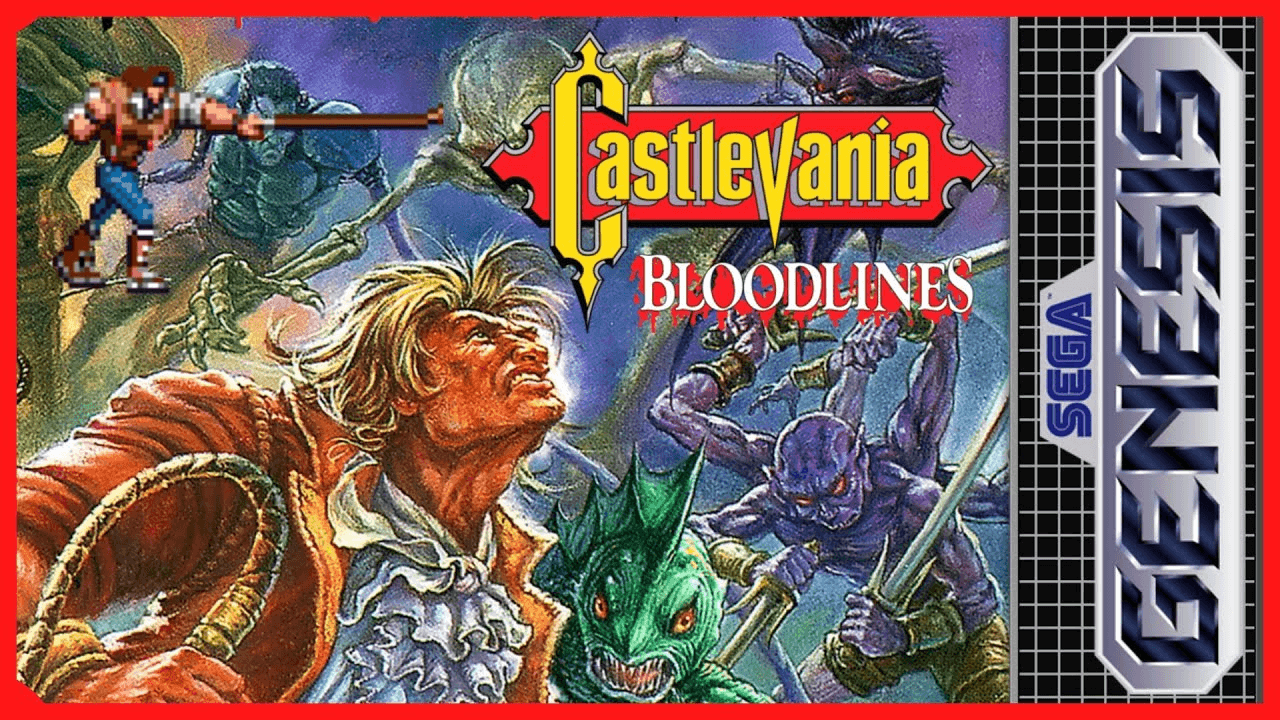
Image credit: Draft web reference from youtube.com
Blade, Boots, and Bloodless Efficiency: Castlevania: Bloodlines on Sega Genesis Still Feels Ferocious
Castlevania: Bloodlines on Sega Genesis is one of those late-era action games that wastes almost no motion. It does not linger. It does not ramble. It throws you into a sequence of tight spaces, nasty enemy placements, and weapon choices that matter more than they first appear to. That is a big part of why it still feels so sharp now: the game is built around speed, but it never confuses speed with sloppiness.
A lot of older action games are remembered for atmosphere first and mechanics second. This one earns its reputation the other way around. The mood is still there — the dark ruins, the elegant menace, the monster-soaked backdrops — but what stays in your hands is the feeling of being pushed to move correctly, not just quickly.
Castlevania: Bloodlines on Sega Genesis and the art of forward pressure
What makes Castlevania: Bloodlines on Sega Genesis stand out is how aggressively it keeps the player advancing. Levels are compact, but they are not gentle. The game does not build long, sprawling stages that let you settle in. Instead, it keeps changing the shape of the space in front of you: narrow ledges, awkward jumps, enemies that appear at the edge of your reaction window, and hazards that punish hesitation.
That creates a very specific kind of momentum. You are not cruising through a haunted castle. You are threading through it.
The best retro action games often do this trick of seeming simple until the timing tightens. Bloodlines leans hard into that idea. It is readable, but it is rarely forgiving. Rooms are designed to force decisions quickly:
- Do you stop to clear a threat or keep moving?
- Do you take the safer route and risk losing tempo?
- Do you spend a second setting up a stronger attack, or do you strike immediately?
Those are small questions, but the whole game is made of them. The result is a run that feels compact because it is constantly asking you to act.
Weapon behavior is the real language of the game
One of the biggest reasons the game still feels unusually focused is the way its weapons behave. This is not a system built around easy, universal comfort. Different weapons change the rhythm of your movement, the reach of your attacks, and how confidently you can handle pressure from more than one angle.
That matters because the game’s difficulty is not just about enemy damage or stage hazards. It is about how well your attack tool fits the moment. A weapon that reaches well might help in a cramped hallway. Another might give you control over a specific enemy pattern but feel awkward when the screen gets crowded. Once you start reading the game this way, Bloodlines feels less like a side-scroller and more like a duel between your timing and its choreography.
A lot of action games reward memorization. Bloodlines rewards familiarity, but it also rewards decisiveness. If you hesitate while testing a weapon, you feel it immediately. If you commit to one and learn its rhythm, the game becomes more playable in a very satisfying way — not easier, exactly, but cleaner.
That cleaning-up effect is important. It is why this game feels so lean. There is very little excess in the way it expects you to fight.
Why the enemy pressure never lets the stage go slack
The enemies in Castlevania: Bloodlines on Sega Genesis are doing more than filling space. They are shaping tempo. A good enemy layout in an action game does not just ask you to attack; it asks you to manage your movement under stress. Bloodlines understands that, and it keeps turning up the pressure in ways that feel deliberate.
You will often run into enemy patterns that are more annoying than dramatic in isolation, but together they create a constant sense of friction. One threat pushes you forward while another blocks the landing zone. A flying enemy enters from a bad angle right as you line up a jump. A ground enemy closes the space you wanted to use as a buffer. The game becomes less about surviving one dramatic set piece and more about never getting lazy for even a second.
That is why its compactness works. A longer stage could dilute that intensity. Instead, the game keeps the pressure high enough that every screen feels like part of one continuous argument.
The late-Genesis speed is part of the identity
There is a particular pleasure in games from the last stretch of a console’s life cycle. Developers know the machine better. They know how much can be packed onto the screen without turning the experience into noise. Bloodlines feels like one of those games that understands the Genesis as a platform for hard edges and quick reactions.
That does not mean it is chaotic. It means it has confidence in clean timing. Animations are brisk. Movement is responsive. Encounters are structured around moments instead of lingering patterns. You feel that throughout the entire run, and it gives the game a kind of severity that still lands today.
It also explains why the game stands apart from better-known entries in the series. Some Castlevania games are remembered for exploration, layering, or atmosphere you can slowly drift through. Bloodlines is more immediate. It is not trying to be the biggest or the most sprawling. It wants to be the sharpest thing in the room.
What makes the run feel punishing instead of bloated
There is a difference between a game being hard and a game being efficient about its punishment. Bloodlines is the second kind. Its challenge does not come from endless padding. It comes from the fact that it rarely wastes your time on easy victories.
That compactness changes how failure feels. When you lose in a long, meandering game, you may blame endurance or repetition. In Bloodlines, you usually know exactly what went wrong:
- you mistimed a jump,
- you entered a room too aggressively,
- you committed to an attack before reading the enemy placement,
- or you got impatient with the stage’s rhythm.
That is a very retro kind of honesty. The game does not hide the lesson. It punishes you, then asks whether you learned anything.
And because the stages move quickly, those lessons arrive quickly too. That makes every mistake feel more useful. You are not slogging through a long failure state. You are re-entering the same compact pressure cooker with a little more knowledge than before.
Why precision matters more than brute force
If there is one idea that ties the whole experience together, it is precision. Not perfection, but precision. Bloodlines does not want you to be fearless. It wants you to be exact.
That shows up in the way you handle movement, the way you manage weapon range, and the way you respond to enemy timing. Even the strongest run feels as if it is held together by small correct choices. That gives the game a wonderfully tense texture. You never feel like you have solved it in a broad, comfortable sense. You feel like you are maintaining control, one clean decision at a time.
That is part of what makes the game so replayable. Once you understand its logic, the whole thing changes shape. It stops being a harsh gauntlet and becomes a test of rhythm. You start noticing how often the game gives you just enough room to succeed if you are disciplined.
A focused action game that knows exactly what it wants
The most impressive thing about Castlevania: Bloodlines on Sega Genesis is not that it is difficult, or stylish, or fast. It is that all of those qualities serve the same purpose. The game knows what kind of experience it wants to create, and it never drifts away from that goal.
Its stages are compact because they need to be. Its weapons matter because the game is built around exact responses. Its enemies feel relentless because the whole design depends on pressure. Nothing in it seems accidental. Even now, that kind of clarity stands out.
In a genre full of sprawling oddities and beloved detours, Bloodlines feels almost severe in the best way. It is a lean action game with a ruthless sense of timing, and that gives it a lasting edge. It still feels fast because it was built to reward players who can keep up. It still feels mean because it never stops testing whether you can.
And it still feels unusually focused because, all these years later, it knows exactly how to make every screen count.
If you’ve played it, I’d love to hear how it landed for you — and if you haven’t, tell me which retro action game still feels most precise to you in the comments.