

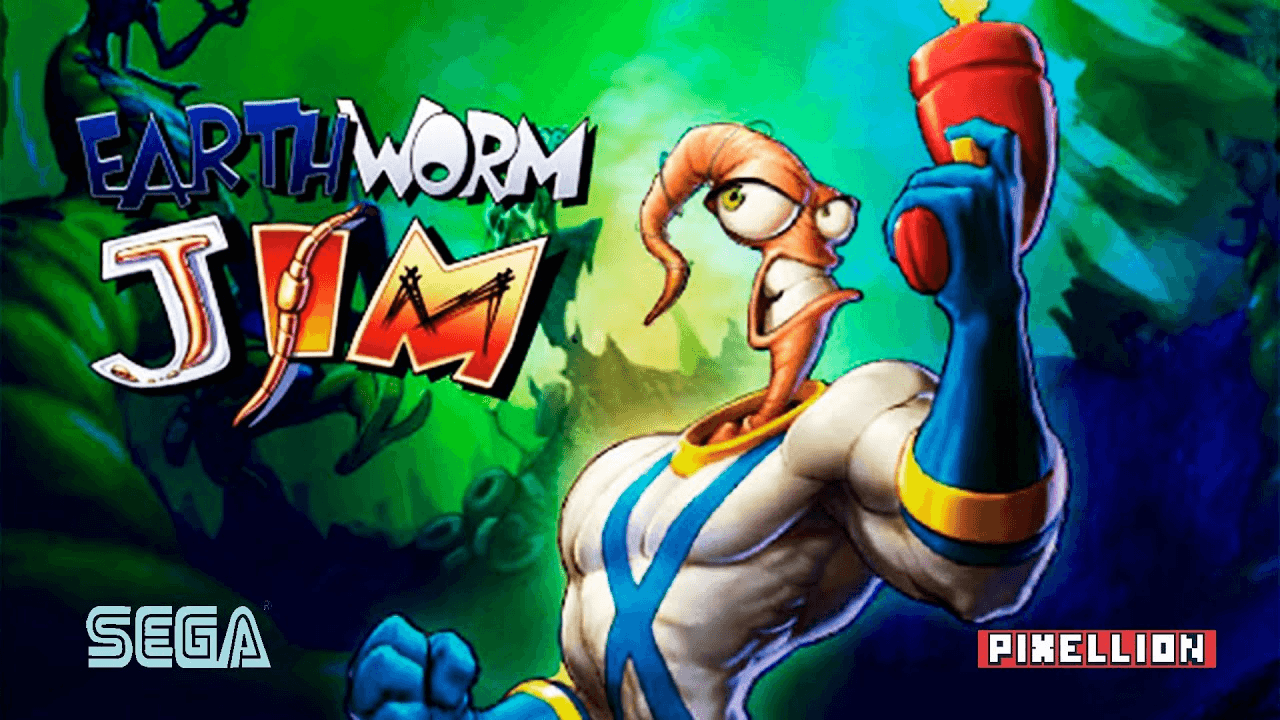
Image credit: Draft web reference from youtube.com
Slapstick Teeth: Earthworm Jim on Sega Genesis and the Art of Cruel Charm
Earthworm Jim on Sega Genesis looks like a joke that learned how to bite. On the surface, it is all rubbery animation, absurd props, and a sense that every screen is trying to outdo the last one with a punchline. But spend real time with it and the laughter starts to share space with something less cuddly: exact jumps, hostile enemy placement, and the kind of stage memory that only comes from getting punished enough times to memorize a room by heart.
That contrast is the game’s lasting trick. It sells itself as a cartoon that somehow escaped onto a cartridge, yet it behaves like a demanding action platformer that expects discipline. The spectacle is not just decoration. It is camouflage.
The joke is the hook, but the stage is the test
The first thing Earthworm Jim understands is that first impressions matter. It wants you to notice how strange it is before you have time to count frames. The hero is a worm in a high-tech suit. The enemies are grotesque, silly, and often random-looking. Backgrounds shift from junkyard chaos to alien absurdity to toybox nightmare. Even the music and sound effects lean into the idea that everything on screen is one bad idea away from collapsing into pure nonsense.
That confidence does real work. It makes the game feel loose, even playful, and that looseness can distract from how tightly built many of the stages are. You are not just moving through a cartoon. You are navigating a sequence of traps that want precision from the player while pretending not to.
The result is a game with two faces:
- one face is a hyperactive comedy sketch
- the other is a stern platformer that remembers every mistake
That split is why the game sticks in memory. It feels wildly improvisational even when it is asking for very specific behavior.
Earthworm Jim on Sega Genesis is full of stage gimmicks, and that is the point
A lesser game would use gimmicks as one-off distractions. Earthworm Jim uses them as identity. Each level wants to be a small mechanical novelty, whether that means riding unusual hazards, surviving awkward environmental changes, or responding to a stage concept that seems determined to make your muscle memory unreliable.
That is part of why the game feels so alive. It does not settle into a single rhythm for long. Just when you think you understand its cadence, it throws in a different kind of movement challenge or an enemy arrangement that changes how you read the screen.
But the gimmicks are not just there to amuse. They often sharpen the difficulty because they break routine. A player cannot coast on broad platformer instincts alone. The game asks for:
Timing
Jumps land only when you commit with confidence. Hesitation is punished, and so is panic.
Pattern recognition
Enemies are rarely just decoration. Many exist to interrupt, reposition, or trap you.
Memorization
The game often feels fair only after you have already been surprised once.
Recovery skill
The gap between a funny mistake and a dead run is usually short.
That design gives the game its personality. The joke is that it is chaotic. The reality is that it is structured enough to demand respect.
Why the cartoon style makes the difficulty hit harder
A grim-looking platformer can prime you for punishment. Earthworm Jim does the opposite. Its art style suggests mischief, not rigor. The color palette is bright. The animation is elastic. The enemies are designed to be memorable in a grotesque, comic-book way. It is easy to mistake all of that for softness.
Then the game starts asking you to execute with precision.
That mismatch matters. When a game looks this playful, failure feels almost rude. You are not expecting to be tested so harshly, so each mistake lands with extra sting. The comedy sets a trap for the player’s confidence. By the time the game starts tightening the screws, you already care enough to keep going.
This is one reason Earthworm Jim still gets talked about with affection instead of just frustration. Its difficulty does not erase its sense of fun; the two qualities amplify each other. The slapstick makes the struggle memorable, and the struggle keeps the slapstick from evaporating into novelty.
The platforming is more exacting than the reputation suggests
People often remember Earthworm Jim as a weird mascot-era oddity, which is fair as far as it goes. But the reputation can flatten how serious the platforming actually is. Movement has weight. Enemy placements matter. Safe-looking spaces are not always safe. The game rewards players who notice how an area is composed, not just how it looks.
That means success is usually earned through observation, not improvisation. You may enter a stage expecting playful chaos, but what you really need is a plan. Where do enemies spawn? Which hazards repeat? Which jumps can be made cleanly only if you approach from the right angle? Which animation, background flourish, or odd prop is actually telegraphing danger?
The answer, more often than not, is: all of them.
That density is part of the challenge. Earthworm Jim wants to overload your senses just enough to make you miss the important detail. The player who slows down, studies patterns, and respects each room usually survives. The player who treats it like a loose cartoon usually gets turned around fast.
Its personality is not window dressing; it is the memory engine
A lot of retro games are remembered for mechanics alone. Earthworm Jim is remembered because the mechanics are welded to image and tone. The stages are not just hard. They are weird in a way that makes the hard parts easier to recall. A bizarre enemy or bizarre setup becomes a mental hook. You may not remember the exact layout of a level on the first pass, but you remember the joke, and the joke helps you remember the threat.
That matters more than it sounds. In a game built on memorization, absurdity becomes a design tool. It gives the player landmarks. It turns challenge into story. When you fail in Earthworm Jim, you are not just losing a life; you are collecting another anecdote about the game’s willingness to be cruel in a funny outfit.
The best retro action games often do this. They create conditions that are harsh enough to be distinct but stylish enough to remain lovable. Earthworm Jim does it with more confidence than most. It refuses to be a neutral platformer. Every screen is making a face at you.
Why it still stands out among Sega Genesis platformers
The Sega Genesis had no shortage of fast, polished action games. That is part of why Earthworm Jim mattered. It did not compete by being merely competent. It competed by being unforgettable. The animation was a sales pitch, yes, but it also helped the game cut through a crowded era where many platformers were chasing speed, attitude, or mascot appeal.
What makes Earthworm Jim interesting now is that it was never just style. Style was the packaging for a game that wanted to be genuinely hard and genuinely strange at the same time. That combination gave it a sharper identity than many peers. It did not simply ask, “Can you beat this level?” It asked, “Can you beat this level while being distracted by how ridiculous everything looks?”
That is a subtler trick than it first appears. Plenty of games have humor. Plenty have challenge. Fewer use comedy to disarm the player before asking for precision.
The hidden lesson: spectacle can make discipline feel fresh
Earthworm Jim on Sega Genesis is a reminder that spectacle does not have to dilute difficulty. In the right hands, it can make difficulty more memorable. The game’s cartoon energy does not soften its challenge. It sharpens the contrast, turning every tough jump and every surprise enemy into part of a larger comic rhythm.
That is why it still feels worth revisiting. Not because it is easy to love in a simple way, but because it is so committed to being itself. It is a platformer that dresses like a punch line and plays like a dare.
And that tension is the whole appeal.
If you remember fighting your way through it, or if you came to it later and felt the difficulty spike immediately, share your take in the comments. I’d love to hear which retro platformers nailed that same mix of style and punishment for you.