
Image credit: Draft web reference from dkoldies.com
The kind of action game that barely lets you blink
Gunstar Heroes on Sega Genesis is the rare run-and-gun game that feels fast without becoming messy. That matters, because a lot of action games from the 16-bit era try to impress you with speed and end up hiding the actual game underneath the noise. This one does the opposite. It moves quickly, throws a lot at the player, and still stays legible.
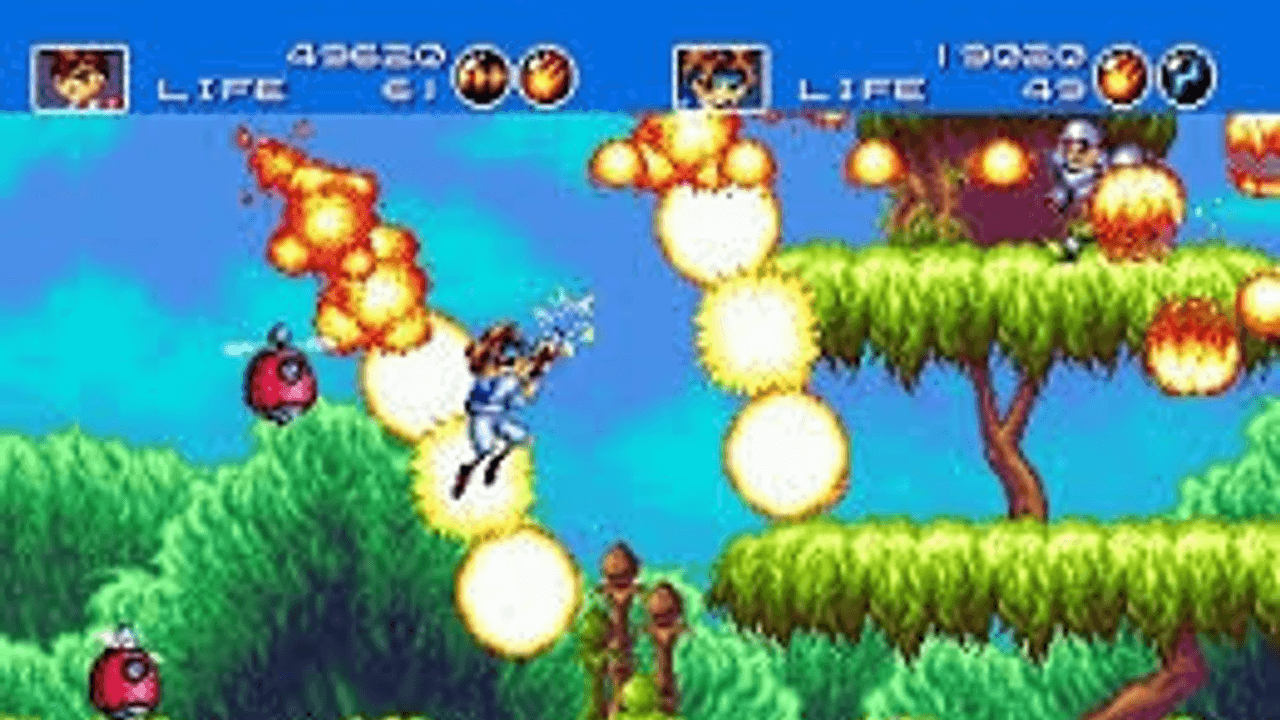
That balance is why it still holds up. The appeal is not just that it is frantic. It is that the design keeps asking for snap decisions, then gives you enough visual clarity to make them. You are constantly moving, shooting, switching weapons, and reacting to stage gimmicks, but the game rarely feels arbitrary. Even when the screen is crowded, it feels like the rules are visible.
That is a big reason Gunstar Heroes remains thrilling decades later. It does not depend on nostalgia for a simpler time. It depends on action design that still understands pacing, surprise, and how to keep the player in control while everything around them is exploding.
Speed that serves the rhythm
A lesser game would treat speed as the main attraction. Gunstar Heroes treats it as part of the language.
The game’s run-and-gun rhythm works because movement and offense are intertwined. You are not just dodging between bursts of enemy fire. You are advancing through spaces that demand aggression. Standing still is rarely the answer, but mindless rushing is not either. The game wants you to move with intent, cut through enemies efficiently, and keep your momentum without losing awareness of what is about to land on top of you.
That creates a satisfying push-pull. One moment you are clearing small enemies in a straight corridor. The next, the game opens up with hazards, shifting platforms, or boss attacks that force you to read the screen differently. The tempo changes often enough that the action never turns into rote repetition. Instead, it feels like a conversation between player reflex and level design.
The best part is how cleanly the game communicates danger. Enemy patterns are bold. Attacks tend to be easy to distinguish from the background. Bosses are loud and theatrical, but they are not visual mush. That clarity is what lets the speed feel exhilarating instead of exhausting.
Gunstar Heroes on Sega Genesis and the joy of weapon swapping
The weapon system is one of the game’s smartest ideas, and it is a huge part of why Gunstar Heroes on Sega Genesis still feels fresh. Instead of locking you into a single fire mode and hoping the level design compensates, the game lets you mix and match weapons in ways that make experimentation feel rewarding.
This does more than add variety. It gives the action a tactical edge. You are constantly deciding whether to keep a familiar tool, pick up a new one, or combine the current weapon with another to create a different effect. That choice matters because the game’s enemy layouts and boss fights change enough to reward flexibility.
It also gives each run a slight personal signature. Even when you are replaying the same stage, the experience can shift depending on which weapons you find and how comfortably you adapt to them. Some weapons handle crowd control better. Others make boss encounters feel more direct. The important thing is that the game encourages experimentation without punishing curiosity too harshly.
A lot of retro action games are remembered for how hard they are. Gunstar Heroes deserves as much credit for how playful it is. The weapon swapping gives the game a sense of improvisation that keeps the player engaged beyond pure survival.
Why the system still feels readable
The weapon mechanics work because they are built around fast recognition rather than deep menu management. You can understand what is happening in a split second. That matters in a game this quick. If the systems were more opaque, the whole thing would collapse under its own speed.
In practice, the game turns weapon choices into immediate action decisions:
- keep the current weapon and press the attack
- switch to something better suited for a boss pattern
- combine pickups to open a new combat option
- adapt mid-stage when the game changes the terrain beneath you
That kind of responsiveness is what makes the design feel modern without needing modern complexity.
Stage variety keeps the game from settling into one groove
If Gunstar Heroes only had one good trick, it would not have lasted. What really elevates it is the amount of mechanical variety packed into its stages. The game refuses to coast on a single formula.
One section may emphasize direct shooting and movement. Another may lean into platforming pressure. Another may escalate into a boss fight that feels like its own set piece. Then the game changes gears again. It is always reintroducing itself.
That variety matters because it keeps the player alert. You are not just mastering one perfect lane of action; you are constantly recalibrating. The game’s pacing is built around surprise, but the surprises do not feel random. They feel curated. Each new section arrives with a new physical logic, and the player can usually grasp it quickly.
That is why the game ages so well. It is not just a series of impressive moments, though it certainly has those. It is a chain of ideas that are introduced, escalated, and replaced before they wear out. The design has confidence in brevity. It knows when to move on.
Co-op gives the chaos a social charge
Played alone, the game is already intense. Played with another person, it becomes louder, funnier, and more volatile in the best possible way.
Co-op changes the energy because the screen is not only filled with enemies and hazards. It is also filled with another human making split-second decisions beside you. That adds a layer of shared improvisation. Good co-op in action games does not just double the firepower. It doubles the personality in the room.
Gunstar Heroes benefits from that immediately. It becomes a game about coordination, rescue, and occasional chaos management. Sometimes one player takes the lead on a boss. Sometimes both players scatter to survive a screen-filling attack. Sometimes the funniest part is simply trying to keep up with each other while the game continues to escalate.
This is part of why the game still gets talked about with such affection. It is not only a technical showcase. It is a social one. It creates stories in real time.
Bosses that are huge without becoming unreadable
The boss design is one of the strongest arguments for the game’s lasting power. The encounters are big, strange, and often ridiculous, but they remain understandable.
That balance is harder to pull off than it looks. Big bosses in retro action games can become cluttered, with patterns obscured by flashing effects or tiny weak points hidden inside visual noise. Gunstar Heroes mostly avoids that trap. Its bosses tend to have a clear silhouette, obvious attack rhythms, and enough visual personality to feel memorable at a glance.
What makes them exciting is not just size. It is progression. Many bosses feel like they evolve mid-fight, shifting forms or changing tactics just when you think you have decoded them. That keeps each encounter from flattening into a single loop. The fights have structure, but they also have drama.
The result is a game that repeatedly delivers the feeling of escalation without losing fairness. You can be overwhelmed and still understand why.
The secret is clarity, not simplicity
It is tempting to describe Gunstar Heroes as simply “fast” or “chaotic,” but that undersells the craft. What the game really does well is make complexity legible.
Its stages are busy, but their goals are rarely confusing. Its enemies attack aggressively, but they usually do so in patterns you can learn quickly. Its weapon system gives you options, but not so many that you freeze. Its co-op mode creates mayhem, but the action stays readable enough that the mayhem feels earned.
That is the design lesson that still stands out. The game understands that high-speed action only works when the player can process the screen in time to respond. It does not solve that problem by slowing down. It solves it by communicating better.
That is why revisiting it now can feel almost refreshing. So many games mistake noise for intensity. Gunstar Heroes is intense because it is clean.
Why it still works now
More than any single feature, the game’s lasting appeal comes from how all of its systems reinforce each other.
- Speed keeps you engaged.
- Weapon swapping keeps you improvising.
- Stage variety keeps the structure from going stale.
- Co-op keeps the experience lively.
- Clear visual design keeps the whole thing readable.
Taken together, those elements make Gunstar Heroes on Sega Genesis feel less like a relic and more like a template for elegant action design. It is old, yes, but not in a way that feels dated. Its best ideas still communicate instantly.
That is a rare thing in retro games. Some are valuable mainly as history. Some are interesting because they show where later design ideas came from. Gunstar Heroes does those things, but it also does the most important one: it remains genuinely fun to play.
If you want a run-and-gun game that still feels like it has momentum in its bones, this is one of the sharpest examples ever made.
What do you think—does Gunstar Heroes still rank among the best action games of its era? Share your favorite weapons, stages, or co-op memories in the comments.