
The first thing Metal Gear Solid on PlayStation does right is make you read the room
People still remember Metal Gear Solid on PlayStation as a cinematic milestone, which is fair. It arrived like a playable action thriller, with voice acting, camera cuts, dramatic entrances, and a story that kept leaning into espionage melodrama. But that reputation can hide the real achievement: the game is not cinematic instead of readable. It is cinematic because readability matters.
That distinction is everything. A lesser game would use the same flourishes to bury the player in spectacle. Metal Gear Solid uses them to teach you how to think.
The result is a stealth game that feels directed without feeling over-directed. Every room, camera angle, radio call, boss encounter, and enemy patrol pattern is doing a job. The game’s style is not decorative. It is functional language.
Cinematic presentation as a stealth tool, not a layer of noise
Metal Gear Solid arrived at a moment when many developers were still testing how far a game could push presentation before play got muddy. The PlayStation hardware gave the team enough room to stage scenes with strong visual framing, but the designers rarely waste that power on empty flash.
Instead, the presentation clarifies stakes and space:
- Cutscenes establish who matters and what the player should care about.
- Camera shifts highlight threats or reveal spatial relationships.
- Close-ups punctuate important clues without forcing the player to hunt them down.
- Dramatic pauses separate action beats so the game’s rules stay legible.
That last point is easy to miss. The game rarely lets its cinematic style and its play systems compete at the same time for long. It stages the story, then hands the room back to you with a clean goal and a clear toolkit.
That is why the whole thing still feels sharp. The game understands that stealth is a mental activity before it is an action activity. If you can see the puzzle, you can solve it.
Why the top-down framing makes stealth easier to learn
One of the smartest choices in the original PlayStation version is its framing. The overhead-ish perspective and tight third-person camera don’t just give the game a signature look; they make the stealth rules readable at a glance.
You are rarely confused about where cover ends, where a hallway bends, or what an enemy cone of vision is likely to catch. Even when the camera tightens for tension, the environment is built in clean, useful shapes. The game favors corridors, vents, fenced compounds, narrow control rooms, and compact outdoor spaces because these spaces are easy to parse.
This matters because stealth can easily become invisible chaos. Metal Gear Solid avoids that by making its levels feel like controlled stages:
1. Each area has a clear patrol rhythm
Guards are dangerous, but they are not random. Their routes are learnable. Their pauses are readable. Their sightlines make sense. That predictability creates tension because you can understand the rules well enough to plan around them.
2. The game uses architecture to explain danger
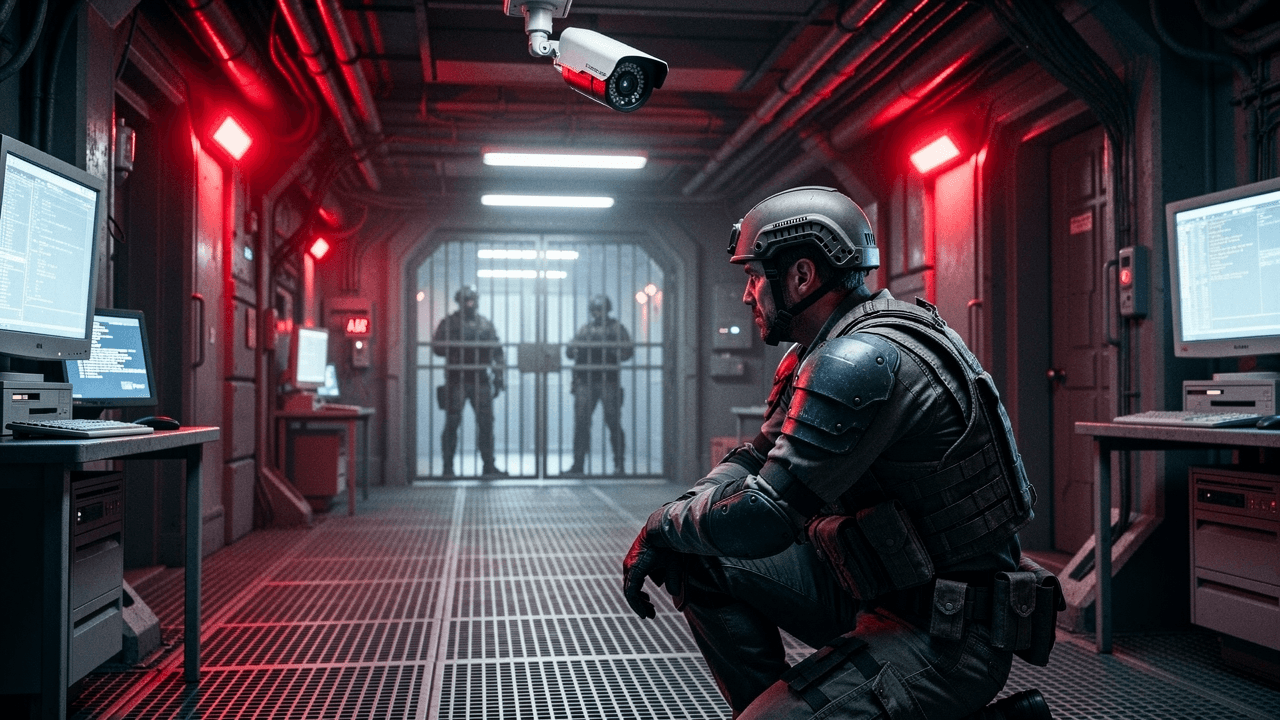
A long hall signals exposure. A corner offers timing. A vent suggests bypass. A camera mounted high in a room tells you the space is being watched even before an alert happens. The game does not need to overexplain these ideas because the environment itself is already talking.
3. The player is rarely asked to multitask visually
Unlike messier action games, the screen is not crammed with competing objectives. You are not reading a dozen overlapping UI systems. You are reading movement, vision, sound, and line of sight. That simplicity is what makes the cinematic style possible in the first place.
The game looks dramatic, but it is built like a diagram.
Codec calls are exposition, but they also function as pacing control
The codec is one of the most famous parts of the game, and it is easy to think of it only as story delivery. It does much more than that.
Codec conversations are how Metal Gear Solid regulates tempo. They let the game shift from tension to explanation without losing the player’s place in the larger structure. Instead of forcing lore into the environment in clumsy ways, the game pauses, explains, and then returns you to a space where those details matter.
That structure solves a classic stealth problem: how do you teach the player without breaking immersion every five minutes?
Metal Gear Solid’s answer is to make radio dialogue part of the mission rhythm. You clear a segment, call in, learn something useful, and move on. The conversations can be theatrical, funny, or absurd, but they almost always serve one of three functions:
- reinforcing the mission objective
- explaining a mechanic or enemy behavior
- expanding a character in a way that affects how you read the story
The codec also keeps the player from being stranded in silence after intense sequences. That is especially important in a game that wants both suspense and personality. The radio chatter gives the campaign a pulse. It is exposition, yes, but it is also a breathing space between stealth problems.
Boss fights are where the game proves its presentation has rules
If the stealth sections teach patience, the bosses prove the game can turn personality into mechanics.
A lot of cinematic games rely on bosses as spectacles that exist outside the normal rule set. Metal Gear Solid does something more elegant. Its bosses are theatrical, but they are still readable. Usually, they are built around a single clear gimmick, or a small cluster of related ideas, that the player can understand through observation.
That is why they work so well in the original PlayStation version. The game frames each encounter like a showpiece, but it does not abandon its logic to do it.
A typical boss in the game asks you to do some combination of the following:
- identify a pattern
- use the environment intelligently
- manage limited resources
- interpret dialogue or visual hints for the next phase
That design keeps the fights from becoming noise. They feel dramatic because they are legible under pressure.
And because the bosses are so character-driven, they also act as punctuation marks in the story. Each one feels like a personality test as much as a mechanical test. The game is constantly asking: do you understand this enemy, or are you just trying to survive them?
The game’s stealth rules are simple on purpose
A huge part of the game’s lasting appeal is that it does not try to overload the player with systems. The stealth rules are spare, but not shallow.
At a high level, you learn a handful of essentials:
- stay out of sight
- use sound carefully
- hide bodies or avoid leaving obvious evidence
- watch patrol patterns before moving
- treat alarms as temporary disasters, not the end of the world
That simplicity is what makes the game’s cinematic style possible. If the rules were more complicated, the cutscenes and radio calls would become interruptions. Because the core logic is compact, the narrative flourishes feel like they belong to the same experience.
The game also helps by communicating failures cleanly. When you are spotted, you know why. When a plan falls apart, the cause is usually visible. That makes stealth feel like a conversation with the level rather than a guessing game.
A readable stealth game does not mean an easy one. It means the punishment feels fair because the information was there.
Why the original PlayStation version still feels cohesive
Later stealth games would expand systems, deepen movement options, and push presentation further. But the original PlayStation version has a special cohesion because its ambitions match its constraints.
The graphics are stylized enough to separate important shapes from background detail. The camera is disciplined enough to support tactical awareness. The voice acting and cutscenes are elaborate enough to sell drama, but not so overwhelming that they drown the mission flow. Even the game’s famous quirky touches fit into the same structure, because they break tension without breaking clarity.
That balance is what makes the game endure. It is not just a movie-like game that happened to be fun. It is a stealth game whose movie-like qualities are part of the fun.
If you want a clean way to think about it, Metal Gear Solid on PlayStation succeeds because it treats presentation as signage. It tells you where the danger is, how to interpret the room, and when to pay attention.
The lasting lesson: style works when it organizes information
A lot of games chase cinematic impact by adding more: more cutscenes, more camera tricks, more spectacle, more noise. Metal Gear Solid’s genius is that it adds style only when style improves comprehension.
That is why the game still feels so carefully designed. The cinematic presentation gives the world attitude, but the stealth rules give it structure. The codec keeps the story moving. The boss fights turn character into puzzle. The level framing keeps the player oriented. Everything feeds the same goal: making the player feel clever inside a tense, authored space.
That is a rare balance, and it is why the original still matters. Metal Gear Solid on PlayStation did not just prove games could look like films. It proved they could borrow film language without sacrificing playability.
And that may be its most durable trick of all.
If you played it back then, or are coming to it later, I’d love to hear how you think it balances spectacle and stealth—share your favorite moments or boss fights in the comments.