

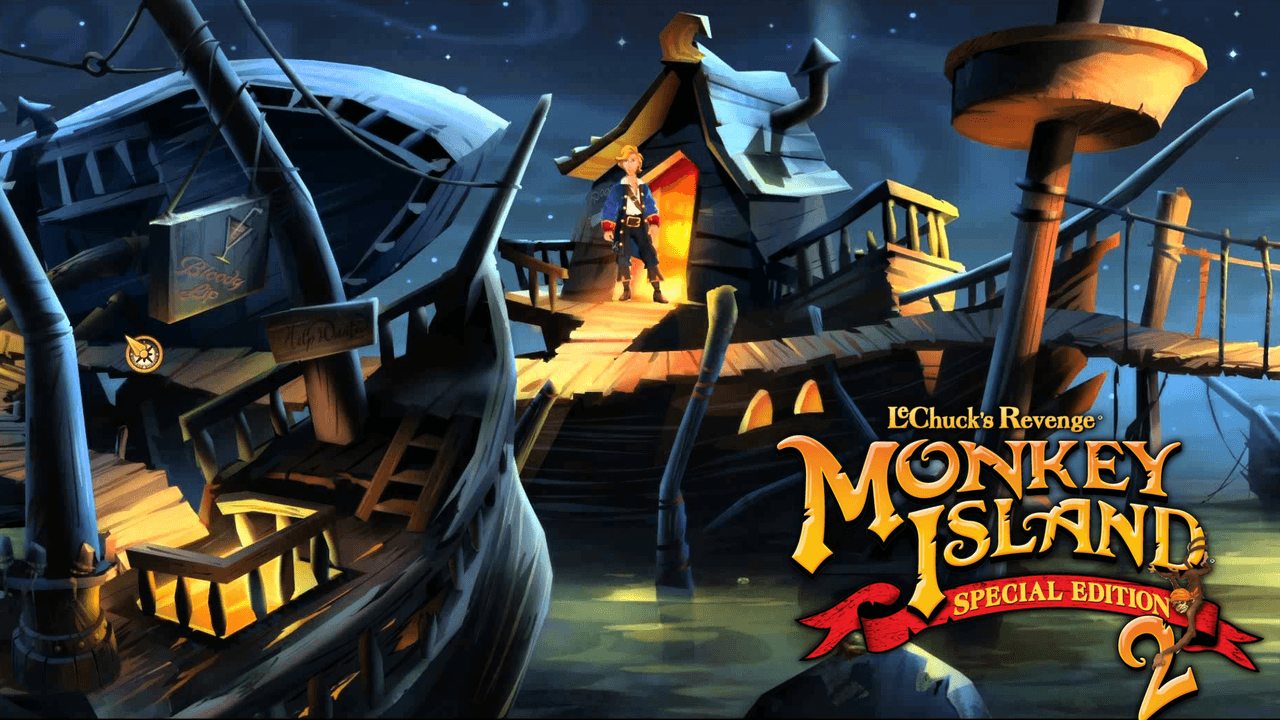
Image credit: Draft web reference from dosgamers.com
A First-Time Player’s Take on Monkey Island 2: LeChuck’s Revenge on PC
I came to Monkey Island 2: LeChuck’s Revenge on PC without the usual armor of nostalgia, which is a useful way to meet an old adventure game. There is no memory smoothing the edges, no childhood affection to excuse a joke that lands sideways, no stored map of every item combination that made sense once upon a time. What’s left is the game itself: a briskly written pirate caper with a mean streak, a handful of puzzles that feel elegantly absurd, and a late-game structure that gets delightfully stranger the longer it goes on.
That first-time-player perspective matters, because Monkey Island 2 is often talked about as if its reputation should automatically explain the experience. It doesn’t. Some of its design still feels sharp enough to cut. Some of it feels like the product of an era that simply expected players to wander, experiment, and occasionally be wrong in public. The result is not a museum piece. It’s a game that keeps revealing its personality in layers.
Monkey Island 2: LeChuck’s Revenge on PC and the comedy of pressure
The first thing that stands out is how little the game treats its jokes like isolated punchlines. The humor is embedded into the motion of play. Conversations are packed with deadpan needling. Item descriptions often feel like punch lines with a job to do. Even a bad idea can become funny if you click the wrong thing and the game reacts with the right amount of disdain.
That tone gives Monkey Island 2 a pace that still feels nimble. It doesn’t over-explain its jokes, and it rarely stops to underline them. The writing assumes a player willing to keep moving, which helps the comedy land as part of the adventure rather than a sequence of scripted gags pasted on top of it.
What surprised me most is how often the game is funniest when it is also most demanding. The puzzles don’t merely sit beside the humor; they create it. You are often solving problems by thinking like a cartoon pirate trapped in a logic system where absurdity is the point, but not the whole answer.
Puzzle logic that is elegant, then suddenly old-school
A modern first playthrough makes the game’s puzzle structure easier to appreciate and harder to forgive at the same time. Some solutions are beautifully readable once the pieces click into place. The game is good at giving you a space, a gag, and a small set of interactable objects, then letting the solution emerge through careful observation.
At its best, Monkey Island 2 makes you feel clever without flattering you too much. It rewards lateral thinking. It likes reversals, misunderstandings, and items whose purpose becomes obvious only after the game has already teased you with them. When the design is on, it has a clean adventure-game logic that still feels satisfying today.
But it is also unmistakably a product of its era in ways that modern players will notice fast. A few puzzles are less like riddles and more like tests of persistence, environmental inventory sorting, or willingness to try every possible verb on every object. That can be charming when the game’s tone is loose and playful. It can also become opaque.
The key difference is that Monkey Island 2 usually feels intentional even when it is frustrating. It doesn’t feel random so much as stubborn. There is a shape to its thinking, and once you understand that shape, the game becomes much more navigable. Before that point, though, it can absolutely ask you to sit with a puzzle longer than you would in a contemporary adventure.
What still works in the puzzle design
- Small, readable spaces that encourage experimentation
- Puzzle setups that support the game’s comic tone
- Strong visual affordances in many scenes
- A sense that each location has its own internal joke logic
- Progress that often feels earned rather than handed to you
Where it feels dated
- Occasional trial-and-error guessing
- Solutions that depend on old adventure-game habits
- A few stretches where momentum drops while you search for the right interaction
- Some late-game sequences that seem designed to be memorable first and convenient second
The tonal shifts are part of the point
One reason the game still feels interesting is that it isn’t content to stay in one register. It can be breezy, almost cartoonishly silly, and then swing into something stranger or more atmospheric. That tonal flexibility gives the whole experience a sense of unpredictability.
The pirate setting is a big part of that. It should be broad, and it is, but it never becomes disposable. Instead, the world feels like a place where jokes and tension share the same air. A goofy character may be immediately memorable, but the environment around them can still feel oddly moody or mysterious.
That balancing act is hard to pull off, and Monkey Island 2 mostly does it with confidence. It understands that comedy gets stronger when the world has stakes, even if those stakes are absurd. As a result, the game’s lighter scenes are funnier, and its weirder stretches feel more deliberate.
The late game gets stranger in a way that still matters
If the early and mid-game are where Monkey Island 2 establishes its puzzle language, the late game is where it starts to show its appetite for oddity. This is where first-time players may feel the design either clicking into a distinct rhythm or drifting into something more elliptical.
For me, those later sections are some of the most memorable because they refuse to settle into a standard adventure-game groove. They feel less interested in tidy escalation than in atmosphere, displacement, and surprise. Even when I wasn’t fully sold on every design choice, I was rarely bored.
That’s an underrated strength. Plenty of older adventure games are remembered for their wit but fade once the structure starts to wobble. Monkey Island 2 keeps pulling you forward because it knows how to make being stuck feel like part of the performance. Sometimes that performance is generous. Sometimes it is maddening. Usually it is both.
Does the humor age well without nostalgia?
Mostly, yes — but not because every joke remains timeless in isolation. The game’s comedy ages well because of timing, specificity, and confidence. It isn’t trying to be universally efficient. It’s trying to be dry, mischievous, and a little theatrical.
Some of the humor depends on adventure-game conventions that newer players may not instinctively share. If you don’t already love the logic of old point-and-click games, a few jokes may feel like rewards for being patient rather than for being surprised. Still, the writing has a clarity that helps. It doesn’t lean on heavy pop-culture references or dated topical humor. It leans on character voice, misdirection, and the elegant stupidity of pirate nonsense.
That gives it longevity. Even when a joke is simple, the delivery tends to be clean. Even when a puzzle is obscure, the world around it usually remains entertaining enough to keep you engaged.
Why it still feels worth playing now
The most compelling thing about Monkey Island 2 on PC, from a first-time-player perspective, is that it feels authored in a way many games still aspire to but rarely match. Its comedy, worldbuilding, and puzzle structure are not separate systems. They are the same system, viewed from different angles.
That doesn’t make it flawless. Some design choices are aged in the obvious way: not broken, exactly, but less considerate than today’s standards. Yet the game’s best ideas still feel alive because they are specific. It knows what kind of jokes it wants to tell. It knows how much friction it wants between you and the solution. It knows how to be weird without apologizing for it.
And for a first-time player, that combination is refreshing. You don’t just get a famous classic. You get a game that is willing to be a little inconvenient if that inconvenience makes the joke better, the scene funnier, or the final answer more satisfying.
Final verdict
As a modern first playthrough, Monkey Island 2: LeChuck’s Revenge on PC is less a comfort-food classic than a sharp reminder of how bold old adventure games could be. Its puzzle logic is uneven but memorable, its tone keeps shifting in ways that still feel purposeful, and its humor mostly survives because it is built into the game’s personality instead of bolted onto it.
If you’re curious about classic point-and-click design, this is one of the essential stops. If you’re coming in fresh, expect some friction. Also expect a game that knows exactly how weird it wants to be.
Have you played Monkey Island 2 recently, or was your first run also a modern one? Share your take, your favorite puzzle, or the joke that still works best in the comments.