

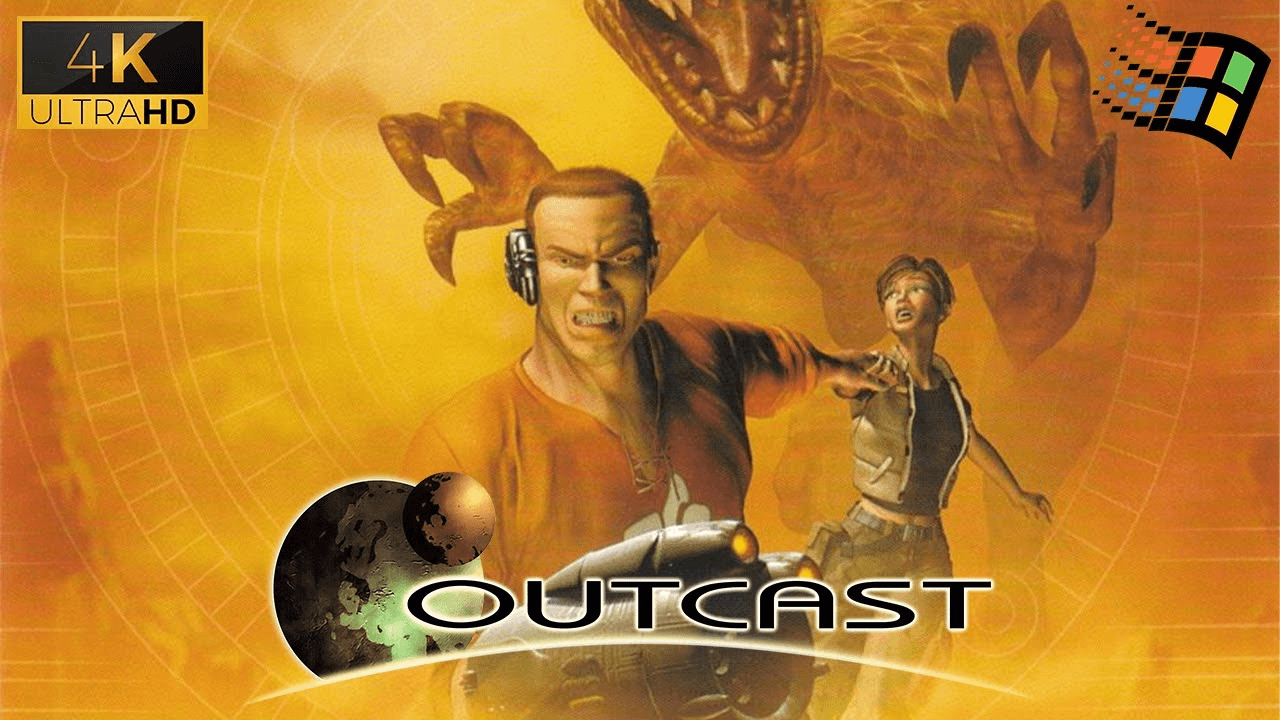
Image credit: Draft web reference from youtube.com
Outcast on PC and the Strange Power of Alien Worldbuilding
Outcast on PC is one of those rare retro games that feels less like a setting you visit and more like a place you have to learn how to survive in. It does not simply ask you to clear enemies and mark objectives. It asks you to understand geography, people, and the logic of a world that refuses to behave like Earth. That ambition is what makes it such a fascinating historical oddity now: imperfect, yes, but stubbornly committed to making exploration feel genuinely alien.
Released in 1999, it arrived at a moment when early 3D worlds were still figuring out how to do scale, readability, and movement at the same time. Many games of the era leaned on familiar fantasy shorthand or corridor-based structure. Outcast did the opposite. It built a planet that felt remote not just because of its art direction, but because nearly every system in the game reinforced the idea that you were an outsider learning local rules.
Outcast on PC treats navigation like part of the fiction
A lot of games sell atmosphere through scenery. Outcast on PC sells it through travel.
From the start, the game makes movement feel deliberate and contextual. You are not just sprinting from one mission marker to another. You are crossing terrain that has weight, distance, and consequence. Valleys take time. Cliffs matter. Rivers interrupt your route. Villages are not arranged for your convenience, and that is exactly the point.
The result is a kind of spatial literacy. You begin to remember paths by landmarks, elevation, and the way settlements nestle into the landscape. That may sound ordinary now, but in a late-1990s PC game, it felt unusually demanding. The world was not there to flatten itself into a minimap-friendly loop. It expected you to pay attention.
That design choice does two important things:
- It slows the player down just enough to notice the planet’s structure.
- It makes getting around feel like a learned skill rather than a UI function.
So when you finally know a route, you do not just know where to go. You know how this world works.
The game’s alienness comes from structure, not just art
Plenty of sci-fi games create novelty through monsters, colors, or architecture. Outcast on PC goes deeper by making the world’s social and geographic layout feel unfamiliar. The villages are distinct. The factions have their own rhythms. The terrain creates natural barriers and informal borders. Even before you understand every detail of the setting, you can feel that you are moving through a civilization with its own internal logic.
That matters because the game rarely relies on exposition alone. It wants the player to infer meaning from placement and pattern. A settlement’s location tells you something about security, trade, and access. A patrol route tells you something about control. A road that detours around a hazard tells you something about the planet’s hostility.
This is one of the reasons the game lingers in memory. Its worldbuilding is not just decorative. It is embodied in the map itself.
Why that still feels unusual
A modern open world often uses convenience as a promise: clearer icons, faster travel, more efficient navigation. Outcast on PC is more interested in mystery. Even when it is being generous, it does not want the player to feel fully fluent right away. It wants the act of learning to be part of the adventure.
That design can be frustrating. It can also be unforgettable.
How the interface reinforces the feeling of being an outsider
One of the most interesting things about Outcast on PC is that its interface does not erase distance between the player and the world. Instead, it often emphasizes it.
Early 3D games were full of awkward HUDs and experimental controls, but here the roughness serves a purpose. Information arrives in a way that feels somewhat mediated, almost like you are operating equipment rather than simply inhabiting a body. That sensation suits the premise perfectly. You are not a native moving through an intuitive environment. You are an outsider trying to interpret a foreign system.
That matters because interface design can quietly shape tone. If the menus, markers, and control flow feel too smooth, the world feels domesticated. If they resist you just enough, the world keeps its edge. Outcast on PC lives in that second space.
Even the act of reading the world feels active. You are constantly translating:
- terrain into route choices
- dialogue into local context
- settlements into political geography
- movement into survival
The game’s interface may not be sleek by later standards, but it is thematically disciplined. It keeps you slightly off balance in a way that supports the fiction.
The early 3D context matters
It is easy to judge an old PC game by modern expectations and miss what it was trying to do in its own era. Outcast on PC was built when ambitious real-time 3D worlds were still unusual enough to feel slightly miraculous. The technical constraints are visible, but so is the ambition.
The game is not merely trying to be big. It is trying to be legible without becoming ordinary. That is a much harder problem.
Its alien landscape has enough variety to suggest depth, but enough consistency to become navigable. Its structures feel handcrafted rather than algorithmic. Its traversal systems are imperfect, yet they create a sense of place that many smoother games never quite reach. You remember not just where things are, but what it felt like to get there.
That emotional residue is the mark of design that understands atmosphere as an interaction between motion and meaning.
Why exploration feels genuinely alien
The strongest compliment you can give Outcast on PC is that it makes the familiar act of map traversal feel culturally specific. You are not simply exploring a fantasy continent with sci-fi props attached. You are moving through a world whose rhythm is different from yours.
That difference shows up in how you orient yourself. It shows up in how you talk to characters. It shows up in the way the game allows distance to matter. Instead of treating travel as dead time between set pieces, it uses travel to build identity. The planet becomes memorable because you do not master it instantly.
The alien quality comes from several layers working together:
- Landmark-driven navigation that encourages spatial memory.
- Non-generic world layout that makes settlements feel rooted in local logic.
- Interface friction that preserves the sense of translating a foreign environment.
- A pace that rewards attention instead of pure efficiency.
Taken individually, none of these ideas is revolutionary. Taken together, they create a world that feels as if it has its own grammar.
Its imperfections are part of its historical value
It would be dishonest to pretend Outcast on PC is flawless. Some of its systems feel unwieldy by modern standards, and some of its ambitions outpace the era’s technology. But that tension is exactly what makes it worth revisiting.
The game is a record of a particular design moment: one where developers were still experimenting with how much personality could be carried by space itself. In that sense, its rough edges are not just flaws to forgive. They are evidence of how hard it was trying.
There is a reason some retro games age into comfort food while others age into conversation pieces. Outcast on PC is a conversation piece. It is the sort of game you return to not because it is the cleanest version of its ideas, but because its ideas are so clearly its own.
Why it still stands out
What makes Outcast on PC endure is not nostalgia for old hardware or a generic appreciation of “innovation.” It is the specificity of its ambitions. It wanted its world to feel strange, its movement to matter, and its structure to communicate culture. That is a rare combination, even now.
If you revisit it today, you may still stumble over the controls or wish certain systems were smoother. But you will probably also notice something a lot of early 3D games fail to achieve: the world does not merely look alien. It behaves like it is alien.
That distinction is why the game remains so interesting. It did not just dress up exploration in a sci-fi skin. It made exploration itself feel unfamiliar.
And that is the kind of historical oddity worth remembering.
If you’ve played it, I’d love to hear whether Outcast on PC still works for you—or what other retro games made movement and worldbuilding feel this distinctive in the comments.