

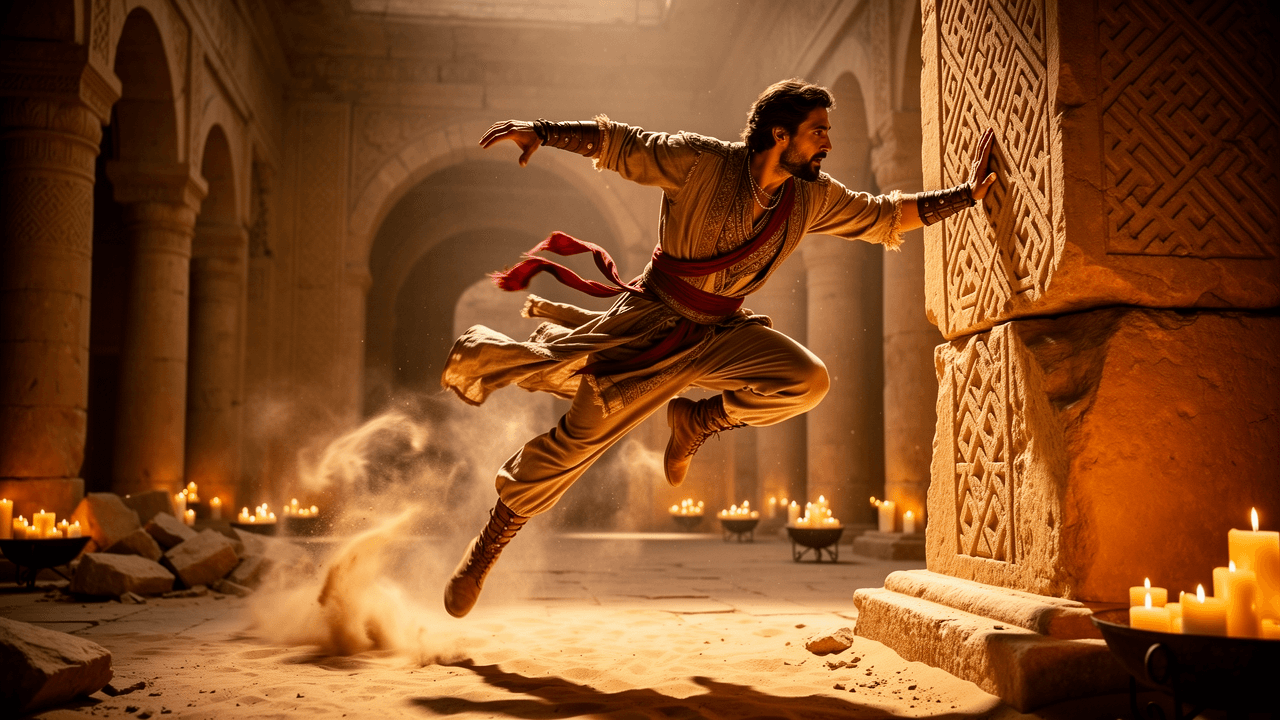
The game that made movement feel like style
Prince of Persia: The Sands of Time on PlayStation 2 arrived at a very specific moment in early-2000s game design, when publishers were chasing spectacle, lock-on combat, and louder-and-bigger everything. It could have followed that trend and still succeeded. Instead, it did something more interesting: it made motion itself the point.
What still stands out, even now, is how carefully the game frames every jump, wall run, shimmy, vault, and sword swing. It does not just ask you to move through spaces. It asks you to read them like a stage set, then perform across them with a kind of controlled confidence. That elegance is the reason the game still has an afterlife. Not nostalgia alone. Not merely the memory of a good PS2 adventure. It is the sense that the game understood an action-adventure hero could feel nimble, human, and cinematic all at once.
Prince of Persia: The Sands of Time on PlayStation 2 and the elegance of traversal
The traversal in Prince of Persia: The Sands of Time on PlayStation 2 is built on a simple promise: if a ledge looks reachable, the game will teach you how to reach it with grace. That sounds obvious now. In 2003, it was anything but.
The levels are arranged less like obstacle courses and more like suspended chains of gestures. You leap to a beam, swing across a gap, catch a wall, run along it, drop to a bar, then vault to safety. Each move flows into the next so naturally that the game’s most impressive trick is how little friction you feel while doing something structurally complex. The environment becomes a choreography partner.
That matters because the game’s traversal is not trying to look realistic. It is trying to look assured. The prince’s movement has a strong, readable rhythm: commit, recover, continue. Even when a jump is dangerous, the animation sells confidence. The result is a rare kind of platforming tension: you feel the risk, but you rarely feel the system fighting you.
A lot of games from that era treated traversal as a checkpoint between combat scenes. This one treated it as a primary language. That is why so many of its rooms are memorable without being especially large. They are not memorable because they are huge. They are memorable because they are composed.
Why the wall run still works
The wall run is the game’s calling card because it captures the whole design philosophy in one motion. It is dramatic, but never noisy. Functional, but never plain. It is the kind of movement that feels impossible the first time you see it, then inevitable the moment you try it yourself.
What helps is the game’s visual clarity. It rarely buries you in clutter. Ledges, bars, columns, and switches are easy to parse, which means your attention stays on timing and flow rather than on fighting the camera. That clean readability is one reason the game feels so polished on PS2 even today.
The rewind mechanic changed how failure felt
If traversal gave the game its grace, the rewind mechanic gave it its identity. The Sands of Time was not the first game to let players recover from mistakes, but it made recovery feel elegant rather than merely forgiving.
The key idea is almost radical in its simplicity: failure does not need to be a hard stop. Miss a jump, eat a bad combat exchange, or overshoot a ledge, and time itself becomes part of the move set. The Dagger of Time lets you pull the game backward, undoing a mistake as if the whole sequence were a draft you could revise in real time.
That design decision did more than lower frustration. It changed the emotional texture of the game. Instead of teaching players to fear experimentation, it encouraged daring. You could push a little further on a risky wall run because the penalty for a slip was not humiliation. It was revision.
That is a big reason the game still feels modern in spirit. Many action games ask you to optimize execution. This one asks you to stay fluid. The rewind mechanic supports the fantasy that a hero in an ancient, trap-filled palace should be agile enough to adapt on instinct. It does not make the game easier in a shallow sense; it makes it more expressive.
The brilliant part: rewind is part of the fiction
The mechanic lands because it is not a bolt-on convenience. It is woven into the world, the story, and the tone. The prince is literally writing and rewriting his own survival. That makes each correction feel like an extension of the narrative rather than an interruption of play.
It also softens the old-school edge of early 2000s design without dulling it. The game can still be punishing in its own way. Traps hurt. Combat can spiral. Platforming demands attention. But rewind preserves momentum, and momentum is the real currency here.
Animation fluidity was the secret sauce
A lot of people remember the game for its mechanics first, but the animation is what sold those mechanics as elegant. Prince of Persia: The Sands of Time on PlayStation 2 has a physical confidence that is still impressive because it rarely looks like a collection of canned inputs.
The prince adjusts his balance, catches himself on ledges, lands with weight, and transitions between states with unusually smooth motion. Those little connective animations are what prevent the game from feeling like a series of disconnected button presses. Every movement has a sense of intention before and after it.
That fluidity matters for two reasons:
- It makes difficult traversal easier to read.
- It gives the character personality without relying on constant dialogue.
The animation also supports the game’s romantic tone. This is a fantasy adventure, yes, but it is not all swagger and noise. There is an almost balletic quality to how the hero moves through ruin, fire, and dust. The animation makes the palace feel ancient while making the action feel alive.
By modern standards, some textures and effects are obviously of their era. But the movement itself holds up because it was designed with discipline. It is not trying to overwhelm you. It is trying to persuade you.
A product of early-2000s design trends, but not trapped by them
The early 2000s were full of games searching for a new cinematic identity. 3D action games were becoming more ambitious about camera work, combat feedback, and set-piece presentation. At the same time, many developers were still wrestling with how to make 3D movement feel natural after the jump from 2D platforms and fixed-angle spaces.
This game sits right inside that transition, but it avoids the awkwardness that often came with it. It embraces cinematic framing without letting presentation dominate play. It embraces puzzle-platforming without turning every room into a math problem. It embraces combat without letting sword fights become the only reason to keep playing.
That balance is why the game felt polished then. It knew what to emphasize.
What it borrowed, and what it rejected
The game clearly draws from the era’s taste for blockbuster adventure design:
- dramatic camera angles
- environmental puzzles
- short combat encounters between traversal sequences
- dramatic musical cues and a storybook tone
But it rejects the clunkier habits that often came with those trends. It is not bloated. It does not over-explain. It does not ask you to memorize a labyrinth of systems just to enjoy the movement. It trusts its core loop.
That trust is part of its lasting identity. Even now, the game feels like it was made by people who understood that polish is not just about higher resolution assets. Polish is also about tempo, readability, and restraint.
Why it still stands out now
The reason Prince of Persia: The Sands of Time on PlayStation 2 still matters is not that it was first to do everything. It is that it made a persuasive case for elegance in a genre that often confuses complexity with depth.
Modern players may come to it with different expectations. They may notice the fixed-era camera habits, the occasionally stiff enemy behavior, or the way certain rooms reveal their seams more obviously than newer games would. But those details do not erase the bigger impression. The game still moves beautifully. It still communicates clearly. It still feels like a designer’s answer to the question: what if action-adventure could be graceful instead of merely efficient?
That question has aged well because so many later games borrowed its lesson, even when they changed the surface.
Its lasting influence is visible in the feel of later action games
You can see the afterlife of this game in the way later titles prize momentum, recovery, and visual legibility. Not every successor copied the rewind mechanic, but plenty absorbed the deeper lesson: players enjoy mastering movement when the game makes that mastery look and feel good.
The best legacy is not imitation. It is standard-setting. This game helped establish a vocabulary for acrobatic action-adventure where the body in motion matters as much as the blade in hand.
The polish was not accidental
Calling the game polished is easy. Explaining why it felt polished is more interesting.
It felt polished because nearly every design choice served the same fantasy:
- the world is perilous but readable
- movement is difficult but never awkward
- failure is real but reversible
- the protagonist looks competent even when the player is learning
That coherence is rare. A lot of games are remembered for one brilliant mechanic or one unforgettable level. This one is remembered for how consistently its parts support each other. The traversal, rewind, animation, and level design all point in the same direction.
That is also why the game’s elegance survives time better than flashier peers. It is not dependent on shock value. It is dependent on form.
A graceful classic, not just a fond memory
In the broader story of early-2000s action games, Prince of Persia: The Sands of Time on PlayStation 2 remains a standout because it understood that mastery can feel gentle. It gave players a world of traps and impossible jumps, then handed them the tools to move through it with confidence and style.
That is the cultural afterlife worth remembering. Not just that it was good for its time, but that it helped redraw the expectations for what acrobatic action-adventure could feel like. It did not lose its elegance in the process. It made elegance the point.
And that is why it still stands out now: not as a relic, but as a beautifully composed design argument that still lands.
What do you remember most about the game’s movement and rewind system? Share your thoughts in the comments.