

Image credit: Draft web reference from wingamestore.com
How RollerCoaster Tycoon on PC Turned Spectacle Into Systems
RollerCoaster Tycoon on PC is remembered for the obvious stuff first: the coasters, the tiny screaming guests, the absurd pleasure of building a park that looks like a fever dream and somehow still stays profitable. But the reason it lasts is not just that it lets you make something spectacular. It is that it teaches spectacle as a system. Every flashy ride, decorative path, and perfectly timed admission price is attached to something legible. You can see the machinery. You can learn it. And then, just when you think you understand it, the game gives you one more emergency to solve.
That is the secret power of the original RollerCoaster Tycoon: it turns a busy simulation into something you can read at a glance, then spends the rest of the game testing whether you can truly manage what you understand.
The cleanest kind of complexity
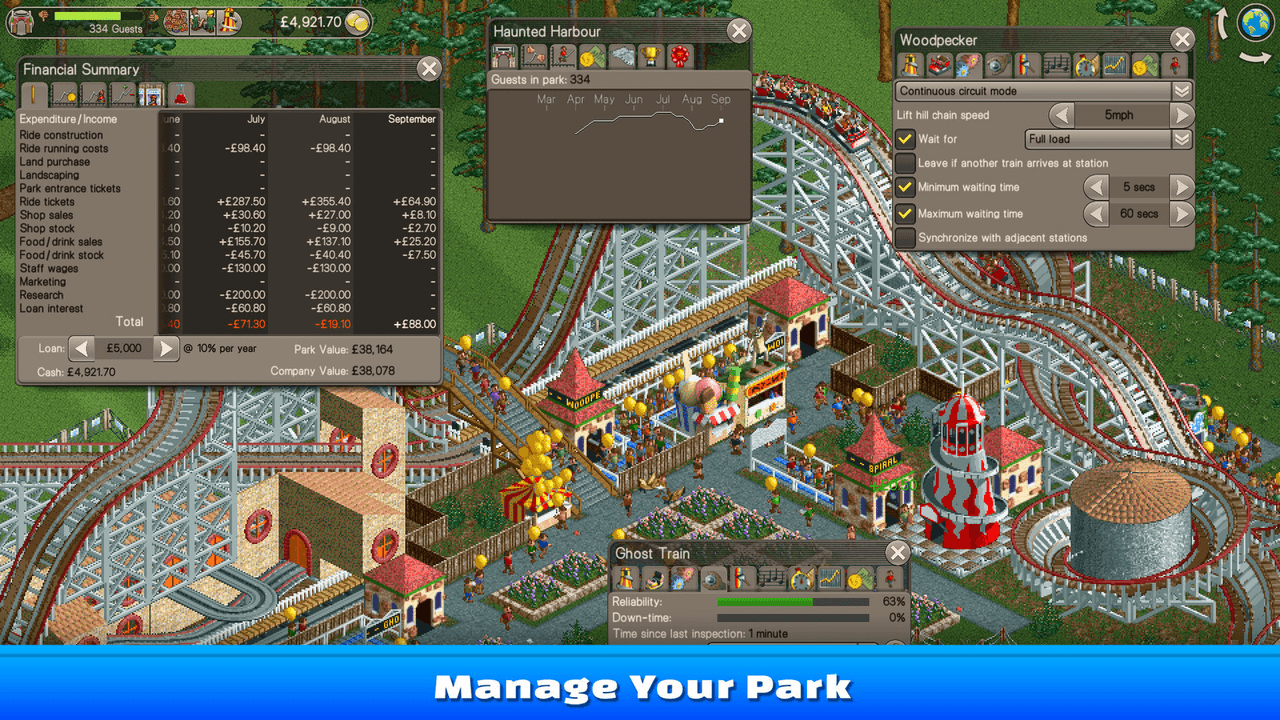
A lot of management games bury the player in menus, abstractions, or spreadsheets pretending to be fun. RollerCoaster Tycoon on PC does the opposite. Its interface is compact, visual, and immediate. Want to build a ride? Click the category, place the track, connect the station, test it. Want to inspect guest sentiment? You can open a guest and read a straightforward list of thoughts and needs. Want to know why the park is failing? The game usually gives you a visible clue long before it asks for a diagnosis.
That clarity matters because it lowers the cost of curiosity. You do not need to memorize arcane command trees before you start experimenting. You can build something ridiculous early, watch what happens, and learn from the result. In practice, that means the game invites tinkering instead of punishing it. Even the mistakes are readable.
That readability is what makes the game feel so modern. Not because it is simplified, but because it is transparent enough to support real problem-solving.
RollerCoaster Tycoon on PC and the joy of visible economics
At the center of the game is a very old management pleasure: keeping the money moving without letting the park collapse under its own ambition. But the economy in RollerCoaster Tycoon on PC works because it is constantly tied to things you can observe. Ride prices, maintenance, research, staff pay, loan interest, food stalls, and guest traffic are not abstract lines on a dashboard. They show up in the park.
Build too much too quickly, and the park becomes expensive before it becomes attractive.
Charge too much, and guests stop engaging.
Neglect maintenance, and your beautiful rides become expensive liabilities.
Ignore staffing, and the whole place starts fraying at the edges.
The game is at its best when those pressures overlap. You are not just balancing a budget. You are balancing the timing of your decisions. A strong park is not simply profitable; it is synchronized. The rides need to pay for themselves. The paths need to support the crowd flow. The scenery needs to justify the ticket price. Each layer reinforces the next.
That is why the economy feels fair even when it is ruthless. You can trace the cause of almost every problem.
Guest behavior is the real tutorial
If the park is the stage, the guests are the critics.
What makes RollerCoaster Tycoon on PC so satisfying is that guest behavior is both funny and functional. Guests do not just wander randomly. They complain, cluster, get hungry, get thirsty, get lost, get stuck in dead-end layouts, and abandon a park that has failed to respect their patience. Their little thought bubbles act like a running commentary on your design.
That commentary is more than charm. It is the game’s best debugging tool.
You can watch guests pile up near a bad path connection and understand that the layout is choking movement.
You can notice that people are avoiding a ride because the queue is too long or the price is too high.
You can see when the park is full of attractions but low on practical services, which is the management equivalent of building a cathedral with no doors.
This is where the game quietly becomes a masterclass in systems design. It does not need to explain itself in paragraphs. It lets the simulation speak through behavior. The guests tell you what the park is doing right and wrong, and the game trusts you to listen.
The park layout is the puzzle beneath the spectacle
The first time you play RollerCoaster Tycoon on PC, it is easy to think the game is mostly about rides. Build bigger coaster. Make more loops. Add more vomit-inducing nonsense. But the longer you play, the more obvious it becomes that layout is the real challenge.
Every path is a promise.
Every shortcut is a choice.
Every dead end is a future problem.
A park that looks good from the outside can still function terribly if guests cannot move through it efficiently. Wide plazas may seem elegant but waste space. Narrow corridors can create bottlenecks. Rides placed without consideration for traffic can turn your park into a traffic jam with cotton candy.
The best parks in the game are often not the flashiest. They are the ones where the scenery, paths, and amenities are arranged like a working city instead of a loose collection of attractions. That makes design feel architectural. You are not just decorating. You are shaping circulation.
And because the game renders all of this in a readable overhead view, you can look at a problem and almost physically feel the flow breaking down.
Why debugging your own park is the real reward
The most underrated pleasure in RollerCoaster Tycoon on PC is not success. It is diagnosis.
There is a special kind of satisfaction in watching your park wobble, then tracing the fault back to the exact decision that caused it. Maybe you overextended your cash flow. Maybe a ride is too long to maintain profitably. Maybe a path network looked elegant until guests started clogging every junction. Maybe your admission strategy made early growth impossible. The game lets you make those mistakes in public and fix them with intention.
That is why the experience stays sticky. It creates a loop of:
- build
- observe
- identify the flaw
- adjust the system
- watch the result
That loop is endlessly replayable because each park becomes a personal case study. You remember not just what you built, but why it failed or succeeded.
In many games, “debugging” is a metaphor. Here, it is the fun.
Readable systems, hard mastery
The genius of RollerCoaster Tycoon on PC is that it does not confuse readability with shallowness. It gives you systems that are easy to grasp and hard to fully exploit.
That balance is rare. A game can be dense in a way that feels obscure, or simple in a way that feels thin. RollerCoaster Tycoon sits in the sweet spot. The rules are approachable, but the consequences compound. Every decision is legible in isolation, yet the park as a whole behaves like a living network of dependencies.
That is why the game can support both kinds of play:
- the playful builder who wants to make absurd coasters and watch guests lose their lunch
- the meticulous manager who wants a park that prints money and runs like clockwork
Both players are using the same tools. The difference is how deeply they understand the relationships between them.
The interface still teaches by doing
One reason the game aged so gracefully is that its interface respects the player’s attention. It does not smother the simulation under decorative complication. It gets out of the way and lets the park become the interface.
That means the player learns by manipulating visible objects instead of parsing layers of hidden data. The game still contains enough information to reward precision, but it avoids burying that information where it cannot be used. In practice, that makes the first hour welcoming and the hundredth hour still interesting.
Even the act of opening ride statistics or guest thoughts feels like part of the same physical space, not a separate administrative universe. That cohesion is a huge reason the game remains playable without much ceremony. You are not switching from one game to another; you are just looking at different levels of the same machine.
Why RollerCoaster Tycoon still works
A lot of old simulation games are admired for their ambition but feel brittle today. RollerCoaster Tycoon on PC is different because its ambitions are embodied in systems that remain easy to parse.
It works because:
- the objectives are clear
- the feedback is immediate
- the visual language is consistent
- the guest behavior doubles as a tutorial
- the economy is strict but understandable
- the layout problems are spatial, not abstract
That combination makes the game durable. You do not need nostalgia to appreciate the design. You only need a willingness to experiment and a little patience for failure.
And failure, in this game, is never just failure. It is information.
A management game that never stops being playful
The lasting charm of RollerCoaster Tycoon on PC is that it keeps its sense of wonder even while it teaches discipline. It never asks you to choose between creativity and control. It turns them into the same activity. Build something outrageous, then make it work. Create the spectacle, then maintain the machine.
That is why the game still stands out in retro PC design. It understands that the best management games do not merely present a system to optimize. They make the act of understanding the system feel like a small accomplishment every time.
So yes, it is a game about theme parks. But it is also a game about reading motion, listening to failure, and learning how a complex place behaves once people start using it.
That is a much better trick than just making a coaster go upside down.
If you still remember your best park, your worst disaster, or the first time the economy collapsed because of one bad design choice, share it in the comments—I’d love to hear it.