

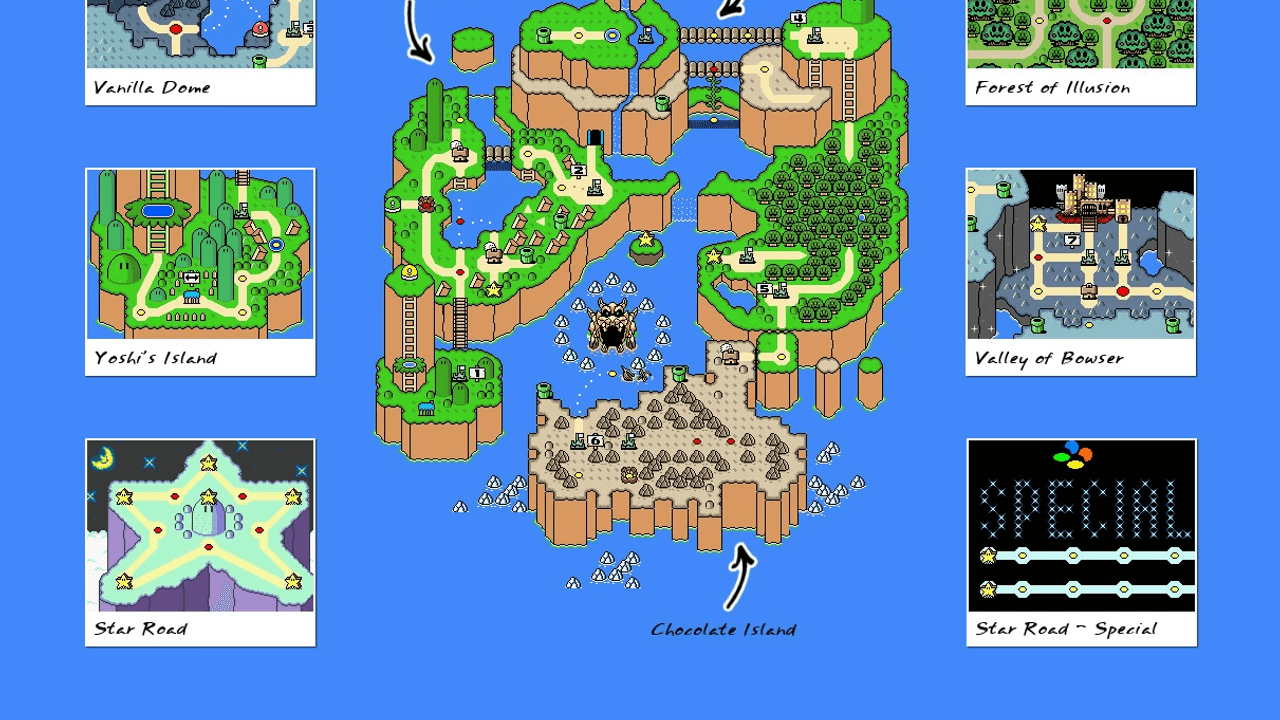
Image credit: Draft web reference from super-mario-saga.fandom.com
How Super Mario World on Super Nintendo Teaches Momentum
Super Mario World on Super Nintendo is one of those rare games that feels effortless the moment you pick it up, then quietly reveals how much work is happening underneath. It does not just give you levels to clear. It gives you a language for moving, jumping, accelerating, and taking risks with confidence. More than three decades later, that lesson still lands cleanly: momentum is the point, and the stages are built to protect it, challenge it, and finally let you express it.
What makes the game special is not only that it is friendly. Plenty of platformers are friendly. The difference is that this one is friendly without becoming timid. Its stages are carefully arranged to teach you how far you can trust your run, when to commit to a jump, and how to keep moving even when the screen starts filling with enemies, slopes, platforms, and secrets. That balance is why it still feels like such a master class.
Super Mario World on Super Nintendo and the feel of motion first
A lot of platform games ask you to stop and start constantly. Super Mario World does the opposite. From the opening area, it wants your feet in motion. The ground curves, the hills tilt, and the physics reward players who let their speed build instead of tapping forward in tiny, cautious steps.
That emphasis on flow changes how you read every obstacle.
- A low enemy is not only a hazard; it is a timing check.
- A raised platform is not only a landing spot; it is part of a run-up.
- A slope is not only scenery; it is a tool for building speed.
- A gap is not just empty space; it is a question about confidence.
This is why the game feels so satisfying even before its more famous tricks appear. You are not simply reacting. You are learning to move with intent.
The brilliance is that the game never explains this in a tutorial box. It teaches through level shape, enemy placement, and repetition. You feel the answer before you can name it.
The cleanest lesson in platforming momentum
The phrase “platforming momentum” gets used a lot, but Super Mario World earns it because the game treats momentum as both a physical system and a design promise. It gives you enough room to accelerate, enough feedback to understand when you have succeeded, and enough recovery options that failure rarely feels punitive.
That matters because momentum is fragile. If a game interrupts it too often, the player stops thinking in arcs and starts thinking in isolated inputs. Super Mario World avoids that problem by structuring many of its stages around readable forward motion. Even when you are making precise jumps, the level often gives you a sense that you are progressing through a larger pattern rather than solving a single obstacle in a vacuum.
Why the controls matter so much
The control feel is crucial here. Mario’s movement has just enough weight to feel physical and just enough responsiveness to feel dependable. You can sense the difference between a quick adjustment and a committed leap. That makes every clean landing feel earned, and it makes mastery visible.
The result is that the game’s best moments are not only about surviving. They are about stringing actions together without breaking rhythm. When you carry speed through a stage, bounce off an enemy, land on a platform, and launch into the next section in one smooth line, the game feels almost musical.
Level design that teaches without lecturing
One reason Super Mario World on Super Nintendo still works so well is that it assumes players can learn by observation. The stages are built like small lessons, but they never feel like school. They begin with a simple pattern, repeat it in a slightly altered form, and then ask you to apply the same idea under stress.
That structure shows up everywhere.
1. It introduces mechanics gently
A new hazard usually arrives in a low-pressure context first. You get to see it, approach it, and understand its behavior before the game turns up the heat. That makes later sections feel fair, because the challenge comes from combination rather than surprise.
2. It layers complexity carefully
Once you understand a basic idea, the game adds another wrinkle: a moving enemy, a tighter jump, a vertical climb, or a timing window that forces you to maintain speed. The challenge grows, but the underlying logic stays visible.
3. It rewards confidence, not just caution
Some platformers train players to inch forward. Super Mario World encourages forward thinking. It rewards people who look beyond the immediate obstacle and plan the next two seconds of movement. That mindset is part of why the game feels so expressive.
The best levels do not merely test your reflexes. They shape your habits.
Secrets that deepen the world instead of distracting from it
The game’s secret exits, hidden paths, bonus areas, and alternate routes are not just collectibles hidden for completionists. They are part of the same design philosophy as the movement system. Curiosity is treated as a skill.
That is a subtle but important difference.
In weaker games, secrets can feel like extra content glued onto the side. In Super Mario World, secrets feel like an extension of the main lesson: if you pay attention to the layout, you will notice that the game often invites experimentation. A suspicious ledge, an empty stretch of wall, or a strangely placed enemy may be a hint that the stage contains more than the obvious route.
This does two things at once:
- It makes replaying the game rewarding because you are no longer just clearing stages; you are reading them.
- It gives the world a sense of density without cluttering the moment-to-moment action.
The design stays clean because the secrets never overwhelm the visible path. They sit just off the obvious line, waiting for players who have learned to trust their instincts.
Controlled escalation is why the difficulty feels fair
A lot of retro platformers are remembered for being hard. Super Mario World is remembered for being fair, and that is a very different kind of praise.
The game escalates in a controlled way. It knows when to ease off, when to introduce new pressure, and when to ask for mastery. That pacing is one of its great strengths. Instead of throwing constant brutality at you, it creates a rhythm of recovery and challenge.
That rhythm keeps the game approachable for newcomers while still giving experienced players plenty to master. If you are new, the early worlds teach you how the game thinks. If you are experienced, the later stages and secret paths let you push that understanding further.
A few reasons the escalation still feels elegant
- Early stages are spacious enough to build confidence.
- New dangers usually arrive in readable forms.
- Challenge often comes from combinations, not cheap surprises.
- The game rarely wastes your attention on busywork.
- Failure tends to teach a specific lesson rather than causing pure frustration.
That last point is especially important. You usually know why you missed a jump or got clipped by an enemy. The game’s feedback is clear, so improvement feels possible.
Why the game still feels approachable
Even now, Super Mario World remains one of the easiest classic platformers to recommend to someone who does not spend much time with retro games. It is approachable because it respects the player’s time and intelligence at the same time.
It does not drown you in systems. It does not demand elaborate menu management. It does not make every stage feel like a punishment. Instead, it keeps the focus on movement, readability, and discovery. That makes it welcoming without flattening its personality.
The game also understands that approachability is not the same as simplicity. There is plenty going on here if you look closely: route branching, hidden exits, alternate rewards, and movement nuances that change how you approach the same stage on repeat runs. The design is clean, but it is not shallow.
Why the game still feels expressive
Expression in platformers often comes from how a player chooses to move through space. Super Mario World gives you enough flexibility to make those choices matter. You can play cautiously, but the game clearly shines when you lean into speed, timing, and improvisation.
That is why it remains so satisfying to watch and to play. Two people can run through the same stage and make it look different. One may hug the safest route. Another may preserve speed, bounce through enemies, and use the terrain more aggressively. The game accommodates both, but it clearly celebrates the second kind of confidence.
That expressive quality is also why the game has aged so well. Its stages are not trying to dazzle you with spectacle that depends on hardware tricks. They are built around ideas that still communicate immediately: forward motion, readable danger, and a reward structure that encourages experimentation.
The lasting lesson
If you want the simplest possible summary, Super Mario World on Super Nintendo teaches one thing better than almost any platformer of its era: movement should feel like a conversation between player and level.
The game speaks in slopes, gaps, enemies, and hidden routes. You answer with timing, speed, and curiosity. When the exchange works, it feels effortless. That is the magic. The game never hides the craft, but it also never lets the craft get in the way of play.
That is why it still stands as such a clean lesson in platforming momentum. It is approachable, expressive, and disciplined all at once. More than a classic, it is a blueprint.
If you have your own favorite stage, secret route, or movement trick from Super Mario World on Super Nintendo, share it in the comments—I’d love to hear how you remember it.