
Why System Shock 2 on PC Still Feels Tense, Inventive, and Dense
Some games age into museum pieces. Others age into habits. System Shock 2 on PC does neither. More than two decades after release, it still feels like a machine designed to keep your shoulders raised. It is not just “a classic” in the abstract. It is a game that actively makes you play carefully, read situations, and accept that every useful advantage has a cost.
That is why it still lands today. Not because nostalgia forgives its rough edges, but because those edges are part of the pressure system. The game’s mixture of immersive sim freedom, survival horror scarcity, and RPG specialization creates a kind of tension that modern design still chases and often softens. System Shock 2 never softens.
The first thing it teaches you is caution
The opening hours are a masterclass in controlled discomfort. You are not handed a fantasy of power. You are dropped into a broken environment, under-equipped, and asked to understand the rules while the rules keep moving.
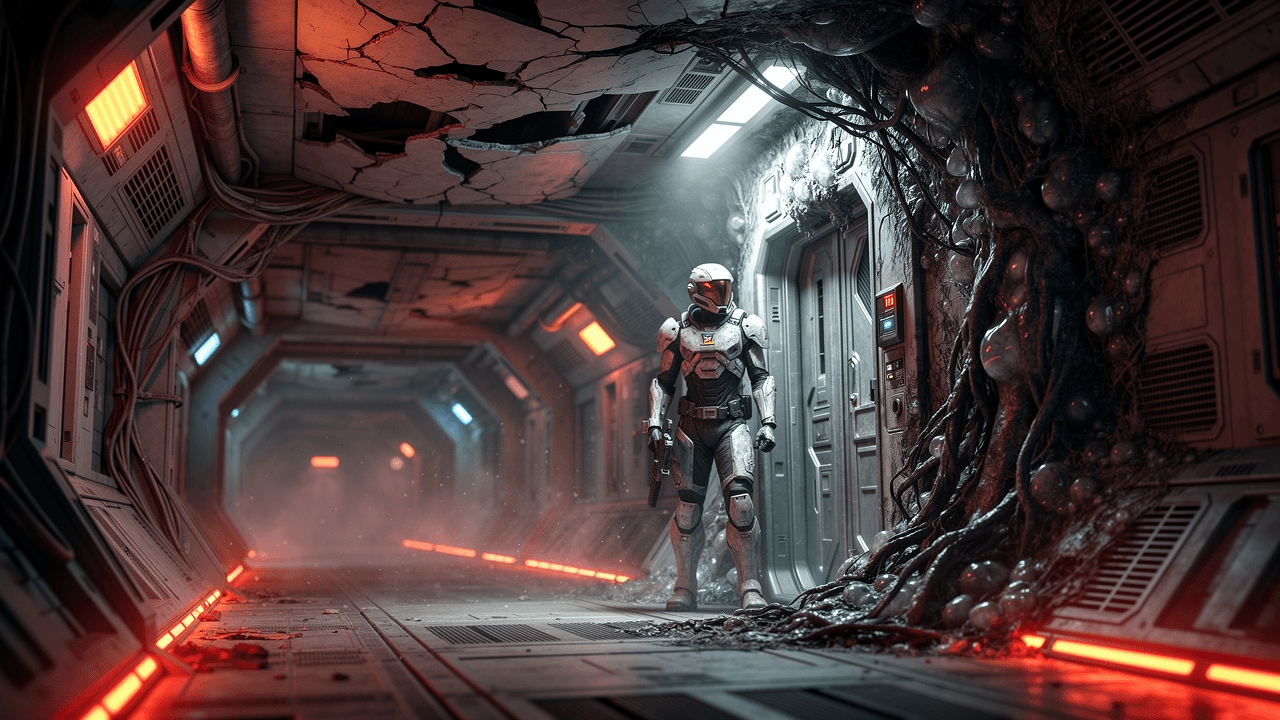
What makes that approach endure is how little the game relies on scripted shock value. Sure, the atmosphere is hostile: the hum of machinery, the sterile corridors, the ruined maintenance spaces, the sense that every section of the ship has already been violated by something unseen. But the real tension comes from mundane decision-making.
- Do you spend the last of your resources now or keep them for a worse fight later?
- Do you invest in a skill that solves problems cleanly, or patch over weakness with another weapon?
- Do you poke into a side room for supplies, knowing the “quiet” space may not stay quiet?
That friction still works because it is built into the whole game, not only into a few set-piece scares. The player is never allowed to settle into autopilot.
The resource pressure is the point
A lot of retro survival horror is remembered for being stingy. System Shock 2 is stingy in a smarter way. It does not simply ration ammo and medkits to create anxiety. It makes every system compete for the same scarce attention.
Health, psi energy, ammo, repair materials, upgrades, inventory space, skill investment: everything wants the same limited budget. The result is a constant low-grade panic that feels more strategic than random.
This is where the game’s RPG layer matters most. On paper, character progression sounds like a route to comfort. In practice, it creates identity. Your build defines not just what you can do, but what you are willing to risk. A psi-focused run feels radically different from a weapon-heavy one, and both feel different from a generalist build that tries to keep options open.
That choice architecture is why the game remains mechanically dense. It is not dense in the sense of bloated systems piled on top of each other. It is dense because each choice reverberates. A small decision early on can change how you handle entire sections later. That kind of pressure ages well because it is legible. You can feel the consequences even before you fully understand them.
Enemy design that respects panic
The enemies in System Shock 2 do one crucial thing very well: they do not merely absorb damage. They disrupt confidence.
Their value is not just in how they look or move, though the horror language is still effective. What matters is how they interact with the player’s fragile sense of control. They are dangerous in ways that prevent casual rhythm. Some are fast enough to punish hesitation. Some are durable enough to make ammo conservation miserable. Some force you to answer questions you would rather ignore, like whether you are prepared for a second fight after the first one barely ended.
The game understands that a good horror enemy does not need to be constantly surprising. It needs to be sufficiently unpleasant that the player starts changing behavior before the encounter happens. That is the real design victory.
You creep more slowly. You check corners more often. You hesitate before opening every door. You start treating silence as suspicious. By the time the enemies appear, the atmosphere has already done half the damage.
Why the interface still shapes behavior
One reason System Shock 2 on PC remains so interesting is that its interface is not a neutral layer. It is part of the design language.
Modern games often hide systems behind sleek presentation. System Shock 2 exposes them. Inventory management, logs, upgrades, and status information all demand active participation. You are not gliding through a polished fantasy of efficiency. You are working inside a system that expects you to notice details and make tradeoffs.
That has a huge effect on pacing. The game does not let information disappear into the background. It insists on being read, processed, and acted on. Even the act of pausing to manage yourself becomes part of the tension, because the ship does not care that you are reorganizing your toolset.
This is one reason it still feels modern in a useful way. Not because it resembles today’s UI trends, but because it understands something many contemporary games forget: friction can be expressive. If the interface makes survival feel like work, then survival feels earned.
The atmosphere is not decoration
A lesser game would treat the ship as a backdrop. System Shock 2 treats it as a pressure vessel.
Every corridor tells the same story in different tones: damage, abandonment, contamination, and the uneasy sense that the place has been claimed by something that doesn’t need to hurry. The setting works because it is coherent. Nothing feels decorative just for the sake of mood. The environment is a system of evidence.
That coherence matters more now than ever. Players are surrounded by horror that competes through noise, saturation, or constant escalation. System Shock 2 is quieter than that, and far more exacting. It understands that dread deepens when the world feels functional. If the ship still has doors, terminals, storage, security systems, and maintenance pathways, then it also still has rules. And if it has rules, then it can hurt you in specific, meaningful ways.
The atmosphere is not there to say “be scared.” It is there to convince you that caution is rational.
The hybrid structure is why it lasts
A big part of the game’s longevity comes from the fact that it is not one thing.
As an immersive sim, it rewards problem-solving and flexible play. As a survival horror game, it weaponizes vulnerability and uncertainty. As an RPG, it creates specialization and consequence. Those three identities do not cancel each other out. They reinforce one another.
That combination gives the game a rhythm that many later titles admire but rarely fully replicate:
- Observe the environment.
- Assess the threat and your own limitations.
- Spend resources to survive the immediate problem.
- Pay for that choice later in another form.
This cycle is the heart of the experience. It keeps the player engaged because it never becomes purely about reflexes or purely about stats. You are always balancing intuition against scarcity.
Why it still feels tense without nostalgia
The simplest answer is that the game still understands stakes.
A lot of older games survive on memory. We forgive awkwardness because we remember an era, a mood, or the feeling of encountering something formative at the right time. System Shock 2 can benefit from that too, but it does not need it. The tension is structural. The invention is practical. The density is earned.
If you come to it now, stripped of the myth, a few things remain immediately clear:
- It demands attention instead of assuming it.
- It turns limited resources into real drama.
- It uses enemies to change player behavior, not just fill space.
- It makes the interface part of the fear.
- It trusts atmosphere to carry mechanical weight.
That is why it still feels like a serious game for serious players, even if that phrase sounds older than the game itself. Not serious in the sense of grim self-importance. Serious in the sense that every system has consequences and the game expects you to live with them.
The enduring appeal of a difficult design
There is a tendency to describe older PC classics as “ahead of their time,” but that phrase can flatten what actually matters. System Shock 2 on PC is not compelling because it predicted the future perfectly. It is compelling because it chose a difficult lane and stayed there.
It does not chase constant reward loops. It does not over-explain itself. It does not smooth over the unpleasant parts that make survival feel real. Instead, it builds a precise relationship between fear, planning, and resource management.
That relationship still has teeth.
And maybe that is the cleanest way to explain its endurance: the game does not ask to be admired from a distance. It asks to be handled carefully. That is a much rarer quality than nostalgia.
Final thoughts
System Shock 2 remains one of those rare PC games that feels alive because it is slightly inconvenient, slightly hostile, and completely committed to its own logic. The result is a tense, inventive, mechanically dense experience that still rewards patience and punishes carelessness in equal measure.
If you have revisited it recently, or if you are finally trying it for the first time, I’d love to hear how it holds up for you. Share your thoughts in the comments—especially your favorite build, most memorable scare, or the moment the ship started getting under your skin.