
The Legend of Zelda: Majora’s Mask on Nintendo 64 and the strange power of repetition
When people talk about The Legend of Zelda: Majora’s Mask on Nintendo 64, they usually lead with the obvious: it is darker, stranger, and more anxious than the Zelda game that came before it. That is true, but it is also too neat. What makes the 2000 Nintendo 64 release endure is not just its tone. It is the way its design turns repetition, pressure, and side quests into a single system that constantly asks you to make peace with failure.
Most action-adventure games reward forward motion. Majora’s Mask does something more unusual: it makes going backward part of the fantasy. The three-day loop is not a punishment for missing content or a clever time-management trick layered on top of a familiar quest structure. It is the structure. Every minute feels temporary, every favor feels urgent, and every success is haunted by the knowledge that it may have to be done again differently.
That is why the game still stands apart. It is not just a memorable entry in a beloved series; it is one of the clearest examples of a blockbuster console game using repetition as emotional language.
The three-day loop is the whole argument
Majora’s Mask gives you a town, a schedule, and a deadline. Then it makes those three things collide.
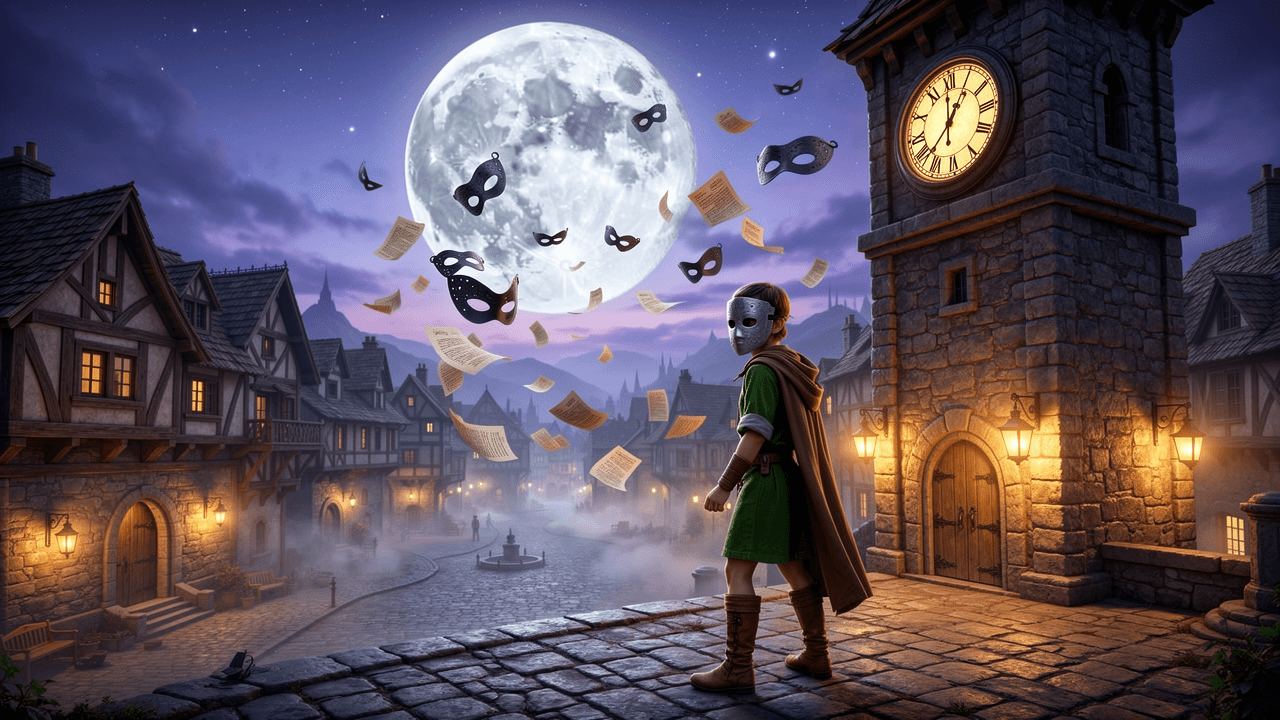
The moon is falling. NPCs live on routines. Events happen at fixed times. Shops close, travelers move, and secrets only appear if you are in the right place at the right hour. On paper, that sounds restrictive. In practice, it is liberating, because the game teaches you to see the world as layered rather than linear.
Instead of asking, “How do I beat the next dungeon?” Majora’s Mask asks something more interesting: “What can I learn this cycle that will matter in the next one?” That change shifts the player from conqueror to observer. You stop treating the world as a sequence of rooms and start treating it as a living clock.
The result is a constant low-grade tension that never fully disappears. Even simple errands carry weight because they occupy time. Even exploration has an opportunity cost. If you go chase a rumor on one side of town, what are you giving up on the other side? If you spend the afternoon helping one person, which other storyline will slip past you before midnight?
That pressure is the game’s secret weapon. It gives the world texture.
Why urgency makes exploration better
A lot of games try to create atmosphere by making the world bigger. Majora’s Mask makes the world feel deeper by making it harder to fully hold at once.
The three-day loop sharpens exploration in a few specific ways:
- It rewards memory. Places become meaningful because you return to them with different knowledge.
- It turns timing into discovery. A path is not just a path if it only matters at dawn, after a storm, or during a festival.
- It makes the familiar unstable. The same street feels different when you know what happens there on the final night.
- It transforms backtracking into narrative. Revisiting locations is not dead time; it is part of the story’s rhythm.
That is a difficult balance to achieve. Too much repetition and the game feels mechanical. Too little and the loop becomes a novelty instead of a design principle. Majora’s Mask threads that needle by making the player feel the cost of time without making the game feel like a chore.
Side quests are not padding; they are the point
If you only remember Majora’s Mask for its main objective, you are remembering the least interesting part of it.
The side quests are where the game becomes emotionally specific. A missing schedule, a delayed meeting, a repeated request, a personal favor that only pays off if you show up at exactly the right moment—these are the things that give the world its pulse. The game understands that a town under threat should not behave like a theme park. People should be distracted, fearful, self-absorbed, stubborn, and occasionally kind.
That is why the side quests matter so much. They are not distractions from the main quest; they are the proof that the main quest is affecting real lives.
The loop also changes how rewards feel. In many games, a side quest gives you an item, a stronger weapon, or a clear numerical upgrade. In Majora’s Mask, the payoff is often subtler. You earn trust. You unlock a route. You witness closure. You learn the shape of somebody’s private anxiety. Those rewards are less flashy, but they last because they are attached to place and memory rather than pure progression.
The game’s side quests can be heartbreaking for a simple reason: they often ask you to care about temporary people in a temporary world.
Pressure gives the game its emotional shape
The moon is not just a threat. It is a design accent.
Majora’s Mask is full of small reminders that time is running out. That matters because the game does not let you inhabit heroism in a clean, triumphant way. You are always doing two things at once: helping people and managing your own deadline. The tension between those roles gives the game its emotional charge.
This is also why the game’s darker reputation has stuck. It is not merely spooky in the surface sense. Its fear comes from consequence and incompletion. You can know exactly what needs to happen and still feel behind. You can save one problem and leave three unresolved. You can become attached to a task and then willingly erase your progress to preserve the chance to do more.
That last point is central. The Song of Time is not a reset button in the usual game-design sense. It is a structural sacrifice. You trade the comfort of permanence for the chance to make better use of what you learned. The game trusts you to value information, access, and emotional continuity more than raw accumulation.
That trust is rare.
What makes The Legend of Zelda: Majora’s Mask on Nintendo 64 so distinctive
A lot of games use timers. A lot of games use side quests. A lot of games encourage replay.
Majora’s Mask is different because it makes all three systems reinforce one another until the player begins thinking like the game’s world. You are not just completing objectives. You are reading schedules, preserving knowledge, and deciding which human-sized stories are worth saving before the clock resets again.
That is also why it has aged so well as a design object, even for players who bounced off it the first time. Its structure is legible. Its logic is consistent. Its pressure is emotional rather than arbitrary. You do not need nostalgia to understand why it works; you only need to sit inside the loop long enough for its priorities to become clear.
A few qualities still stand out more than they did at release:
- It respects player curiosity. Hidden events and timed encounters invite experimentation.
- It supports mastery through knowledge. Progress often comes from knowing when, not merely where.
- It gives side content narrative dignity. Optional stories feel authored, not leftover.
- It makes repetition expressive. Reusing the same three days becomes a way to reveal new meaning.
That last point may be the game’s most enduring achievement. Repetition is usually what designers try to hide. Majora’s Mask puts it in the foreground and dares you to find beauty in it.
A 2000 Nintendo 64 release that still feels ahead of its time
Viewed in the context of its original release, Majora’s Mask was a strange gamble. It followed one of the most celebrated adventure games ever made, yet it refused to repeat that formula cleanly. The world was smaller, but denser. The tone was harsher. The systems were less about grand traversal and more about observation, discipline, and social timing.
That choice has given the game a long afterlife.
Modern players often talk about “content” as if more is always better, but Majora’s Mask suggests a different standard: density, recurrence, and consequence. It proves that a game can feel expansive without being geographically huge, and emotionally large without relying on endless escalation. Its world matters because it can be revisited, not because it is infinite.
The 2000 Nintendo 64 release also has a kind of formal bravery that still reads clearly today. It does not smooth over inconvenience. It does not pretend that deadlines are optional. It uses friction to create attachment. And it understands that if you make players care about the people in a doomed town, the simplest errands can become unforgettable.
Why it still works now
Majora’s Mask remains distinctive because it asks for a different relationship with play. It wants patience, memory, and a willingness to let go of efficient completion. In return, it offers one of the most tightly designed action-adventure structures ever released on the Nintendo 64.
The game’s genius is that it never separates mechanics from mood. Repetition creates tension. Pressure creates empathy. Side quests create texture. The loop binds them together until the player feels the weight of each passing hour.
That is why The Legend of Zelda: Majora’s Mask on Nintendo 64 still feels like more than a sequel, more than a cult favorite, and more than a “dark Zelda.” It is a design thesis about time itself—how we spend it, waste it, recover it, and remember the people we met while it was slipping away.
If you have your own take on Majora’s Mask, or a side quest that stuck with you the most, share it in the comments.