

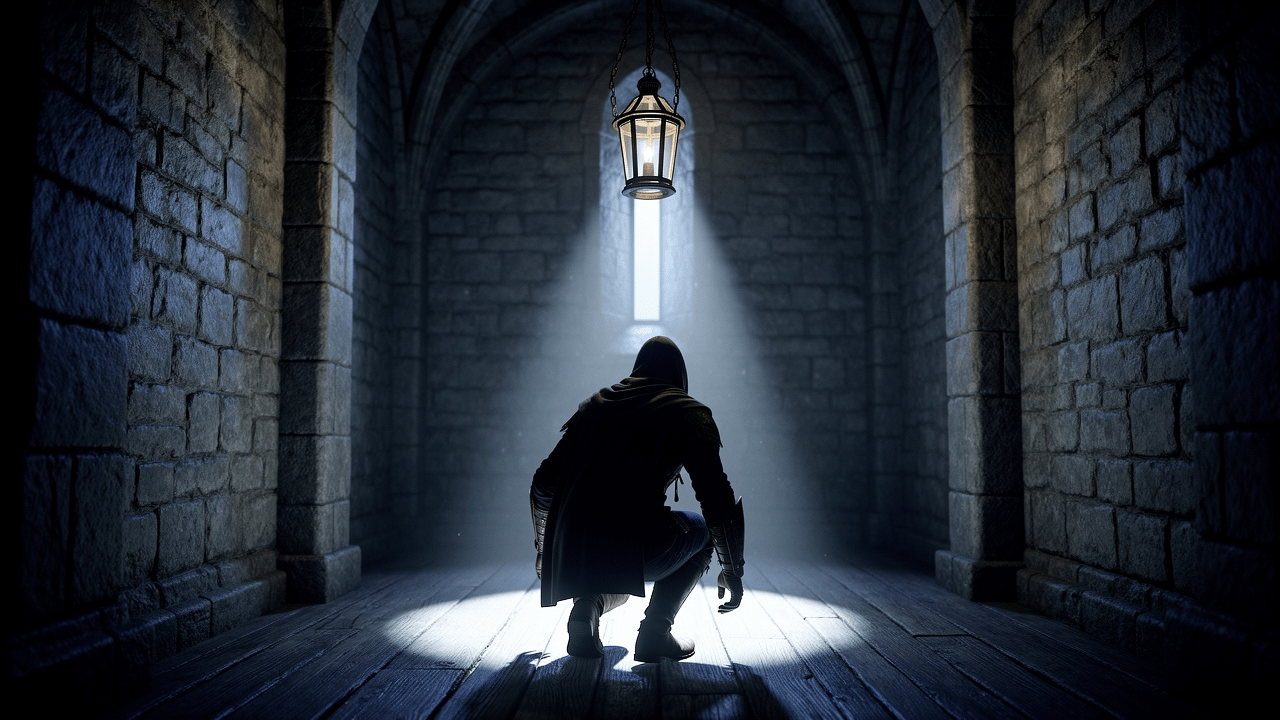
Dark Corners, Soft Footsteps: Why Thief: The Dark Project on PC Still Teaches Stealth
The first thing I learned in Thief: The Dark Project on PC was not how to fight. It was how to listen. That sounds obvious now, but when you come to the game cold, without nostalgia or a manual full of warning labels, it feels almost rude in how little it explains. You do not get a parade of glowing markers. You do not get a friendly voice telling you exactly when to crouch, exactly where to go, or exactly how much danger is too much. Instead, the game quietly turns the world itself into the lesson.
That is what makes Thief so striking even today. It does not teach stealth as a checklist. It teaches it as a physical state: sound has weight, light has consequences, and every step forward feels borrowed. If you are a first-time player, that design can be disorienting for the first hour. Then it clicks, and the whole game changes shape.
Stealth starts with your ears, not your eyes
Most games tell you danger is near by making something visible on the screen. Thief prefers a subtler method: floorboards creak, armor clinks, guards mutter, doors groan, arrows thud into wood. The soundscape is not decoration. It is a navigation tool.
At first, you notice the obvious things. Running is loud. Metal boots are loud. Water makes noise. But Thief keeps expanding that logic until you start treating every room like a question. Can I cross this hall without being heard? Is that carpet safer than the stone beside it? Will a guard notice if I open this door now, or will the hinge give me away?
That constant uncertainty is the point. The game does not present sound as a binary alarm. It presents it as a spectrum of risk.
What the game teaches without saying it
- Different surfaces affect how much noise you make.
- Movement speed changes how audible you are.
- Armor and equipment can make you feel heavier, and therefore more exposed.
- Enemy voice lines matter because they reveal patrol patterns and alert states.
- Even “quiet” actions can become dangerous if the room is otherwise silent.
The result is that you stop playing by instinct alone and start playing by listening with intent. That shift is huge. It makes every space feel inhabited rather than staged.
Light is not atmosphere; it is a threat meter
The other lesson arrives through visibility. Thief: The Dark Project on PC gives you a concealment system that is simple to understand but deeply effective in practice: if you are in the light, you are easier to detect. If you are in shadow, you have a chance to vanish.
That sounds straightforward, but the emotional effect is enormous. In a lot of stealth games, cover is just cover. In Thief, darkness feels like a resource you have to spend carefully. You begin scanning rooms for the safest line of movement, not just the nearest objective. You find yourself hugging walls, waiting for a torch to flicker past, or refusing a shortcut because it crosses too bright a patch of stone.
The game also does a brilliant job of making you aware of your own body in space. You are not only asking, “Can I hide?” You are asking, “How much of me is visible right now?” That turns movement into a kind of calibration. Crouching matters. Positioning matters. Even the shape of a room matters.
And because the game gives you ways to influence light, you begin to think creatively instead of passively. A torch can be snuffed. A room can be darkened. A route can be made safer, but never completely safe. Thief keeps the player active inside the stealth system rather than merely obedient to it.
Why the missions feel like puzzles made of pressure
One of the reasons Thief: The Dark Project on PC still feels distinct is the structure of its missions. These are not just levels filled with guards. They are spaces with memory, mood, and purpose. Mansions, cathedrals, crypts, city streets, and underground passages all ask different questions of the player.
What makes this so effective for a first-time player is that the game never reduces stealth to one correct answer. You are not solving a single enemy encounter. You are learning the personality of a place.
A noble house might reward patient observation. A cellar might punish careless movement. A religious space might feel eerie because the geometry creates blind corners and echoing sound. A guarded compound might be all about timing, patience, and reading patrols.
That variety matters because it keeps stealth from becoming mechanical. Each mission feels like a conversation between your skills and the building itself. You are not simply sneaking through a level. You are decoding it.
Consequence is the real tutorial
The most old-fashioned thing about Thief is also its smartest. It teaches by consequence.
If you are too loud, a guard hears you. If you stand in the wrong light, you are spotted. If you rush, you miss the pattern. If you panic, you create the very attention you were trying to avoid.
That kind of design can feel harsh at first, especially if you are used to modern stealth games that smooth out failure. But Thief understands something essential: stealth becomes meaningful when the player has to internalize the rules instead of merely reading them.
There is a real difference between knowing a mechanic and feeling it. Thief pushes you toward the second one. The game’s tension comes from the fact that you are never entirely sure you have done enough. That uncertainty changes the way you move. You slow down. You wait. You stop assuming that the game will forgive you for a sloppy decision.
And once that happens, the world gets bigger. Not because it has more space, but because every room now contains multiple possible outcomes.
The tension changes how you inhabit spaces
This is the part that surprised me most as a first-time player: Thief does not just ask you to sneak. It changes your relationship to architecture.
A hallway is no longer just a hallway. It is a visibility lane. A balcony is no longer just a balcony. It is a risk of silhouette. A stairwell is no longer just a route. It is a sound amplifier. A doorway is no longer just an opening. It is a place where a guard might catch the edge of your movement.
Because of that, you start thinking like a trespasser instead of an explorer. You are no longer admiring the environment from a distance. You are reading it tactically.
That shift creates a strange kind of intimacy. You remember rooms not because they were pretty, but because they were dangerous in a specific way. A torch-lit landing becomes memorable because you had to cross it three times before you got it right. A patrolling corridor becomes memorable because you listened to a guard’s footsteps until you could predict the turn.
That is one of the reasons Thief still feels modern in spirit even when its edges are unmistakably old. The game is not trying to impress you with spectacle. It is trying to make you nervous in a deliberate, intelligent way.
The learning curve is the point, not a flaw
If you are opening Thief: The Dark Project on PC for the first time, you might initially feel under-taught. That feeling is understandable. The game assumes you will learn by doing, failing, and paying attention. It is not generous in the contemporary sense.
But I would argue that its restraint is part of why it endures. The game trusts you to notice:
- when your footsteps matter,
- when a torch changes the entire risk profile of a room,
- when a patrol route can be exploited,
- when silence itself becomes information.
That trust creates ownership. When you survive a mission, it feels earned because the knowledge came from your own mistakes. The game did not just tell you to be stealthy. It made you understand what stealth costs.
That is a much rarer kind of design than it should be.
Why Thief still matters
So much of stealth game design has become legible at a glance. That is not a bad thing by itself, but it does mean many games arrive with a lot of explanation attached. Thief, by contrast, still feels like it is asking a more interesting question: what if the player learned the rules of stealth the same way a thief would learn a building? Slowly. Cautiously. Through sound, shadow, and close calls.
That is why Thief: The Dark Project on PC remains such a foundational game. Not because it invented every stealth idea, but because it made stealth feel embodied. You do not just understand the mechanics. You inhabit them.
For a first-time player, that can be intimidating. Then it becomes absorbing. Then it becomes unforgettable.
If you have played Thief, I would love to hear how it felt the first time it clicked for you. And if you are new to it, share what surprised you most in the comments.